 English
 Polski
 Deutsch
 Français
 ελληνικά
 Español
 Italiano
26,92 €

Quantity:
Total:
Total products:
Total shipping: To be determined
Total:
Science-based food supplements

Manufacturer: Kenay GmbH
In stock
| Quantity | Price | You Save |
|---|---|---|
| 2 | 30,14 € | Up to 2,51 € |
| 4 | 29,52 € | Up to 7,54 € |
By buying this product you can collect up to 31 loyalty points. Your cart will total 31 points that can be converted during next order into a voucher of 1,55 €.
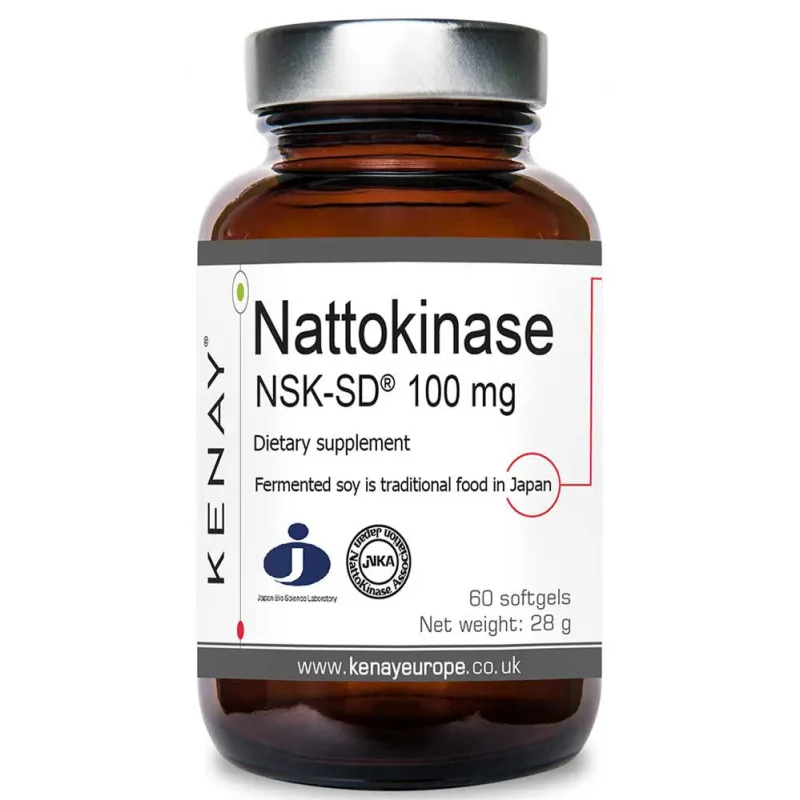
Nattokinase 100 mg NSK-SD®
60 capsules
Item Catalog Number: K1014EN
Original product name: Nattokinase 100 mg NSK-SD®
In recent years, Natto has gained the reputation of a superfood. This traditional Japanese dish made from fermented soybeans has a number of health benefits. Natto's health benefits are due to the presence of an enzyme - nattokinase (discovered in the sticky part of Natto). Nattokinase is an enzyme produced by a certain strain of Bacillus subtilis bacteria during the fermentation of soybeans. Nattokinase gained popularity due to its beneficial cardiovascular health effects. This enzyme also helps maintain the balance of the intestinal microbiome.
JAPAN BIO SCIENCE LABORATORY has patented a unique modern technology enabling the removal of vitamin K from Nattokinase NSK-SD®.
Vitamin K interacts with warfarin and other blood thinners. Nattokinase NSK-SD® is safe for use in people taking warfarin or other anticoagulants because it does not contain vitamin K.[2,33]
JAPAN BIO SCIENCE LABORATORY is the only Japanese company that can export Nattokinase without vitamin K2.[2,33]
Benefits at a Glance:
Nattokinase has beneficial effects in the prevention and treatment of cardiovascular diseases.[3,4] For many years, scientists, especially from Japan, Korea and China, have been constantly researching Nattokinase's role in the prevention and treatment of cardiovascular diseases.[3-6] Nattokinase is considered as safe, powerful, low cost, and all-natural supplement to support heart and cardiovascular health.[3-4,6-9]
Both, animal and human studies has shown beneficial effects of Nattokinase. It supports the circulatory system by thinning the blood and dissolving blood clots.[3,4,10-15] Nattokinase shows an effect on both oxidative injury-mediated arterial thrombosis [3,4,16,17] and inflammation-induced venal thrombosis.
Atherosclerosis, which is primary cause of many cardiovascular diseases, is also a cause of heart diseases and stroke. Nattokinase shows promising anti-atherosclerotic and lipid-lowering effects. [3-4,18]
Many studies showed anti-atherosclerotic and lipid-lowering effects of Nattokinase supplementation. In a clinical study on rats,[3,4,16,19] Nattokinase and the natto extract supplementation suppressed endothelial's intimal thickening in rats with diagnosed endothelial injury. Other study demonstrated that NK prevented arteriosclerosis by its direct antioxidant effect leading to reduced lipid peroxidation and improved lipid metabolism (inhibition of LDL oxidation).[3,4,20]
One of clinical trials demonstrated that after 26 weeks of Nattokinase supplementation, there was a significant reduction in CCA intima-media thickness (CCA-IMT) and carotid plaque size when compared with the baseline before treatment.[3,4,5,21] Nattokinase may be a great alternative to statins, a commonly used drug to reduce atherosclerosis.
In animal models, nattokinase showed a hypolipidaemic effect and can significantly reduce the increased serum triglycerides, total cholesterol, and LDL cholesterol levels.[3,4,5,22]
One study[3,4,24] suggested that nattokinase consumption for 8 weeks caused beneficial changes to blood pressure in patients having hypertension.
Long-term use of antihypertensive drugs causes side effects,[3,4,25]so nattokinase may be a promising alternative for the management of hypertension in patients with diagnosed cardiovascular diseases. Nattokinase supplementation may be a successful additional treatment strategy for patients with hypertension.[3,4,26] Of course, each action requires consultation with the attending physician.
One study compared the antithrombotic effects of aspirin and nattokinase. In both in vitro and in vivo tests, nattokinase showed excellent platelet aggregation inhibitory effects.[3,4,27] Long-term use of aspirin comes with serious gastrointestinal side effects and bleeding.[3,4,29] Nattokinase does not cause such a side effects.[3,4,28,29] It may therefore prove to be a very effective, natural and body-friendly way to improve blood flow without the unpleasant side effects from the digestive system associated with long-term aspirin supplementation. [3,4,28]
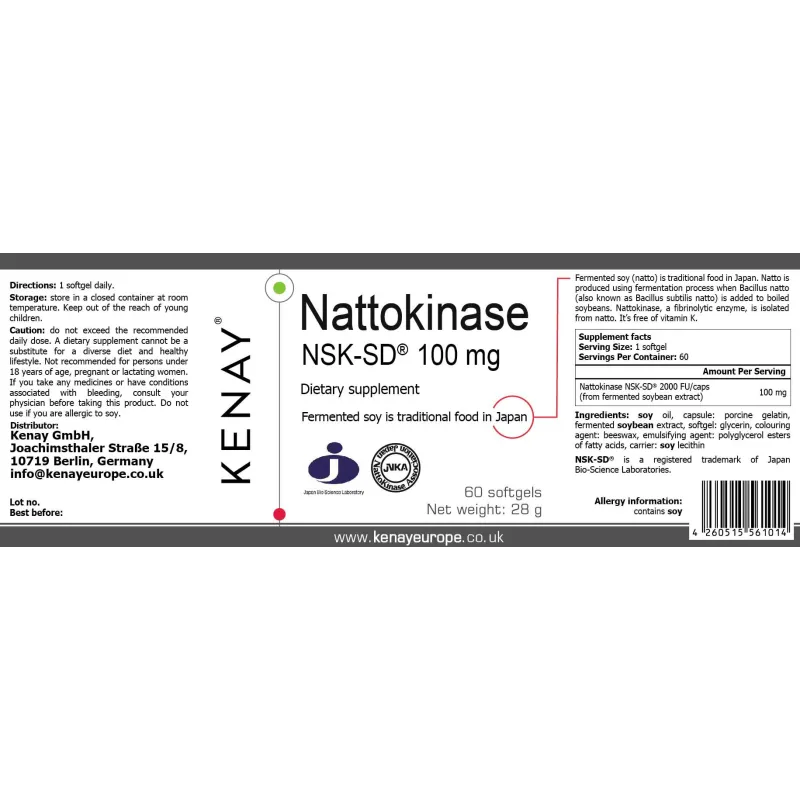
Daily dose: 1 capsule
| Amount per day: (1 capsule) | |
|---|---|
|
Nattokinase NSK-SD® 2000 FU/caps. (from fermented soybean extract) |
100 mg |
|
Ingredients: soy oil; porcine gelatin; fermented soybean extract; softgel: glycerin; colouring agent: beeswax; emulsifying agent: polyglycerol esters of fatty acids; carrier: soy lecithin. |
|
Contains soy
NSK-SD® is a trademark of Japan Bio-Science Laboratories.
Dosage and Use
Take one (1) capsule daily or as recommended by a healthcare practitioner.
Storage: Store in a closed container at room temperature, out of the reach of small children.
Warnings:
Before you start using any dietary supplement, consult your doctor.
Dietary supplements are not medicines.
Do not exceed the recommended daily dose.
Dietary supplements cannot be used as a substitute for a varied diet.
Do not use in case of hypersensitivity to any ingredient of the preparation.
The product should not be used by pregnant or breastfeeding women and children and adolescents under 18 years of age.
26,92 €

21,53 €
48,15 €
26,92 €



Nattokinase is a potent fibrinolytic enzyme derived from natto, a traditional Japanese fermented soybean food consumed for over 1,000 years for cardiovascular health. This enzyme directly breaks down fibrin, the protein mesh forming blood clots, offering natural support for healthy blood viscosity and circulation. NSK-SD represents the gold standard nattokinase—it's the most extensively researched form with over 36 clinical studies validating safety and efficacy. The "SD" designation indicates vitamin K2 removal through proprietary processing, crucial because vitamin K2 promotes blood clotting, directly opposing nattokinase's anticoagulant effects. Standard nattokinase contains 50-90 mcg vitamin K2 per 100 mg dose, potentially interfering with blood thinning medications and creating inconsistent effects. NSK-SD guarantees less than 2 mcg vitamin K2 per serving, eliminating this concern while maintaining full fibrinolytic activity of 2000 fibrinolytic units (FU) per 100 mg. This pharmaceutical-grade purity, combined with extensive safety testing including allergen screening and vitamin K verification, makes NSK-SD the trusted choice for practitioners and patients requiring reliable cardiovascular support without vitamin K interference.
Nattokinase provides comprehensive cardiovascular benefits through multiple complementary mechanisms centered on blood fluidity and vascular health. The primary action involves direct fibrinolysis—breaking down fibrin clots and preventing excessive clot formation that can obstruct blood vessels. Clinical studies demonstrate nattokinase reduces fibrinogen levels by 7-10% and decreases blood viscosity (thickness) by 10-15%, improving circulation throughout the body. This enhanced blood flow translates to measurable health improvements: reduced blood pressure with typical decreases of 5-10 mmHg systolic and 3-7 mmHg diastolic after 8 weeks, improved microcirculation delivering more oxygen and nutrients to tissues, and reduced risk of thrombotic events. Beyond clot dissolution, nattokinase activates the body's own clot-dissolving systems by enhancing tissue plasminogen activator (tPA) and urokinase production while inhibiting plasminogen activator inhibitor-1 (PAI-1), creating sustained fibrinolytic activity. The enzyme also demonstrates anti-atherosclerotic properties, reducing arterial plaque formation and improving endothelial function. Research shows improvements in arterial stiffness markers and reduced inflammation in vascular tissue. These combined effects make nattokinase valuable for supporting healthy circulation, maintaining blood pressure, and promoting overall cardiovascular resilience.
Nattokinase should never be used to replace prescribed anticoagulant medications without physician supervision, but it may offer valuable complementary support or natural alternatives for specific populations under medical guidance. For individuals taking warfarin (Coumadin), the NSK-SD form's vitamin K2 removal makes it theoretically safer than standard nattokinase, though combination still requires careful INR monitoring as nattokinase's anticoagulant effects are additive. Some practitioners successfully use nattokinase alongside low-dose aspirin for enhanced cardiovascular protection, particularly in individuals with elevated cardiovascular risk who don't meet criteria for pharmaceutical anticoagulation. The advantage over aspirin is that nattokinase works through direct fibrinolysis rather than platelet inhibition alone, potentially offering more comprehensive clot prevention. For individuals seeking natural alternatives to avoid long-term pharmaceutical anticoagulation, nattokinase combined with other supplements like omega-3s, vitamin E, and garlic may provide meaningful cardiovascular protection, though this approach requires medical supervision and regular monitoring. Research suggests nattokinase's effects are dose-dependent and reversible—discontinuation returns clotting parameters to baseline within days. The enzyme shows particular promise for individuals with subclinical hypercoagulability, elevated fibrinogen, or family history of thrombotic events who want preventive support. Critical consideration: nattokinase significantly increases bleeding risk when combined with anticoagulants, requiring physician coordination and careful monitoring.
Nattokinase demonstrates particular efficacy for several cardiovascular and circulatory conditions. Hypertension responds favorably to nattokinase, with clinical trials showing significant blood pressure reductions—one study demonstrated 5.5 mmHg systolic and 2.8 mmHg diastolic decreases after 8 weeks at 2000 FU daily, with effects comparable to some pharmaceutical interventions. Individuals with poor circulation, cold extremities, or Raynaud's phenomenon benefit from improved blood fluidity and microcirculatory flow. Those with elevated fibrinogen levels—a significant cardiovascular risk marker—experience 7-10% reductions with regular supplementation. Nattokinase may support recovery from deep vein thrombosis (DVT) by enhancing clot resolution, though only under medical supervision alongside standard treatment. Individuals concerned about stroke prevention, particularly those with atrial fibrillation not on anticoagulants, may gain protective benefits. The enzyme also shows promise for reducing symptoms associated with chronic venous insufficiency through improved venous blood flow. Athletes and frequent travelers benefit from nattokinase's ability to reduce exercise-induced hypercoagulability and prevent travel-related thrombosis during long flights. Some practitioners use nattokinase for reducing arterial plaque and supporting cardiovascular health in individuals with atherosclerosis or family history of heart disease. The key is recognizing nattokinase as preventive and supportive rather than acute treatment—it's valuable for maintaining healthy circulation and reducing long-term cardiovascular risk in appropriate populations.
Clinical research supports nattokinase dosing of 2000-4000 FU (fibrinolytic units) daily, with NSK-SD providing 2000 FU per 100 mg serving. For general cardiovascular support and circulation enhancement, 2000 FU (100 mg NSK-SD) once daily typically suffices, with many practitioners recommending evening dosing to support overnight clot dissolution when thrombotic risk peaks. Individuals with elevated cardiovascular risk, hypertension, or higher fibrinogen may use 4000 FU daily split into morning and evening doses for enhanced effect. Taking nattokinase on an empty stomach, particularly 1-2 hours before or after meals, optimizes absorption and activity as food proteins may interfere with enzyme function. Effects develop progressively—blood viscosity improvements emerge within 2-4 weeks, blood pressure reductions manifest over 4-8 weeks, and optimal cardiovascular benefits require 8-12 weeks of consistent use. The safety profile is generally excellent in appropriate populations, with NSK-SD demonstrating no serious adverse events in extensive clinical trials. However, critical precautions apply: discontinue 2 weeks before surgery due to bleeding risk, avoid combining with anticoagulants without medical supervision, use caution with antiplatelet medications and high-dose omega-3s. Mild digestive upset occurs occasionally but typically resolves with continued use or dose reduction. People with soy allergies should approach cautiously though fermentation often reduces allergenicity. Long-term use appears safe based on decades of natto consumption in Japanese populations, though periodic breaks or physician monitoring provides additional safety assurance.
Results: Clinical trial demonstrates nattokinase supplementation at 2000 FU daily reduces systolic blood pressure by 5.5 mmHg and diastolic pressure by 2.8 mmHg after 8 weeks, with effects maintained throughout supplementation period in individuals with hypertension.
Citation: Kim JY, et al. Hypertens Res. 2008 Aug;31(8):1583-8.
Results: Research shows nattokinase reduces blood viscosity by 10-15% and decreases fibrinogen levels by 7-10% within 4 weeks, improving circulation efficiency and reducing cardiovascular risk markers in healthy adults and those with elevated clotting risk.
Citation: Hsia CH, et al. Nutr Res. 2009 Mar;29(3):190-6.
Results: Studies reveal nattokinase enhances fibrinolytic activity by increasing tissue plasminogen activator and decreasing plasminogen activator inhibitor-1, creating sustained clot-dissolving capacity superior to placebo with dose-dependent effects.
Citation: Fujita M, et al. Biosci Biotechnol Biochem. 1993 Aug;57(8):1340-2.
Results: Long-term safety trials with NSK-SD nattokinase demonstrate excellent tolerability with no serious adverse events, confirmed vitamin K2 removal below 2 mcg per dose, and maintained fibrinolytic potency of 2000 FU per 100 mg serving.
Citation: Kurosawa Y, et al. J Atheroscler Thromb. 2015;22(1):24-33.