English
 Polski
 Deutsch
 Français
 ελληνικά
 Español
 Italiano
12,46 €

Quantity:
Total:
Total products:
Total shipping: To be determined
Total:
Science-based food supplements

Manufacturer: Life Extension
In stock
| Quantity | Price | You Save |
|---|---|---|
| 2 | 18,86 € | Up to 1,57 € |
| 4 | 18,47 € | Up to 4,72 € |
By buying this product you can collect up to 19 loyalty points. Your cart will total 19 points that can be converted during next order into a voucher of 0,95 €.

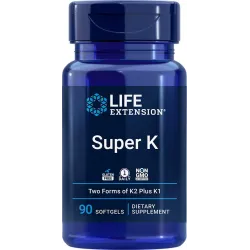
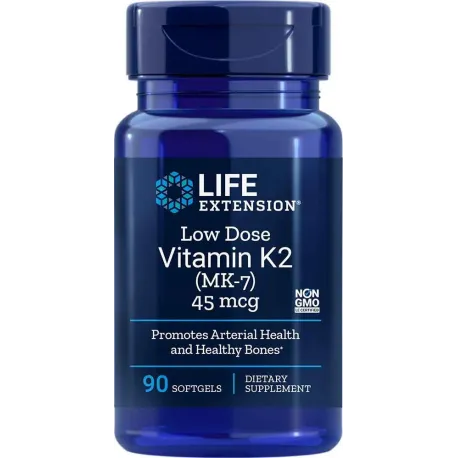
Low-Dose Vitamin K2
45 mcg, 90 softgels
Item Catalog Number: 01936EU
 An abundance of human clinical data reveals that vitamin K plays a critical role in maintaining healthy bone density by facilitating the transport of calcium from the bloodstream into the bone.1-5 Vitamin K is also required by calcium-regulating proteins in the arteries. Matrix Gla-protein (MGP) is a vitamin K-dependent protein, and it must be carboxylated to function properly. Poor vitamin K status leads to inactive uncarboxylated MGP (ucMGP), which accumulates at sites of arterial calcification.6,7 Since MGP is a potent local inhibitor of arterial calcification, MGP is important in relation to the health of the entire cardiovascular system. Without adequate vitamin K, calcium in the blood can bind to the arterial wall resulting in calcification.8,9 As people age, even a subclinical vitamin K deficiency can pose risks to the vascular system. Poor vitamin K status also results in increased circulating levels of undercarboxylated osteocalcin that is shown to be associated with increased bone loss in postmenopausal women.10,11
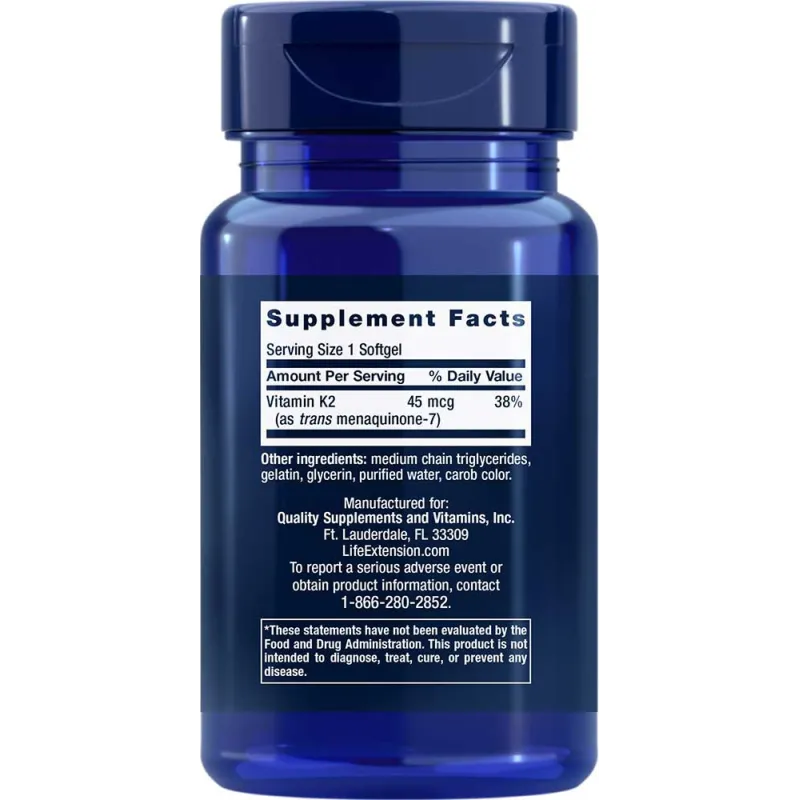
Serving Size 1 softgel
| Amount Per Serving | |
|---|---|
| Vitamin K2 (as all-trans menaquinone-7) | 45 mcg |
| Ingredients: Medium chain triglycerides, capsule (gelatine), humectant (glycerol), menaquinone (vitamin K2), purified water, roasted carob fruit extract | |
Non-GMO
Dosage and Use
Take one (1) softgel daily with food, or as recommended by a healthcare practitioner.
Caution
If you are taking anti-coagulant or anti-platelet medications, or have a bleeding disorder, consult your healthcare provider before taking this product.
Warnings
KEEP OUT OF REACH OF CHILDREN
DO NOT EXCEED RECOMMENDED DOSE
Do not purchase if outer seal is broken or damaged.
When using nutritional supplements, please consult with your physician if you are undergoing treatment for a medical condition or if you are pregnant or lactating.
12,46 €
24,96 €
15,31 €
27,31 €
Vitamin K exists in two primary forms with distinct biological roles. Vitamin K1 (phylloquinone) is found abundantly in green leafy vegetables and is primarily involved in blood clotting. Your liver uses K1 to produce clotting factors that prevent excessive bleeding. Vitamin K2 (menaquinone), on the other hand, is found in fermented foods and animal products and plays crucial roles beyond clotting - particularly in calcium metabolism and cardiovascular health.
The K2 form, specifically MK-7 (menaquinone-7), has several advantages over both K1 and shorter-chain K2 forms like MK-4. MK-7 has a much longer half-life in your bloodstream - remaining active for 72 hours compared to just 1-2 hours for K1 and 6-8 hours for MK-4. This extended duration means MK-7 provides more sustained activation of vitamin K-dependent proteins throughout your body.
The most important K2-dependent proteins include osteocalcin (which helps bind calcium to bone matrix) and matrix Gla-protein or MGP (which prevents calcium from depositing in soft tissues like arteries). Without adequate K2, these proteins remain inactive and cannot perform their critical functions, potentially leading to both reduced bone density and increased arterial calcification.
Vitamin K2's role in bone health centers on activating osteocalcin, a protein produced by bone-building cells. Once activated, osteocalcin binds calcium ions and incorporates them into the bone matrix. Studies demonstrate that vitamin K2 supplementation increases the percentage of carboxylated osteocalcin, improves bone mineral density, and reduces fracture risk.
The cardiovascular benefits are equally important. Matrix Gla-protein (MGP) is produced by cells in arterial walls and, when activated by K2, prevents calcium from depositing in arterial tissue. Studies have found that people with higher K2 intake have less arterial calcification and better cardiovascular outcomes.
Postmenopausal women concerned about bone health should prioritize K2, as bone loss accelerates significantly after menopause. Anyone taking high-dose vitamin D or calcium supplements should consider K2, as it helps direct calcium appropriately. People following plant-based diets may have suboptimal K2 status since K2 is primarily found in animal products and fermented foods.
The most important consideration is interaction with warfarin (Coumadin). If you're on warfarin, you should not take vitamin K supplements without medical supervision. However, newer anticoagulants don't interact with vitamin K in the same way. Vitamin K2 appears very safe with no established upper intake limit.
Vitamin K2 is fat-soluble, so take it with a meal containing dietary fat. Consistency is important for maintaining stable activation of K2-dependent proteins. For maximum benefit, combine K2 with vitamin D and adequate calcium intake. Allow adequate time to assess benefits - effects on bone density occur gradually over months to years.
Results: Three-year study found postmenopausal women taking 180 mcg daily MK-7 had significantly improved bone strength and 50% less age-related decline in bone mineral density compared to placebo.
Citation: Knapen MH, et al. Three-year low-dose menaquinone-7 supplementation helps decrease bone loss in healthy postmenopausal women. Osteoporos Int. 2013.
Results: MK-7 supplementation increased percentage of carboxylated osteocalcin by 40-50% within 6-12 weeks.
Citation: Theuwissen E, et al. Low-dose menaquinone-7 supplementation improved extra-hepatic vitamin K status. Br J Nutr. 2012.
Results: Population study found highest K2 intake associated with 57% lower risk of cardiovascular mortality over 10 years.
Citation: Geleijnse JM, et al. Dietary intake of menaquinone is associated with a reduced risk of coronary heart disease. J Nutr. 2004.
Results: Long-term K2 supplementation reduced inactive undercarboxylated MGP by 50%.
Citation: Cranenburg EC, et al. Vitamin K intake and status are low in hemodialysis patients. Kidney Int. 2012.