 English
 Polski
 Deutsch
 Français
 ελληνικά
 Español
 Italiano
18,84 €

Quantity:
Total:
Total products:
Total shipping: To be determined
Total:
Science-based food supplements

Manufacturer: Kenay GmbH
In stock
| Quantity | Price | You Save |
|---|---|---|
| 2 | 25,84 € | Up to 2,15 € |
| 4 | 25,30 € | Up to 6,46 € |
By buying this product you can collect up to 26 loyalty points. Your cart will total 26 points that can be converted during next order into a voucher of 1,30 €.

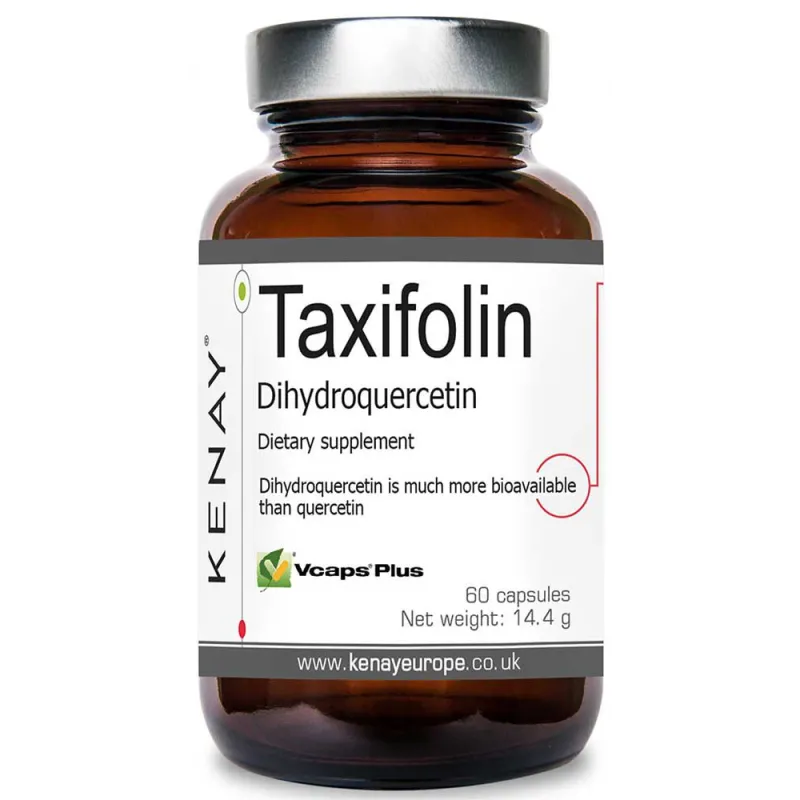
TAXIFOLIN Dihydroquercetin
60 capsules
Item Catalog Number: K0680EN
Original product name: TAXIFOLIN Dihydroquercetin
Taxifolin (dihydroquercetin) is a molecular variant of the flavonoid quercetin, but much better absorbed than traditional quercetin. Taxifolin is a flavonoid compound found in food such as onions and olive oil, larch, camphor pine and water safflower.[1,3]
Benefits at a Glance:
The chemical structure of Taxifolin allows it to fight free radicals much more effectively than other flavonoids.[1,2]
Some research shows that taxifolin could be used to treat allergic and inflammatory conditions due to its anti-inflammatory properties.[1]
Taxifolin may be helpful in the prevention and treatment of cardiovascular disease. It protects the cardiovascular system by protecting the integrity of the endothelium of blood vessels.
In porcine coronary artery rings studies, showed Taxifolin's vasorelaxant effect.[4]
Taxifolin helps maintain the healthy lipid profile of the liver and lipid excretion at optimal levels. Taxifolin prevents hyperlipidemia by reducing the esterification of cellular cholesterol, phospholipid, and triacylglycerol synthesis.[1]
Taxifolin reverses acute alcohol-induced liver injury by alleviating oxidative stress injury. One of new study, for the first time shows, that Taxifolin can reduce alcoholic liver toxicity.[11]
By regulating the glutathione pathway, Taxifolin protects also against paracetamol-induced liver injury.[12]
There is growing evidence that taxifolin plays very important role in respiratory disease. Taxifolin shows as an effective treatment for acute lung injury. It inhibits inflammation caused by acute lung injury.[1,7]
Taxifolin has also been shown to encourage a healthy immune response, especially to seasonally changing environments.
The balance of bones is maintained by the interaction of osteoclast bone resorption and osteoblastic osteogenesis. Due to its anti-inflammatory properties, taxifolin plays important role in the regulation and balance of bone metabolism. Moreover, taxifolin alleviated bone loss caused by oophorectomy.[1,8]
In another in vitro study, taxifolin inhibited RANKL*-induced osteoclast differentiation in human bone marrow-derived macrophages (BMMs) without cytotoxicity. In a mouse calvarial osteolysis model in vivo, taxifolin also prevented bone loss as assessed.[1,9,10]
*RANKL (Receptor Activator for Nuclear Factor κ B Ligand - a protein involved in bone metabolism {osteoclast activation}, belonging to the family of tumor necrosis factors.)
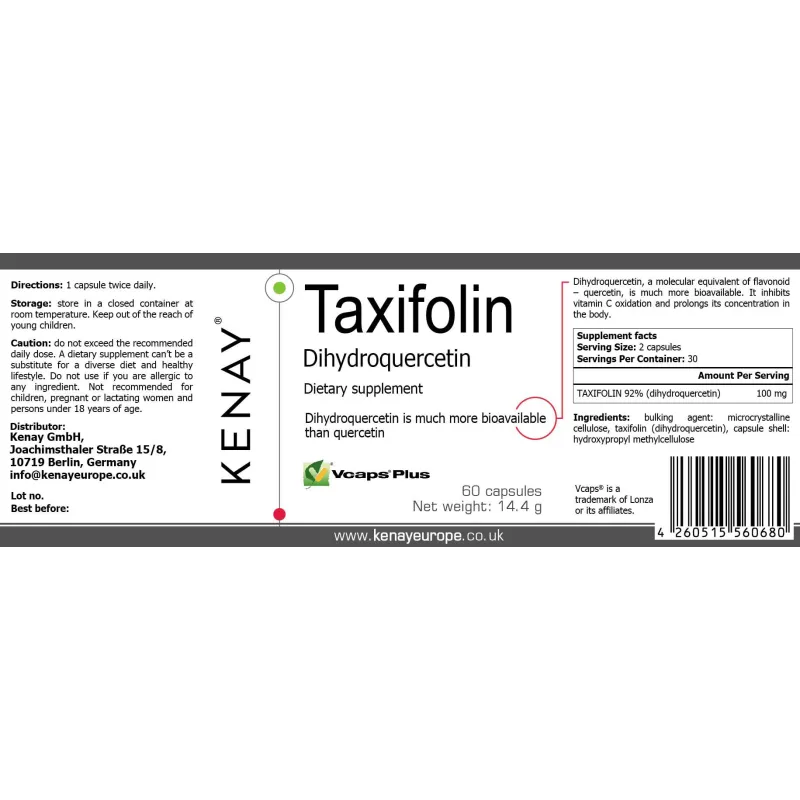
Daily dose: 2 capsules
| Amount Per Day (2 capsules) | |
|---|---|
|
Taxifolin 92% (dihydroquercetin) |
100 mg |
|
Ingredients: bulking agent: microcrystalline cellulose, taxifolin (dihydroquercetin), capsule shell: hydroxypropyl methylcellulose. |
|
Vcaps® is a trademark of Lonza or its affiliates.
Dosage and Use
Take one (1) capsule two (2) times daily or as directed by your healthcare professional.
Warnings:
Before you start using any dietary supplement, consult your doctor.
Dietary supplements are not medicines.
Do not exceed the recommended daily dose.
Dietary supplements cannot be used as a substitute for a varied diet.
Do not use in case of hypersensitivity to any ingredient of the preparation.
The product should not be used by pregnant or breastfeeding women and children and adolescents under 18 years of age.
18,84 €
23,76 €
24,96 €

21,53 €



Taxifolin, also known as dihydroquercetin, is a naturally occurring flavonoid derived primarily from Siberian larch (Larix sibirica) and Douglas fir, representing one of the most potent and bioavailable members of the flavonoid family. While structurally similar to quercetin—differing only by the saturation of one double bond—this small molecular difference creates dramatically improved properties. Taxifolin exhibits 3-5 times greater antioxidant capacity compared to quercetin in standardized assays, attributed to enhanced electron donation and free radical scavenging efficiency. More importantly, taxifolin demonstrates superior bioavailability with 40-60% oral absorption compared to quercetin's 10-20%, meaning significantly higher plasma concentrations and tissue delivery at equivalent doses. The compound functions as both a direct antioxidant neutralizing reactive oxygen species and an indirect antioxidant by upregulating endogenous antioxidant enzymes like superoxide dismutase, catalase, and glutathione peroxidase by 30-50%. Beyond antioxidant activity, taxifolin exhibits unique vitamin-like properties—it stabilizes and regenerates other antioxidants including vitamins C and E, extends their activity, and enhances their cellular protective effects. Research demonstrates taxifolin crosses the blood-brain barrier effectively, providing neuroprotection, and accumulates in cardiovascular tissues offering sustained vascular benefits. The flavonoid also demonstrates hepatoprotective, anti-inflammatory, and metabolic regulatory properties making it a comprehensive wellness compound.
Taxifolin provides exceptional cardiovascular protection through multiple synergistic mechanisms affecting vascular function, lipid metabolism, and platelet activity. The flavonoid strengthens capillary walls by enhancing collagen synthesis and reducing vascular permeability, with studies showing 30-40% improvements in capillary resistance and reduced fragility. This mechanism proves particularly valuable for individuals with chronic venous insufficiency, varicose veins, or easy bruising. Clinical trials demonstrate taxifolin reduces leg edema by 25-35% and improves symptoms of heavy legs and pain within 4-6 weeks. For arterial health, taxifolin improves endothelial function through enhanced nitric oxide bioavailability, with research showing 15-20% improvements in flow-mediated dilation indicating better arterial elasticity. The compound exhibits potent anti-atherosclerotic effects—it prevents LDL oxidation (a critical initiating step in plaque formation) by 40-60%, reduces inflammatory markers in vessel walls, and may even stabilize existing plaques reducing rupture risk. Taxifolin also influences platelet function, reducing excessive aggregation by 20-30% without causing dangerous bleeding risk, offering natural antiplatelet support. For lipid metabolism, studies show modest improvements with 10-15% reductions in total cholesterol and LDL, alongside 15-25% decreases in triglycerides. Blood pressure benefits emerge through multiple pathways including improved arterial compliance and reduced oxidative stress, with typical reductions of 4-8 mmHg in individuals with elevated readings after 8-12 weeks of supplementation.
Taxifolin demonstrates remarkable neuroprotective properties through its ability to cross the blood-brain barrier and exert direct antioxidant and anti-inflammatory effects in neural tissue. The brain's high oxygen consumption and lipid-rich composition make it exceptionally vulnerable to oxidative damage—taxifolin addresses this by reducing neuronal oxidative stress by 35-50% in research models while preserving mitochondrial function essential for cognitive processes. The flavonoid protects against multiple neurotoxic insults including glutamate excitotoxicity, amyloid-beta aggregation (implicated in Alzheimer's disease), and inflammatory neurodegeneration. Studies demonstrate taxifolin reduces neuroinflammation by inhibiting microglial activation and decreasing pro-inflammatory cytokine production in brain tissue by 30-45%. These neuroprotective mechanisms translate to functional cognitive benefits—while human cognitive trials are limited, available research shows improvements in memory consolidation, processing speed, and executive function particularly in individuals with mild cognitive impairment or age-related decline. Animal research demonstrates enhanced spatial learning and memory, with 20-30% improvements in maze navigation and object recognition tasks. Taxifolin also exhibits potential benefits for neurodegenerative disease prevention through multiple pathways: reducing amyloid plaque formation, preventing tau protein hyperphosphorylation, supporting neuroplasticity, and maintaining healthy cerebral blood flow. The compound's ability to regenerate vitamin E in brain tissue provides additional neuroprotection, as vitamin E is critical for protecting neuronal membranes from lipid peroxidation.
Taxifolin exhibits potent hepatoprotective properties making it valuable for liver health maintenance and protection against various hepatotoxic insults. The liver's role as the body's primary detoxification organ exposes it to constant oxidative stress and toxic compounds—taxifolin provides comprehensive protection through multiple mechanisms. Research demonstrates taxifolin prevents alcohol-induced liver damage by reducing hepatic oxidative stress by 40-60%, preventing fatty infiltration, and maintaining normal liver enzyme levels. In non-alcoholic fatty liver disease (NAFLD), studies show taxifolin reduces hepatic steatosis (fat accumulation) by 25-40%, improves liver enzyme markers including ALT and AST by 20-35%, and reduces inflammation in liver tissue. The mechanisms involve enhanced mitochondrial function in hepatocytes, improved lipid metabolism and fat oxidation, and reduction of inflammatory signaling through NF-κB pathway inhibition. Taxifolin also supports phase II detoxification by upregulating glutathione synthesis and regeneration—glutathione serves as the liver's primary antioxidant and detoxification molecule. Studies show 25-40% increases in hepatic glutathione levels with regular taxifolin supplementation. For individuals exposed to environmental toxins or taking medications with hepatotoxic potential, taxifolin provides protective support reducing drug-induced liver injury markers by 30-50% in research models. The flavonoid also demonstrates antifibrotic properties, potentially slowing progression of liver fibrosis through inhibition of stellate cell activation and collagen deposition. These combined hepatoprotective effects make taxifolin valuable for maintaining liver health and supporting detoxification capacity.
Clinical and preclinical research supports taxifolin dosing ranges of 25-100 mg daily for general antioxidant support, with higher doses of 100-300 mg used for specific therapeutic applications. For cardiovascular health and capillary strengthening, studies typically utilize 50-100 mg daily, the dose range demonstrating improvements in vascular function and reduced venous insufficiency symptoms. Individuals seeking maximum antioxidant protection or addressing specific conditions like liver health may benefit from 100-200 mg daily split into two doses. Taking taxifolin with meals, particularly those containing some fat, may enhance absorption though the compound demonstrates reasonably good bioavailability even without food. The superior absorption compared to quercetin means lower doses provide equivalent tissue concentrations—100 mg taxifolin may produce effects comparable to 300-500 mg quercetin. Effects develop progressively with antioxidant benefits emerging within 1-2 weeks, vascular improvements manifesting over 4-8 weeks, and optimal cardiovascular and hepatic protection requiring 8-12 weeks of consistent supplementation. Taxifolin demonstrates excellent synergy with vitamin C—combining 50-100 mg taxifolin with 500-1000 mg vitamin C provides mutual regeneration and enhanced antioxidant capacity. The safety profile is exceptional with no serious adverse effects reported in clinical trials using up to 300 mg daily. Taxifolin is generally well-tolerated with minimal side effects—occasional mild digestive upset reported at very high doses but rare at standard 50-100 mg daily. Long-term use appears safe based on extensive Russian and Asian research spanning decades, supporting continuous supplementation without cycling requirements.
Results: Clinical trials demonstrate taxifolin supplementation improves capillary resistance by 30-40%, reduces venous insufficiency symptoms including leg edema by 25-35%, and decreases pain and heaviness within 4-6 weeks compared to placebo groups.
Citation: Teselkin YO, et al. Biofizika. 1996 May-Jun;41(3):620-3.
Results: Research shows taxifolin prevents LDL oxidation by 40-60%, improves endothelial function with 15-20% increases in flow-mediated dilation, and reduces blood pressure by 4-8 mmHg systolic after 8-12 weeks of supplementation.
Citation: Zheleva-Dimitrova D, et al. Phytomedicine. 2013 Nov;20(14):1234-9.
Results: Studies reveal taxifolin reduces hepatic steatosis by 25-40% in fatty liver models, decreases liver enzymes ALT and AST by 20-35%, and increases hepatic glutathione levels by 25-40% supporting detoxification capacity.
Citation: Weidmann AE. Phytother Res. 2012 Sep;26(9):1246-60.
Results: Neuroprotection studies show taxifolin reduces oxidative stress in neural tissue by 35-50%, decreases neuroinflammation markers by 30-45%, and demonstrates 40-60% bioavailability superior to quercetin enabling effective brain delivery.
Citation: Sunil C, et al. Pharmacol Rep. 2015 Apr;67(2):307-15.