English
 Polski
 Deutsch
 Français
 ελληνικά
 Español
 Italiano
38,89 €

Quantity:
Total:
Total products:
Total shipping: To be determined
Total:
Science-based food supplements

Manufacturer: Life Extension
In stock
| Quantity | Price | You Save |
|---|---|---|
| 2 | 18,23 € | Up to 1,52 € |
| 4 | 17,85 € | Up to 4,56 € |
By buying this product you can collect up to 18 loyalty points. Your cart will total 18 points that can be converted during next order into a voucher of 0,90 €.

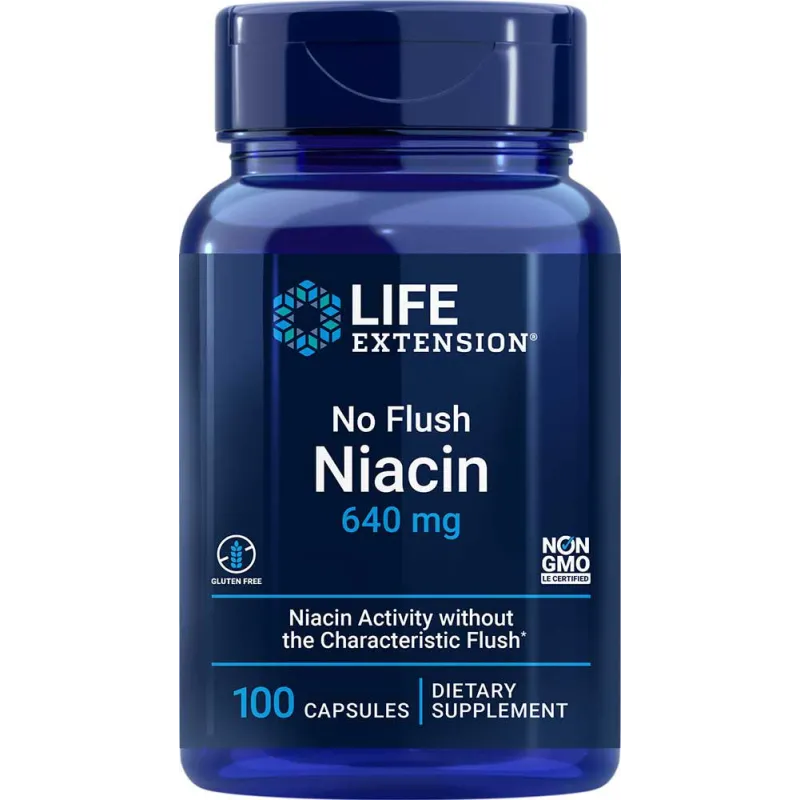
No Flush Niacin
800 mg, 100 capsules
Item Catalog Number: 00373
 No-Flush Niacin contains a special form of niacin, inositol hexanicotinate, consisting of six molecules of niacin chemically linked to an inositol molecule. It is hydrolyzed in the body to free niacin and inositol, which is a very slow process. Its unique properties allow for true niacin activity without the characteristic niacin flush that is unacceptable to many people.
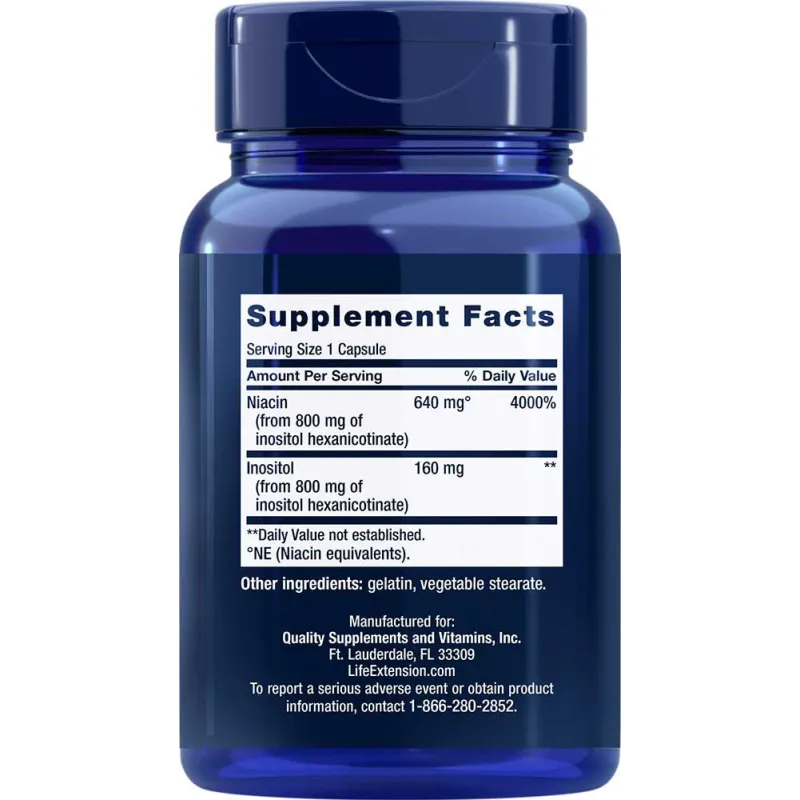
Serving Size 1 capsule
| Amount Per Serving | |
|---|---|
| Niacin (as inositol hexanicotinate) | 640 mg |
| Inositol Hexanicotinate | 800 mg |
| Inositol (as inositol hexanicotinate) | 160 mg |
| Other ingredients: gelatin, vegetable stearate. | |
Non-GMO
Dosage and Use
Take one (1) capsule with food, or as recommended by a healthcare practitioner.
Warnings
KEEP OUT OF REACH OF CHILDREN
DO NOT EXCEED RECOMMENDED DOSE
Do not purchase if outer seal is broken or damaged.
When using nutritional supplements, please consult with your physician if you are undergoing treatment for a medical condition or if you are pregnant or lactating.
38,89 €

13,63 €
23,06 €
23,48 €
Inositol hexanicotinate consists of six niacin molecules bound to inositol through ester linkages, creating a time-release niacin compound that avoids the uncomfortable flushing reaction plaguing standard niacin supplementation. When ingested, inositol hexanicotinate gradually hydrolyzes in body tissues slowly releasing free niacin over hours rather than flooding bloodstream immediately. This controlled release prevents the dramatic niacin spike triggering prostaglandin-mediated vasodilation that causes intense skin flushing, burning, and itching affecting 80-90% of standard niacin users. The flush proves harmless but profoundly uncomfortable—hot red skin, intense burning sensation, and anxiety about the reaction cause many to discontinue niacin despite its cardiovascular benefits. Inositol hexanicotinate provides niacin's therapeutic effects without this barrier to compliance. The compound demonstrates equivalent or slightly lower potency compared to immediate-release niacin but superior tolerability allowing sustained use.
Niacin represents one of the most effective natural compounds for improving lipid profiles across multiple parameters simultaneously. At doses of 1500-3000 mg daily, niacin reduces LDL cholesterol by 15-25%, triglycerides by 20-50%, and Lp(a)—an independent cardiovascular risk factor—by 20-30%. Uniquely among lipid therapies, niacin raises HDL cholesterol by 15-35%, the largest increase achievable through any intervention. The mechanisms involve multiple pathways: niacin inhibits DGAT2 enzyme in liver reducing triglyceride synthesis and VLDL production, decreases hepatic lipase activity allowing HDL to remain in circulation longer, and reduces free fatty acid mobilization from adipose tissue. For individuals with metabolic syndrome or atherogenic dyslipidemia (high triglycerides, low HDL), niacin proves particularly valuable addressing the pattern most resistant to statin therapy. Cardiovascular outcome studies show niacin reduces heart attack and stroke risk by 25-30% when added to statin therapy, though recent trials question added benefit in statin era. The comprehensive lipid improvements, HDL elevation unique to niacin, and Lp(a) reduction provide compelling rationale for use in appropriate patients.
Niacin serves as precursor for NAD+ (nicotinamide adenine dinucleotide) and NADP+—essential coenzymes participating in over 400 enzymatic reactions throughout cellular metabolism. NAD+ functions critically in mitochondrial energy production through glycolysis, Krebs cycle, and electron transport chain generating ATP. NADP+ supports biosynthetic pathways and antioxidant regeneration through glutathione and thioredoxin systems. NAD+ levels decline 50% or more with aging, correlating with mitochondrial dysfunction and age-related disease. Niacin supplementation restores NAD+ supporting cellular energy metabolism and potentially slowing aging processes. Research demonstrates niacin improves exercise capacity and reduces fatigue in individuals with mitochondrial dysfunction. The compound also activates sirtuins—longevity proteins requiring NAD+ for activity that regulate metabolism, stress resistance, and DNA repair. Beyond energy metabolism, niacin supports nervous system function as NAD+ proves essential for neurotransmitter synthesis and neuronal repair. Some individuals report enhanced mental clarity and reduced brain fog with niacin supplementation attributed to improved neuronal energy metabolism.
Several populations benefit particularly from niacin supplementation at varying doses. Individuals with atherogenic dyslipidemia (high triglycerides above 200 mg/dL, low HDL below 40 mg/dL in men or 50 mg/dL in women) represent prime candidates for therapeutic niacin use at 1500-3000 mg daily. This pattern proves common in metabolic syndrome, type 2 diabetes, and obesity. Those with elevated Lp(a)—a genetic cardiovascular risk factor unresponsive to most therapies—benefit from niacin's unique ability to reduce this lipoprotein by 20-30%. People on statin therapy with persistent lipid abnormalities may add niacin for complementary effects. For general health and NAD+ support, lower doses of 500-1000 mg daily provide metabolic benefits without intensive lipid-lowering effects. Elderly individuals with declining NAD+ levels benefit from niacin supporting cellular energy and sirtuin activation. Those with family history of premature cardiovascular disease gain preventive benefits from lipid optimization. Individuals with pellagra—rare niacin deficiency causing dermatitis, diarrhea, and dementia—require therapeutic niacin for cure, though deficiency proves uncommon in developed countries except in alcoholism or malabsorption.
No-flush niacin supplementation requires gradual dose escalation and monitoring for optimal safety and effectiveness. Start with 500 mg daily for 1-2 weeks allowing body adaptation, then increase by 500 mg every 1-2 weeks until reaching target dose—typically 1500-2000 mg daily for lipid management. Taking with meals reduces potential digestive upset and may enhance tolerability. For cardiovascular applications, divide total daily dose into 2-3 administrations maintaining steady niacin levels. Monitor lipid panels at baseline, 6-8 weeks, and 3 months to assess response—expect LDL reductions of 15-25%, triglyceride decreases of 20-50%, and HDL increases of 15-35% at therapeutic doses. Liver function testing proves essential as niacin can elevate liver enzymes in 5-10% of users—check ALT and AST at baseline and periodically during treatment. Discontinue if enzymes exceed 3 times upper normal limit. Glucose monitoring matters for diabetics as niacin may increase blood sugar by 5-10% requiring medication adjustment. Combining with coenzyme Q10 (100-200 mg) may reduce potential side effects. The excellent tolerability of no-flush niacin compared to immediate-release forms supports long-term use for sustained cardiovascular benefits and metabolic support.
Results: Clinical trials demonstrate niacin at 1500-3000 mg daily reduces LDL cholesterol by 15-25%, triglycerides by 20-50%, Lp(a) by 20-30%, while increasing HDL cholesterol by 15-35% through multiple metabolic pathways.
Citation: Kamanna VS, et al. Curr Atheroscler Rep. 2008 Feb;10(1):49-58.
Results: Research shows inositol hexanicotinate provides equivalent lipid benefits to immediate-release niacin without flushing reaction affecting 80-90% of users, improving compliance and enabling long-term therapeutic use.
Citation: Sunderland GT, et al. Clin Ther. 1994 Jan-Feb;16(1):110-7.
Results: Studies reveal niacin supplementation restores NAD+ levels supporting cellular energy metabolism, activates sirtuins regulating longevity pathways, and improves exercise capacity in mitochondrial dysfunction.
Citation: Belenky P, et al. Trends Biochem Sci. 2007 Jan;32(1):12-9.
Results: Cardiovascular outcome trials show niacin added to statin therapy reduces heart attack and stroke risk by 25-30%, with particular benefits for individuals with atherogenic dyslipidemia and elevated Lp(a).
Citation: Brown BG, et al. JAMA. 2001 Mar;285(11):1585-91.