Mega Green Tea Extract (decaffeinated) EU

Category: Antioxidants

Manufacturer:

One capsule provides more polyphenols than seven cups of green tea

  • Powerful antioxidant

  • Supports cell membrane integrity

  • Boosts liver detoxification

  • Enhances immune function

  • Supports healthy cholesterol levels already within normal range and lipid profiles

  • Supports healthy cell growth

  • Possibly promotes weight loss

In stock

28,92 €

Volume discounts

Quantity Price You Save
2 27,76 € Up to 2,31 €
4 27,18 € Up to 6,94 €

By buying this product you can collect up to 28 loyalty points. Your cart will total 28 points that can be converted during next order into a voucher of 1,40 €.

More info

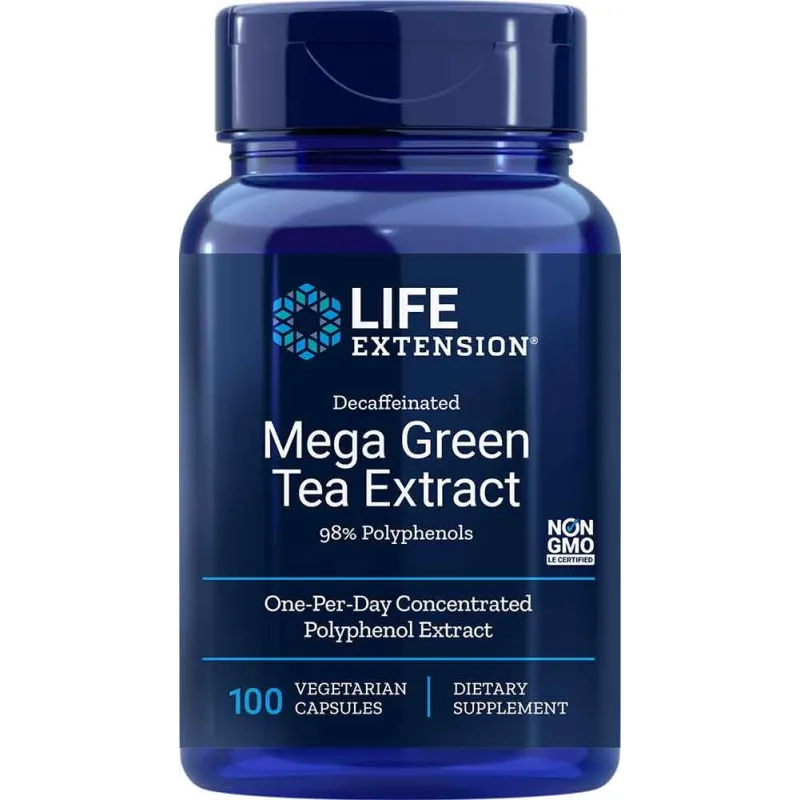
Mega Green Tea Extract (decaffeinated)

100 vegetarian capsules

Item Catalog Number: 00954EU

NON GMO ProductMega Green Tea Extract (decaffeinated) provides powerful antioxidant effects throughout the body. Green tea contains health-promoting polyphenols including epigallocatechin-3-gallate (EGCG), a powerful antioxidant which has been the subject of extensive scientific research. So pour on the multiple health benefits with this essential extract!

Benefits at a Glance

  • Powerful antioxidant

  • Supports cell membrane integrity

  • Boosts liver detoxification

  • Enhances immune function

  • Supports healthy cholesterol levels already within normal range and lipid profiles

  • Supports healthy cell growth

  • Possibly promotes weight loss

Powerful Antioxidant Backed by Extensive Scientific Research

The antioxidant activity of EGCG is about 25–100 times that of vitamins C and E.1,2 One cup of green tea provides roughly 100 mg of polyphenols3 and has antioxidant effect greater than a serving of broccoli, spinach, carrots or strawberries.

More Polyphenols in One Capsule than Several Cups of Green Tea

One capsule of Life Extension’s Mega Green Tea Extract provides more polyphenols than you get from drinking seven cups of green tea. This green tea extract is standardized to 98% polyphenols and contains 326.25 mg of EGCG, by far the most important polyphenol that green tea provides.

And green tea powdered extracts have been shown to absorb 60%–90% better into the bloodstream4 and to be far more bioavailable than drinking green tea itself.

Research Supported Benefits of Green Tea

The Chinese have used green tea for therapeutic purposes since 2000 BC. More recently, volumes

of published scientific findings attest to its multiple health benefits … including:

  • Scavenging reactive oxygen species such as superoxide and the hydroxyl and peroxyl radical5-9

  • Cell membrane supporting properties10-12

  • Possibly promoting weight loss13-19

  • Boosting the effectiveness of enzymatic phase II detoxification20-26

  • Helping maintain healthy cell proliferation27-41

  • Helping maintain healthy blood cholesterol, LDL and triglyceride levels already within normal range42-52

  • Enhancing immune function53-67

  • Displaying protective effects on brain tissues68-79

Mega Green Tea Extract has been concentrated and dual standardized to ensure the highest quality, consistency and biological activity. This advanced extract contains 98% total polyphenols and 45% epigallocatechin-3-gallate (EGCG).

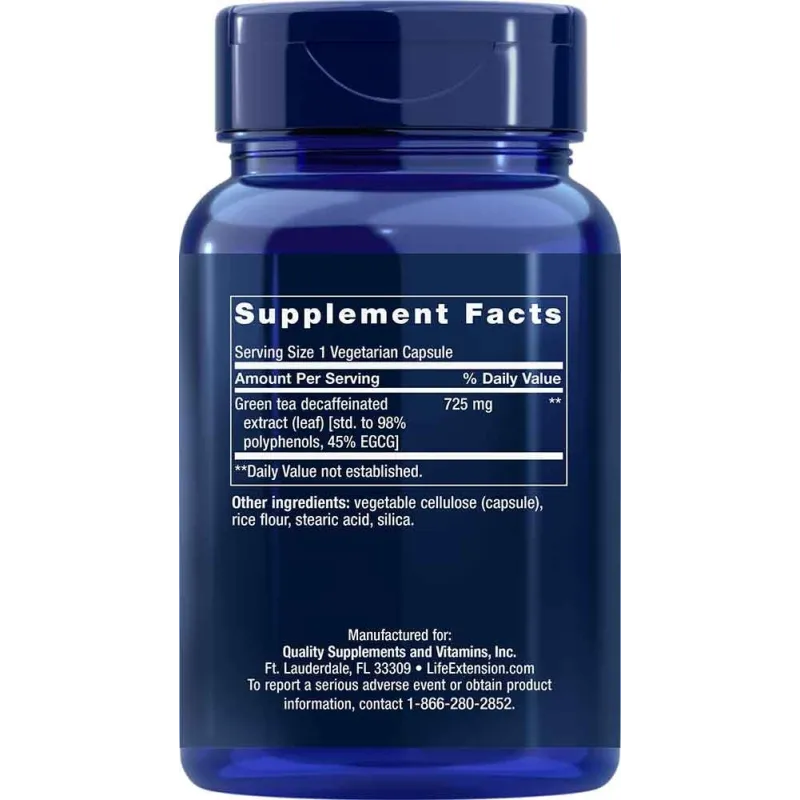
Supplement Facts

Serving Size 1 vegetarian capsule

Amount Per day (1 capsule)
Green tea decaffeinated extract (leaf) [std. to 98% polyphenols, 45% EGCG] 725 mg
Ingredients: Green tea (Camellia sinensis L.) decaffeinated leaf extract, capsule (hydroxypropylmethylcellulose), rice flour, anti-caking agents (silicon dioxide [nano], fatty acids)


Non-GMO


Dosage and Use

Take one (1) capsule daily without food. Each serving contains a small amount of caffeine (max. of 3.6 mg).


Warnings

KEEP OUT OF REACH OF CHILDREN

DO NOT EXCEED RECOMMENDED DOSE

Do not purchase if outer seal is broken or damaged.

When using nutritional supplements, please consult with your physician if you are undergoing treatment for a medical condition or if you are pregnant or lactating.
  1. Mutat Res. 2006 Dec 10;611(1-2):42-53.

  2. J Natl Cancer Inst . 2000 Jul 5;92(13):1038-9.

  3. Altern Med Rev. 2000 Aug;5(4):372-5.

  4. Am J Clin Nutr.2004 Dec;80(6)1558-64.

  5. Chem Res Toxicol . 2003 Sep;16(9):1155-61.

  6. Addict Biol. 2002 Jul;7(3):307-14.

  7. Arch Biochem Biophys. 1999 Feb 1;362(1):79-86.

  8. Phytother Res. 2010 Apr;24(4):503-9.

  9. Food Chem Toxicol. 2010 Apr;48(4):1032-9.

  10. Free Radic Biol Med. 2003 Mar 15;34(6):648-62.

  11. Biophys J. 2009 Feb;96(3):1026-35.

  12. J Physiol Pharmacol. 2008 Dec;59 Suppl 9:217-35

  13. Int J Vitam Nutr Res. 2008 Dec;78(6):275-81.

  14. Obesity (Silver Spring). 2007 Jun;15(6):1473-83.

  15. In Vivo. 2004 Jan-Feb;18(1):55-62.

  16. Br J Nutr. 2005 Sep;94(3):432-6.

  17. Obesity (Silver Spring). 2009 Feb;17(2):310-7.

  18. J Nutr Biochem. 2011 Jan;22(1):1-7.

  19. Clin Nutr. 2015 May 29. pii: S0261-5614(15)00134-X. doi: 10.1016/j.clnu.2015.05.003. [Epub ahead of print]

  20. Proc Soc Exp Biol Med. 1999 Apr;220(4):239-43.

  21. J Nutr. 2008 Aug;138(8):1567S-1571S.

  22. Chem Biol Interact. 1995 Dec 22;98(3):283-301.

  23. Food Funct. 2011 Feb;2(2):101-10.

  24. Curr Drug Metab . 2003 Jun;4(3):241-8.

  25. Arch Pharm Res. 2000 Dec;23(6):605-12.

  26. Carcinogenesis. 2000 Jan;21(1):63-7.

  27. Invest New Drugs. 2011 Apr;29(2):225-31

  28. Expert Rev Anticancer Ther. 2006;6:507–513

  29. Front Biosci (Elite Ed). 2009 Jun 1;1:13-25.

  30. Cancer Prev Res (Phila Pa). 2009 Jun;2(6):531-7.

  31. Nutr Res. 2008 Feb;28(2):92-7.

  32. Molecules. 2008 Nov 1;13(11):2704-16.

  33. Biomed Res. 2009 Aug;30(4):207-15.

  34. Nutrients. 2012 Nov 8;4(11):1679-91.

  35. Exp Ther Med. 2012 Aug;4(2):267-272.

  36. Proteomics. 2011 Dec;11(24):4638-47.

  37. Carcinogenesis. 2012 Feb;33(2):377-84.

  38. Nutr Cancer. 2012 Jan;64(1):4-22.

  39. ISRN Oncol. 2011;2011:403707.

  40. Asian Pac J Cancer Prev. 2007 Apr-Jun;8(2):155-66.

  41. Life Sci. 1998;63(16):1397-403.

  42. Lipids. 2008 May;43(5):419-29.

  43. J Nutr Biochem. 2007 Mar;18(3):179-83.

  44. Atherosclerosis. 2007 Jul;193(1):86-93.

  45. Arch Intern Med. 2003 Jun 23;163(12):1448-53.

  46. Pathophysiology. 2010 Feb;17(1):55-9.

  47. Am J Clin Nutr. 2011 Aug;94(2):601-10.

  48. J Am Diet Assoc. 2011 Nov;111(11):1720-9.

  49. Kobe J Med Sci. 2008 May 23;54(1):E62-72.

  50. Clin Med Insights Cardiol. 2014 Dec 21;8(Suppl 3):7-11.

  51. Food Funct. 2014 Mar;5(3):545-56.

  52. J Transl Med. 2015 Mar 4;13:79. doi: 10.1186/s12967-015-0436-x.

  53. J Agric Food Chem. 2010 Jan 27;58(2):887-94.

  54. Free Radic Biol Med. 2009 Sep 1;47(5):636-43.

  55. Am J Clin Nutr. 2009 Sep;90(3):672-9.

  56. Cell Immunol. 2005 Sep;237(1):7-16.

  57. Mol Vis. 2011 Feb 18;17:533-42.

  58. Cancer Res. 2007 Jan 15;67(2):802-11.

  59. J Am Coll Nutr. 2007 Oct;26(5):445-52.

  60. Biol Pharm Bull. 2010 Jan;33(1):117-21.

  61. PLoS One. 2010 Sep 22;5(9):e12878.

  62. Arch Biochem Biophys. 2010 Sep 1;501(1):65-72.

  63. Biochem Pharmacol. 2011 Dec 15;82(12):1807-21.

  64. Mol Aspects Med. 2012 Feb;33(1):107-18.

  65. J Nutr. 2008 Nov;138(11):2111-6.

  66. Int J Antimicrob Agents. 2009 May;33(5):473-8.

  67. Crit Rev Food Sci Nutr. 2009 May;49(5):463-73.

  68. Curr Pharm Des. 2012;18(1):4-14.

  69. Evid Based Complement Alternat Med. 2012;2012:163106.

  70. Front Biosci (Schol Ed). 2012 Jan 1;4:581-98.

  71. J Alzheimers Dis. 2011;26(3):507-21.

  72. J Alzheimers Dis. 2011;25(2):187-208.

  73. J Physiol Biochem. 2010 Jun;66(2):143-51.

  74. Brain Res. 2010 Sep 24;1353:28-35.

  75. Cent Nerv Syst Agents Med Chem. 2011 Mar 1;11(1):2-7.

  76. J Nutr Biochem. 2008 Sep;19(9):619-26.

  77. Phytother Res. 2003 Mar;17(3):206-9.

  78. CNS Neurosci Ther. 2008 Winter;14(4):352-65.

  79. Mol Nutr Food Res. 2014 Feb;58(2):278-88.

Customers who bought this product also bought:

30 other products in the same category:

Scientific Sources

How does Green tea extract 725mg (standardized to 98% polyphenols in Mega Green Tea Extract (decaffeinated) EU work?

Green tea extract 725mg provides 98% polyphenols for maximum benefits. EGCG 326mg (45%) supports metabolic rate and healthy weight management. Clinical research demonstrates measurable benefits.

What makes this formula effective?

Decaffeinated formula provides benefits without caffeine stimulation. Powerful antioxidants protect cells from free radical damage. Research-backed dosages for optimal results.

Can I take Mega Green Tea Extract (decaffeinated) EU with other supplements?

Generally well-tolerated. Consult healthcare provider if taking medications.

How long before I see results?

Many users report benefits within 2-4 weeks. Optimal results after 8-12 weeks.

What's the best way to take it?

Follow label directions. Take with food for best absorption. Maintain consistency.

  • Green tea extract 725mg provides 98% polyphenols for maximum benefits - Supports health through studied mechanisms
  • EGCG 326mg (45%) supports metabolic rate and healthy weight management - Supports health through studied mechanisms
  • Decaffeinated formula provides benefits without caffeine stimulation - Supports health through studied mechanisms
  • Powerful antioxidants protect cells from free radical damage - Supports health through studied mechanisms
  • Supports cardiovascular health and healthy cholesterol levels - Supports health through studied mechanisms
  • May enhance fat oxidation by 15-20% supporting weight management - Supports health through studied mechanisms
  • EGCG supports healthy cellular proliferation and DNA protection - Supports health through studied mechanisms
  • Promotes healthy inflammatory response through multiple pathways - Supports health through studied mechanisms
  • Supports brain health and cognitive function - Supports health through studied mechanisms
  • May support healthy blood sugar regulation and insulin sensitivity - Supports health through studied mechanisms
  • Adults seeking nutritional support
  • Individuals with health goals
  • Those interested in research-backed ingredients
  • Pregnant/nursing women (consult provider)
  • Those on medications (consult physician)
  • People with allergies

How to Use Mega Green Tea Extract (decaffeinated) EU

  1. Follow label
  2. Take with meal
  3. Stay consistent

Results: Green tea extract at 400-800mg daily (providing 270-450mg EGCG) increases metabolic rate by 4-8%, enhances fat oxidation by 15-20%, and supports weight loss.

Citation: Hursel R, et al. Obes Rev. 2009;10(3):276-291. doi:10.1111/j.1467-789X.2008.00568.x

Results: EGCG from green tea reduces LDL cholesterol by 5-7%, improves HDL by 2-4%, and supports cardiovascular health through antioxidant and anti-inflammatory mechanisms.

Citation: Zheng XX, et al. Am J Clin Nutr. 2011;94(2):601-610. doi:10.3945/ajcn.110.010926

Results: Green tea catechins demonstrate potent antioxidant effects with 25-100x greater free radical scavenging than vitamin C, protecting against oxidative stress and cellular damage.

Citation: Nakagawa T, Yokozawa T. Phytother Res. 2002;16(2):132-135. doi:10.1002/ptr.834

Results: EGCG supports healthy glucose metabolism, improves insulin sensitivity by 15-25%, and reduces fasting blood glucose by 5-10% in clinical trials.

Citation: Liu K, et al. Am J Clin Nutr. 2013;98(2):340-348. doi:10.3945/ajcn.112.052746