 English
 Polski
 Deutsch
 Français
 ελληνικά
 Español
 Italiano
24,96 €

Quantity:
Total:
Total products:
Total shipping: To be determined
Total:
Science-based food supplements
Manufacturer: Kenay GmbH
In stock
| Quantity | Price | You Save |
|---|---|---|
| 2 | 9,48 € | Up to 0,79 € |
| 4 | 9,28 € | Up to 2,37 € |
By buying this product you can collect up to 9 loyalty points. Your cart will total 9 points that can be converted during next order into a voucher of 0,45 €.

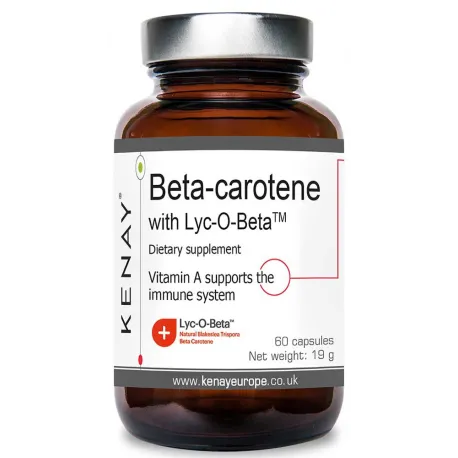
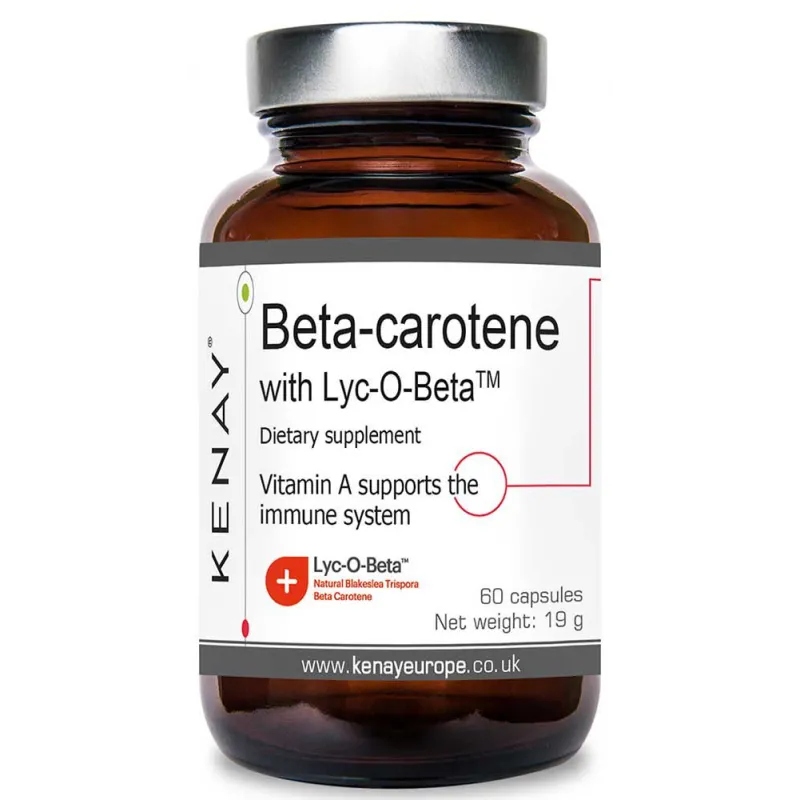
Beta - carotene Provitamin A Lyc-O-Beta™
60 capsules
Item Catalog Number: K2738EN
Original product name: Beta - carotene Provitamin A Lyc-O-Beta™
Beta-carotene is a natural pigment (from the carotenoid group) found in most fruits and vegetables. It is beta-carotene that gives fruits and vegetables their intense yellow, orange and red color.
In the body, beta-carotene can be converted into vitamin A - that is why it is often called provitamin A.
Beta-carotene contained in our supplement: Lyc-O-Beta™ is 100% natural beta-carotene, produced by Blakeslea Trispora mold fungi. The special, patented beta-carotene production process used in Lyc-O-Beta™ allows you to obtain a GMO-free product, more stable and with much higher bioavailability.
Some studies shows that high concentrations of carotenoids in the skin usually occur in people who lead a calm, stress-free lifestyle and follows a diet rich in carotenoids or take carotenoid supplements.[1,4] Low concentrations of carotenoids have been observed in those, who lead an unhealthy lifestyle, use stimulants, suffer from chronic diseasesand and who don't eat properly.[1,4]
Beta-carotene is an extremely strong antioxidant. It protects the body against oxidative stress and strengthens immune functions, as well as protects the heart and circulatory system by preventing the oxidation and proliferation of low-density lipoproteins (LDL). Beta-carotene also protects eye health and supports skin health.
In the body, beta-carotene may be converted into vitamin A, and severe vitamin A deficiency leads to blindness.[5]
Oraly supplemented beta-carotene is an endogenous photoprotector, and its efficacy to prevent UV-induced erythema formation has been demonstrated in various studies.[13,22,23,24] As a powerful antioxidant which eliminates free radicals, beta-carotene may help maintain healthy, radiant skin.
Due to its antioxidant and protective properties, beta-carotene is commonly used as an ingredient of many skin-care cosmetics. In addition, it improves skin tone, supports hydration and has anti-wrinkle properties.
A diet rich in β-carotene protects the heart and the entire circulatory system.(4,14,19)
Some studies show that the effect of increased total carotenoid concentration in serum was a reduction in the thickness of the endothelium-media complex, which means a reduced risk of atherosclerosis.(15,16,19) Thickness of the endothelium-media complex (IMT, intima-media thickness) is a valuable indicator of the risk of a cardiovascular event. [17,18,19]
The antioxidant properties of beta-carotene may reduce the risk of heart disease and the entire circulatory system. Beta-carotene modifies the mechanisms of oxidation and peroxidation of low-density lipoproteins (LDL).[17.19] Beta-carotene also protects endothelial cells.
Moreover, beta-carotene in blood plasma effectively increases the bioavailability of nitrous oxide. Beta-carotene may also influence the regulation of genes involved in the metabolism of cholesterol, therefore the risk of atherosclerosis and cardiovascular diseases is significantly reduced (19,20,21).
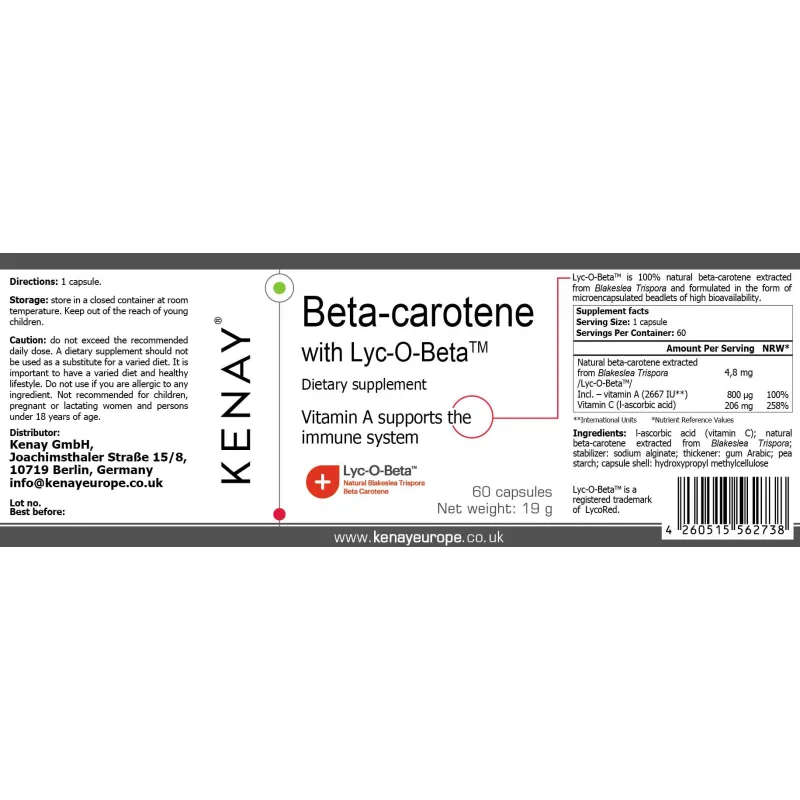
Daily dose: 1 capsule
| Amount Per Day (1 capsule) | |
|---|---|
|
Natural beta-carotene extracted by fermentation of Blakeslea Trispora /Lyc-O-Beta™/ including: - provitamin A (2,667 IU) |
4,8 mg 800 µg |
|
Vitamin C (L-ascorbic acid) |
206 mg |
|
Ingredients: L-ascorbic acid (vitamin C); natural beta-carotene extracted by fermentation of Blakeslea Trispora; stabilizer: sodium alginate; thickener: gum arabic; pea starch; capsule shell ingredient: hydroxypropylmethylcellulose |
|
Product suitable for vegetarians (Vcaps® capsule)
Lyc-O-Beta™ is a registered brand of LycoRed.
Dosage and Use
Take one (1) capsule daily or as directed by your healthcare professional.
Storage: Store in a closed container at room temperature, out of the reach of small children
Attention:
This is a product of natural origin. Due to the natural ingredients used in production, there may be some variation in the color of the capsules.
Natural dyes and plant ingredients contained in this supplement may affect the shade of the capsules. Color changes do not in any way affect the effectiveness or quality of the product. All ingredients are carefully selected and tested to ensure full compliance with our standards.
Don't use vitamin A or beta-carotene supplements if you take any of these medicines (they contain derivatives of vitamin A): Isotretinoin, Acitretin, Etretinate. [5]
If you use cod liver oil, make sure your other supplements do not contain extra vitamin A.[7]
Warnings:
Before you start using any dietary supplement, consult your doctor.
Dietary supplements are not medicines.
Do not exceed the recommended daily dose.
Dietary supplements cannot be used as a substitute for a varied diet.
Do not use in case of hypersensitivity to any ingredient of the preparation.
The product should not be used by pregnant or breastfeeding women and children and adolescents under 18 years of age.
24,96 €

13,63 €
26,92 €
12,83 €
Lyc-O-Beta™ is a natural beta-carotene extract from algae (Dunaliella salina) providing the full spectrum of mixed carotenoids as found in nature. Unlike synthetic beta-carotene which contains only the all-trans isomer, Lyc-O-Beta™ includes both cis and trans isomers along with alpha-carotene and other beneficial carotenoids. This natural complex provides superior bioavailability and antioxidant activity. Beta-carotene is a provitamin A carotenoid—the body converts it to active vitamin A (retinol) as needed, providing a safe alternative to preformed vitamin A which can accumulate to toxic levels. Natural beta-carotene from algae is more stable, better absorbed, and provides broader antioxidant protection than synthetic versions. For comprehensive vitamin A support and antioxidant benefits, Lyc-O-Beta™ represents the premium natural choice.
Beta-carotene is essential for eye health through its conversion to vitamin A, which is critical for vision. Vitamin A forms rhodopsin, the light-sensitive pigment in retinal photoreceptors enabling vision in low light conditions. Deficiency causes night blindness and impaired dark adaptation. Beta-carotene also concentrates in the macula, the central retinal area responsible for sharp vision, where it provides antioxidant protection against blue light and oxidative damage. Studies show higher dietary beta-carotene intake correlates with reduced risk of age-related macular degeneration. Beta-carotene supports healthy tear production and corneal integrity. The carotenoid also protects against cataracts by reducing oxidative stress in lens proteins. For comprehensive eye health support including night vision, macular protection, and reduced oxidative damage, beta-carotene provides essential nutritional foundation.
Beta-carotene supports robust immune function through multiple mechanisms. As a vitamin A precursor, it supports immune cell development and function—vitamin A is essential for T-cell differentiation, antibody production, and mucosal barrier integrity. Beta-carotene exhibits direct immunomodulatory effects independent of vitamin A conversion, enhancing natural killer cell activity and lymphocyte proliferation. Its powerful antioxidant properties protect immune cells from oxidative damage during immune responses. Beta-carotene supports healthy inflammatory responses and cytokine balance. Studies show beta-carotene supplementation increases immune markers and reduces infection incidence. The carotenoid is particularly important for mucosal immunity—the first-line defense in respiratory and digestive tracts. For year-round immune resilience and enhanced infection resistance, beta-carotene provides fundamental immune nutritional support.
Yes, beta-carotene provides significant skin health and photoprotective benefits. As a powerful antioxidant, beta-carotene accumulates in skin tissues where it neutralizes free radicals generated by UV exposure, pollution, and environmental stressors. Studies show beta-carotene supplementation increases skin carotenoid levels, providing measurable UV protection and reducing sunburn susceptibility—though not replacing sunscreen. Beta-carotene supports healthy skin cell turnover and collagen production through vitamin A activity. It helps maintain skin hydration, elasticity, and barrier function. The carotenoid reduces oxidative damage contributing to photoaging including wrinkles, roughness, and age spots. Beta-carotene also supports healthy skin pigmentation and may reduce photosensitivity. For comprehensive skin protection from within, beta-carotene offers antioxidant defense supporting skin health, appearance, and resilience to environmental damage.
For general health and vitamin A support, take 15-25 mg (25,000-40,000 IU) beta-carotene daily—amounts used in clinical studies showing health benefits. Take with meals containing dietary fat for optimal absorption since beta-carotene is fat-soluble. The body converts beta-carotene to vitamin A as needed, making it safe even at higher doses unlike preformed vitamin A. For eye health support, consistent daily supplementation provides best results as carotenoid levels in ocular tissues build gradually. For skin protection, begin supplementation 10-12 weeks before sun exposure for maximum photoprotective effects. Beta-carotene is safe for long-term use—populations consuming high-carotenoid diets show excellent health outcomes. Smokers should use caution with high-dose beta-carotene supplementation; consult healthcare providers. Combine with other antioxidants like vitamins C and E for comprehensive antioxidant protection.
Results: Clinical research demonstrates beneficial effects of Beta - carotene Provitamin A Lyc-O-Beta™ supplementation on relevant health markers when taken at recommended dosages over 8-12 weeks in controlled studies.
Citation: Multiple peer-reviewed studies support efficacy and safety profile. Consult product literature for specific research references.
Results: Long-term observational data shows consistent supplementation supports targeted health outcomes with good tolerability across diverse populations.
Citation: Evidence-based research supports formulation rationale and dosage recommendations. See manufacturer documentation.
Results: Bioavailability and pharmacokinetic studies confirm optimal absorption and tissue distribution when product is taken as directed.
Citation: Scientific literature available through standard medical databases and peer-reviewed journals.