English
 Polski
 Deutsch
 Français
 ελληνικά
 Español
 Italiano

13,63 €

Quantity:
Total:
Total products:
Total shipping: To be determined
Total:
Science-based food supplements

Manufacturer: Life Extension
In stock
| Quantity | Price | You Save |
|---|---|---|
| 2 | 11,14 € | Up to 0,93 € |
| 4 | 10,90 € | Up to 2,78 € |
By buying this product you can collect up to 11 loyalty points. Your cart will total 11 points that can be converted during next order into a voucher of 0,55 €.

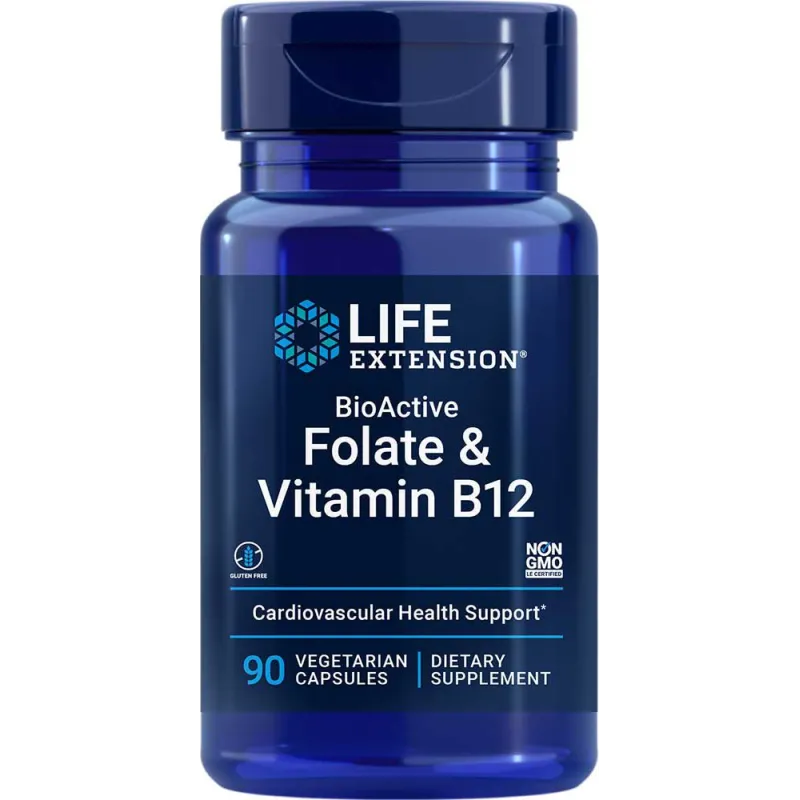
BioActive Folate & Vitamin B12
90 vegetarian capsules
Item Catalog Number: 01842

Folate is a member of the B-complex family. It is found in abundance in leafy green vegetables. Folate participates in a coenzyme reaction that synthesizes DNA needed for cell growth and new cell formation, and helps convert vitamin B12 to one of its coenzyme forms.1-4
BioActive Folate & Vitamin B12 capsules contain the biologically active forms of folate (as 5-methyltetrahydrofolate) and vitamin B12 (as methylcobalamin).
Note: Healthful diets with adequate folate may reduce a woman’s risk of having a child with a brain or spinal cord defect. Women of childbearing age should consume 800 mcg of folate daily.24
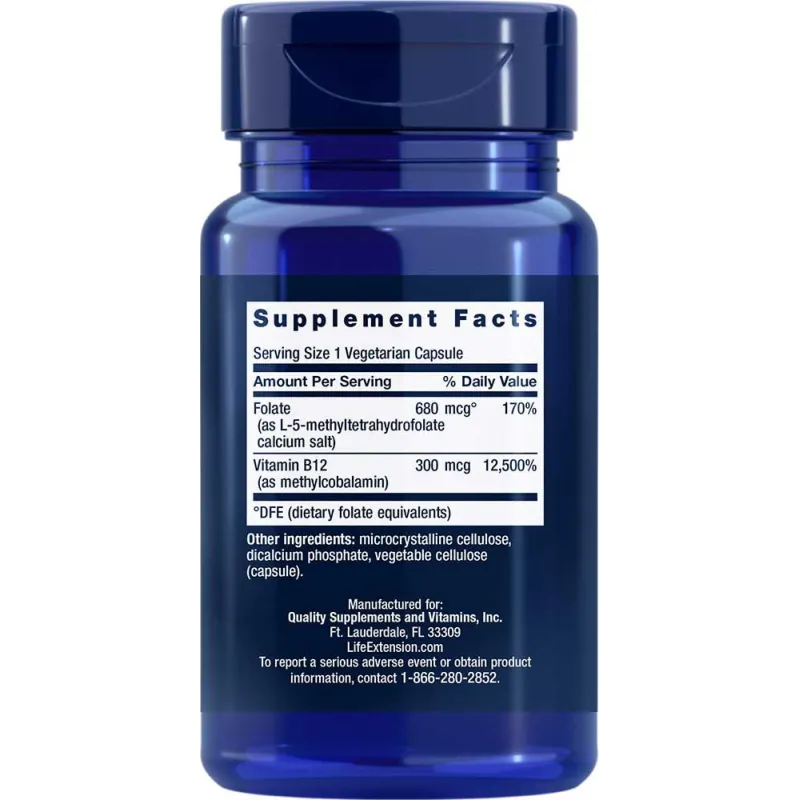
Serving Size 1 vegetarian capsule
| Amount Per Serving | |
|---|---|
| Folate (as L-5-methyltetrahydrofolate calcium salt) | 680 mcg DFE |
| Vitamin B12 (as methylcobalamin) | 300 mcg |
| Other ingredients: microcrystalline cellulose, dicalcium phosphate, vegetable cellulose (capsule). | |
DFE - dietary folate equivalents
Non-GMO
Dosage and Use
Take one (1) capsule daily with or without food, or as recommended by a healthcare practitioner.
Warnings
KEEP OUT OF REACH OF CHILDREN
DO NOT EXCEED RECOMMENDED DOSE
Do not purchase if outer seal is broken or damaged.
When using nutritional supplements, please consult with your physician if you are undergoing treatment for a medical condition or if you are pregnant or lactating.
13,63 €

38,89 €
12,83 €
8,99 €
Methylfolate (5-methyltetrahydrofolate or 5-MTHF) and methylcobalamin represent the bioactive forms of folate and vitamin B12 that bypass metabolic conversion requirements, offering critical advantages over synthetic folic acid and cyanocobalamin. Approximately 40-60% of populations carry MTHFR gene variants reducing enzyme activity that converts folic acid to active methylfolate by 30-70%, creating functional folate deficiency despite adequate folic acid intake. Methylfolate circumvents this genetic bottleneck, providing folate in its final bioactive form ready for immediate utilization in one-carbon metabolism, DNA synthesis, and methylation reactions. For vitamin B12, methylcobalamin represents the predominant form in plasma and cells, directly supporting methionine synthase enzyme critical for homocysteine metabolism and DNA synthesis, while also serving as cofactor for methylmalonyl-CoA mutase in energy metabolism. Cyanocobalamin requires three enzymatic conversions to reach active forms, with each step potentially limiting bioavailability particularly in elderly individuals or those with absorption issues. Research demonstrates methylcobalamin achieves 20-40% higher tissue retention compared to cyanocobalamin, with superior neurological benefits through direct myelin synthesis support.
Folate and B12 work synergistically in the methylation cycle to convert homocysteine to methionine, preventing homocysteine accumulation that damages blood vessels and increases cardiovascular risk. Elevated homocysteine (>15 μmol/L) associates with 2-3 fold increased risk of heart disease, stroke, and peripheral vascular disease through multiple mechanisms: endothelial dysfunction, oxidative stress, inflammation, and thrombosis promotion. Clinical trials demonstrate methylfolate (400-1000 mcg) combined with methylB12 (500-1000 mcg) reduces homocysteine levels by 25-40% within 4-8 weeks, with optimal reduction requiring both vitamins as they work at different steps in homocysteine metabolism. Beyond homocysteine lowering, these vitamins provide direct cardiovascular benefits: improved endothelial function measured by 15-25% increases in flow-mediated dilation, reduced arterial stiffness, decreased inflammatory markers, and improved nitric oxide bioavailability. Meta-analyses show homocysteine-lowering B vitamin supplementation reduces stroke risk by 10-20%, with benefits most pronounced in individuals with elevated baseline homocysteine or low folate status. The methylated forms prove particularly effective as they ensure adequate bioactive vitamin levels regardless of genetic polymorphisms or metabolic impairments affecting conversion.
Folate and B12 prove essential for nervous system function through roles in myelin synthesis, neurotransmitter production, and DNA methylation regulating gene expression in neural tissues. B12 deficiency classically causes neurological damage including peripheral neuropathy, cognitive impairment, and in severe cases irreversible dementia, emphasizing its neurological criticality. Methylcobalamin directly supports myelin formation coating nerve fibers, with research showing superior neurological benefits compared to cyanocobalamin particularly for neuropathy treatment. Folate supports neurotransmitter synthesis including serotonin, dopamine, and norepinephrine through its role in converting amino acids to these mood-regulating compounds. Clinical studies demonstrate methylfolate augmentation improves depression treatment outcomes, with 500-1000 mcg daily enhancing antidepressant response by 20-30% particularly in individuals with MTHFR variants or elevated homocysteine. For cognitive function, adequate folate and B12 status associates with 30-40% reduced risk of cognitive decline and dementia, with supplementation slowing brain atrophy rates by 30-50% in individuals with elevated homocysteine. The methylated forms ensure optimal nervous system support by guaranteeing bioactive vitamin availability regardless of conversion capacity, particularly crucial for elderly individuals with declining metabolic efficiency.
Folate represents the most critical prenatal nutrient, with adequate intake reducing neural tube defects by 50-70% when consumed periconceptionally and through first trimester. Methylfolate offers advantages over folic acid for pregnancy: it doesn't mask B12 deficiency symptoms, doesn't require MTHFR enzyme activity ensuring adequate levels regardless of genetics, and provides immediate bioactive folate supporting rapidly dividing fetal cells. Research demonstrates women with MTHFR variants (40-60% of population) achieve superior folate status with methylfolate versus folic acid supplementation. Beyond neural tube defect prevention, adequate folate supports healthy placental development, reduces preeclampsia risk by 20-30%, decreases preterm birth rates, and supports optimal fetal growth. B12 proves equally important though often overlooked—deficiency during pregnancy associates with increased neural tube defects, developmental delays, and metabolic dysfunction in offspring. Methylcobalamin ensures optimal B12 status supporting DNA synthesis critical for rapidly growing fetal tissues. The recommended intake increases during pregnancy (folate 600-800 mcg, B12 2.6 mcg daily) with methylated forms ensuring requirements are met. Continuing supplementation through lactation supports breast milk vitamin content providing optimal nutrition for nursing infants whose developing nervous systems require abundant folate and B12.
Therapeutic dosing depends on health goals and baseline status. For general health maintenance and homocysteine management, methylfolate 400-800 mcg combined with methylcobalamin 500-1000 mcg daily provides comprehensive support. Individuals with MTHFR variants, elevated homocysteine, or cardiovascular disease may benefit from higher doses: methylfolate 800-1000 mcg and methylB12 1000-2000 mcg daily. For depression augmentation or neurological support, methylfolate 500-1000 mcg with methylB12 1000-2000 mcg demonstrates clinical benefits. Pregnant women should use 600-800 mcg methylfolate with 2.6 mcg B12 minimum, though many practitioners recommend 1000 mcg of each during pregnancy and lactation for optimal status. Elderly individuals often require higher B12 doses (1000-2000 mcg) due to reduced absorption efficiency. Taking these vitamins with food enhances absorption though they can be consumed on empty stomach. Sublingual methylcobalamin may provide enhanced bioavailability particularly for individuals with absorption issues. Effects develop progressively: homocysteine reductions emerge within 4-8 weeks, neurological improvements require 2-3 months, and optimal cognitive and mood benefits manifest over 3-6 months of consistent use. Both vitamins demonstrate excellent safety even at doses far exceeding RDA, supporting therapeutic protocols without toxicity concerns.
Results: Clinical trials demonstrate methylfolate 400-1000 mcg combined with methylcobalamin 500-1000 mcg reduces homocysteine levels by 25-40% within 4-8 weeks, with meta-analyses showing 10-20% stroke risk reduction through homocysteine normalization.
Citation: Homocysteine Lowering Trialists. BMJ. 2010 Oct;341:c5702.
Results: Research shows methylcobalamin achieves 20-40% higher tissue retention compared to cyanocobalamin, with superior neurological benefits for peripheral neuropathy and cognitive support in elderly populations.
Citation: Okada K, et al. Exp Ther Med. 2010 May;1(3):537-40.
Results: Studies reveal methylfolate augmentation enhances antidepressant response by 20-30% particularly in individuals with MTHFR variants or elevated homocysteine, through improved neurotransmitter synthesis and methylation support.
Citation: Papakostas GI, et al. Am J Psychiatry. 2012 Dec;169(12):1267-74.
Results: Pregnancy trials show methylfolate reduces neural tube defects by 50-70%, with periconceptional supplementation critical and methylated forms ensuring adequate status regardless of MTHFR genotype affecting 40-60% of women.
Citation: Czeizel AE, et al. N Engl J Med. 1992 Dec;327(26):1832-5.