 English
 Polski
 Deutsch
 Français
 ελληνικά
 Español
 Italiano

38,89 €

Quantity:
Total:
Total products:
Total shipping: To be determined
Total:
Science-based food supplements

Manufacturer: Life Extension
Waiting for delivery
| Quantity | Price | You Save |
|---|---|---|
| 2 | 40,00 € | Up to 3,33 € |
| 4 | 39,17 € | Up to 10,00 € |
By buying this product you can collect up to 41 loyalty points. Your cart will total 41 points that can be converted during next order into a voucher of 2,05 €.

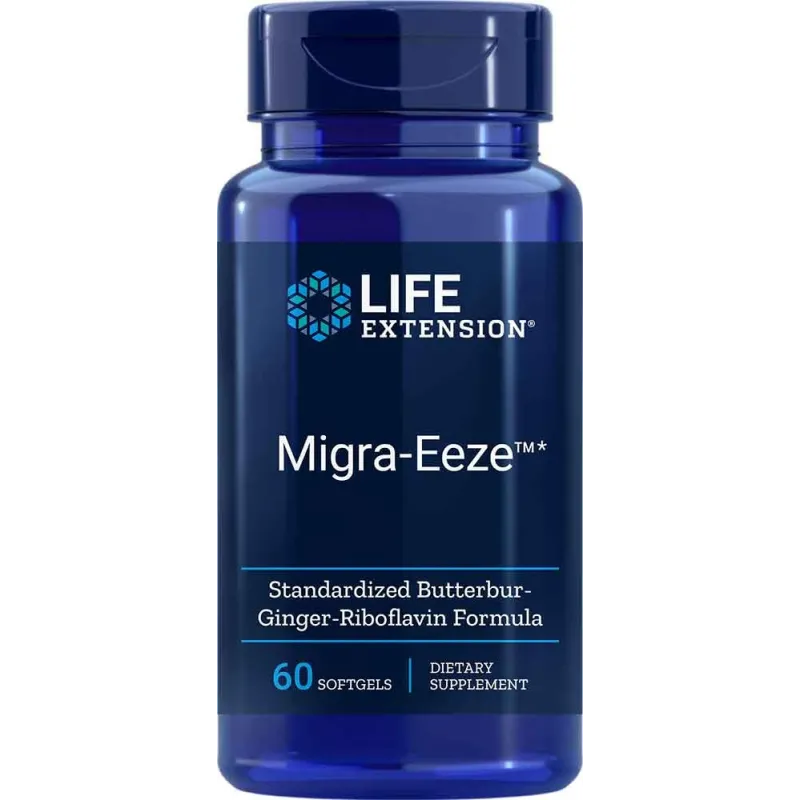
Migra-Eeze™
60 softgels
Item Catalog Number: 00709
Butterbur’s principal active constituent, petasin, eases muscle discomfort and helps relax the constriction of cerebral blood vessels. Butterbur’s ability to relax constricted arteries and smooth muscle may help control head cavity discomfort.
Migra-Eeze™ contains butterbur root extract standardized to provide 22.5 mg of petasins with each daily dose of two softgels. Riboflavin (vitamin B2) and ginger are included based on the ability of these nutrients to exert functional changes that may also guard against cranial discomfort.
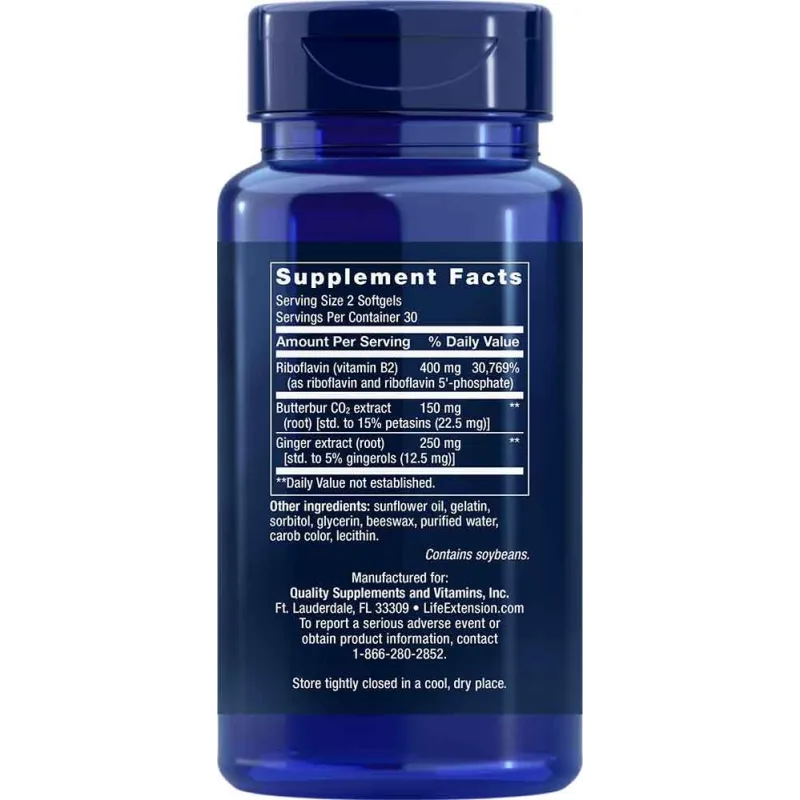
Serving Size 2 softgels
Servings Per Container 30
| Amount Per Serving | |
|---|---|
| Riboflavin (vitamin B2) (as riboflavin and riboflavin 5' phosphate) | 400 mg |
| Butterbur CO2 extract (root) [std. to 15% petasins (22.5 mg)] | 150 mg |
| Ginger extract (root) [std. to 5% gingerols (12.5 mg)] | 250 mg |
| Other ingredients: sunflower oil, gelatin, sorbitol, glycerin, beeswax, purified water, carob, lecithin. | |
Contains soybeans.
Migra-Eeze™ uses a patented butterbur extract carefully extracted using state-of-the-art technology to obtain key active ingredients while containing extremely low levels (<0.1 ppm) of pyrrolizidine alkaloids (PA).
Dosage and Use
Take two (2) softgels daily in divided doses with or without food or as recommended by a healthcare practitioner.
For optimal results, take regularly for four to six months, then reduce dose or discontinue use. If benefits subside, repeat for up to four to six months.
Warnings
KEEP OUT OF REACH OF CHILDREN
DO NOT EXCEED RECOMMENDED DOSE
Do not purchase if outer seal is broken or damaged.
When using nutritional supplements, please consult with your physician if you are undergoing treatment for a medical condition or if you are pregnant or lactating.
38,89 €
23,76 €
26,96 €
34,67 €







Migra-Eeze combines feverfew, ginger, and riboflavin (vitamin B2)—three evidence-based nutrients targeting different migraine mechanisms. Feverfew contains parthenolide inhibiting inflammatory mediators and serotonin release from platelets that trigger migraine attacks. Studies show feverfew reduces migraine frequency by 20-50% with consistent use. Ginger provides anti-inflammatory compounds including gingerols and shogaols that inhibit prostaglandin and leukotriene synthesis—inflammatory pathways implicated in migraine pathophysiology. Clinical trials demonstrate ginger powder at 250-500 mg reduces migraine severity by 40-60% and works as quickly as sumatriptan for acute attacks. Riboflavin supports mitochondrial energy production in brain, with migraine patients showing evidence of mitochondrial dysfunction. High-dose riboflavin at 400 mg daily reduces migraine frequency by 50% in responders, though benefits require 3-4 months to fully manifest.
Research demonstrates natural migraine prevention can rival pharmaceutical approaches with superior safety profiles. Feverfew supplementation at 100-150 mg daily reduces migraine frequency by 24-50% in clinical trials—comparable to prescription preventives like beta-blockers and calcium channel blockers which reduce frequency by 30-50%. The combination approach in Migra-Eeze likely enhances effectiveness through complementary mechanisms. Riboflavin at 400 mg daily shows 50% responder rates (achieving 50% or greater migraine reduction) matching prescription preventive efficacy. Ginger provides rapid acute relief with studies showing effectiveness equivalent to sumatriptan for aborting attacks. The key advantage involves safety—while prescription preventives cause significant side effects (fatigue, weight gain, cognitive impairment), natural approaches demonstrate excellent tolerability. However, natural prevention requires patience as benefits develop over 6-12 weeks versus pharmaceutical options working faster.
Effective migraine prevention with Migra-Eeze requires consistent daily supplementation allowing cumulative benefits to develop. Take recommended dose daily with food to enhance absorption and minimize digestive upset—feverfew and ginger can cause stomach irritation on empty stomach. Allow 4-12 weeks for full preventive benefits to manifest as feverfew and riboflavin require tissue saturation. Track migraine frequency, severity, and duration in headache diary to objectively assess response. For acute migraine attacks, higher ginger doses (500-1000 mg) at first symptoms can abort or reduce attack severity. Combine preventive supplementation with trigger avoidance—common triggers include aged cheese, alcohol, MSG, artificial sweeteners, irregular sleep, and skipped meals. Adequate hydration, regular sleep schedule, stress management, and magnesium supplementation (400 mg daily) enhance preventive effects. Some individuals respond dramatically while others show modest benefit—continue for 3 months before assessing effectiveness.
Migra-Eeze proves most valuable for individuals experiencing frequent migraines (2 or more monthly) seeking natural prevention without pharmaceutical side effects. Those with medication-resistant migraines who haven't responded to prescription preventives may find success with complementary natural approach. People experiencing medication overuse headaches from excessive triptan or analgesic use benefit from natural alternatives breaking the rebound cycle. Individuals wanting to reduce prescription medication reliance can use Migra-Eeze as adjunct therapy potentially allowing medication dose reduction under physician guidance. Pregnant women and those planning pregnancy find natural migraine prevention particularly valuable as most prescription options prove contraindicated. Adolescents and young adults with migraines may prefer natural approaches as first-line prevention before pharmaceuticals. Those experiencing migraine-related symptoms including nausea benefit from ginger's anti-nausea properties.
Migra-Eeze demonstrates good safety profile though several precautions warrant attention. Feverfew has mild antiplatelet effects requiring discontinuation 2 weeks before surgery and caution with blood thinners. Ginger also shows antiplatelet activity—individuals on warfarin or other anticoagulants need physician monitoring. Pregnant women should avoid feverfew as it may stimulate uterine contractions. Some individuals experience mouth ulcers or digestive upset from feverfew—taking with food minimizes this. Riboflavin proves exceptionally safe though high doses cause harmless bright yellow urine. Feverfew may interact with medications metabolized by liver enzymes though clinical significance remains unclear. Those with ragweed allergies may react to feverfew (both are Asteraceae family plants). Start with lower doses and gradually increase to assess tolerance. Abrupt feverfew discontinuation after long-term use may cause rebound headaches—taper gradually if stopping.
Results: Clinical trials demonstrate feverfew supplementation at 100-150 mg daily reduces migraine frequency by 24-50%, with effectiveness comparable to prescription preventives like beta-blockers achieving 30-50% reduction rates.
Citation: Pittler MH, et al. Cochrane Database Syst Rev. 2004;(1):CD002286.
Results: Research shows ginger powder at 250-500 mg reduces migraine severity by 40-60% with effectiveness equivalent to sumatriptan for acute migraine treatment within 2 hours of administration.
Citation: Maghbooli M, et al. Phytother Res. 2014 Mar;28(3):412-5.
Results: Studies reveal riboflavin 400 mg daily achieves 50% responder rates (50% or greater migraine frequency reduction) in clinical trials, matching prescription preventive medication efficacy.
Citation: Schoenen J, et al. Neurology. 1998 Feb;50(2):466-70.
Results: Combined natural approaches demonstrate superior safety profiles versus pharmaceuticals with excellent tolerability, though preventive benefits require 6-12 weeks to fully manifest with consistent daily supplementation.
Citation: Maizels M, et al. Headache. 2004 Nov-Dec;44(9):885-90.