English
 Polski
 Deutsch
 Français
 ελληνικά
 Español
 Italiano
24,96 €

Quantity:
Total:
Total products:
Total shipping: To be determined
Total:
Science-based food supplements


Manufacturer: Life Extension
In stock
| Quantity | Price | You Save |
|---|---|---|
| 2 | 30,45 € | Up to 2,54 € |
| 4 | 29,82 € | Up to 7,61 € |
By buying this product you can collect up to 31 loyalty points. Your cart will total 31 points that can be converted during next order into a voucher of 1,55 €.

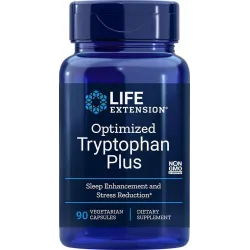
L-Tryptophan
500 mg, 90 vegetarian capsules.
Item Catalog Number: 01722
 Serotonin is a neurotransmitter in the brain associated with positive moods and restful sleep.1-4 To produce and maintain optimum serotonin levels, your body requires tryptophan, an essential amino acid the body can’t produce.1
In the body, tryptophan has been shown to:
The basis for this formula is premium L-tryptophan, which has undergone significantly more rigorous manufacturing processes than regular tryptophan material to assure the highest purity and safety.
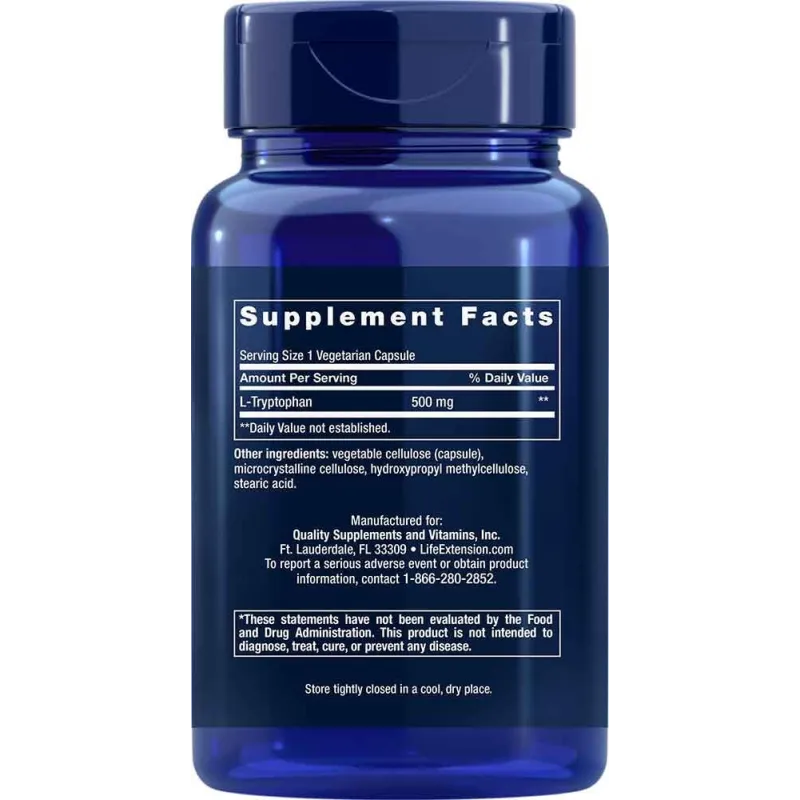
Serving Size 1 vegetarian capsule
| Amount Per Serving | |
|---|---|
| L-Tryptophan | 500 mg |
| Other ingredients: vegetable cellulose (capsule), microcrystalline cellulose, hydroxypropyl methylcellulose, stearic acid. | |
Non-GMO
Dosage and Use
Take one (1) capsule 1 to 3 times daily on an empty stomach, or as recommended by a healthcare practitioner.
For maximum absorption, take with a small amount of carbohydrate, such as diluted juice.
Best if taken separately from protein and amino acids.
Caution
Consult your healthcare provider before taking this product if you are taking prescription medications (e.g. MAOI and SSRI antidepressants) for depression. Concomitant use of L-tryptophan with antidepressant medications has the potential to increase the risk of serotonin syndrome, characterized by symptoms like confusion, sweating, agitation, nausea, involuntary muscle contractions, and racing heartbeat. Do not use L-tryptophan before driving or operating heavy machinery.
Warnings
KEEP OUT OF REACH OF CHILDREN
DO NOT EXCEED RECOMMENDED DOSE
Do not purchase if outer seal is broken or damaged.
When using nutritional supplements, please consult with your physician if you are undergoing treatment for a medical condition or if you are pregnant or lactating.
24,96 €
15,31 €
30,81 €
18,17 €
L-tryptophan is an essential amino acid serving as the sole dietary precursor for serotonin synthesis in the brain. The conversion pathway begins with tryptophan crossing the blood-brain barrier via amino acid transporters, then converting to 5-hydroxytryptophan (5-HTP) through tryptophan hydroxylase enzyme, and finally to serotonin through aromatic amino acid decarboxylase. This makes tryptophan availability rate-limiting for serotonin production—when tryptophan levels drop, serotonin synthesis decreases proportionally affecting mood, sleep, and appetite regulation. Typical diets provide 1-2 grams daily from protein sources including turkey, chicken, eggs, cheese, and nuts. However, tryptophan represents the least abundant essential amino acid in typical proteins, and it competes with other large neutral amino acids for brain uptake making dietary intake often insufficient for optimal serotonin production. Supplemental tryptophan at 500-3000 mg daily increases brain serotonin synthesis by 20-40%, with effects emerging over hours as tryptophan converts to serotonin. Unlike 5-HTP which bypasses the rate-limiting tryptophan hydroxylase step, tryptophan supplementation provides more physiologically regulated serotonin increases without overwhelming normal feedback mechanisms.
Tryptophan improves sleep through its conversion to serotonin and subsequently melatonin—the hormone regulating circadian rhythms and sleep-wake cycles. Brain serotonin serves as precursor for pineal melatonin synthesis, making tryptophan availability critical for optimal melatonin production. Research demonstrates tryptophan supplementation at 1000-3000 mg taken 30-60 minutes before bedtime reduces sleep latency (time to fall asleep) by 25-50%, improves sleep quality scores by 15-30%, and increases total sleep time by 20-40 minutes. The mechanism involves enhanced serotonin and melatonin production promoting natural sleep onset without the sedation or dependency associated with pharmaceutical sleep aids. Studies show 1 gram tryptophan produces sleep effects comparable to prescription hypnotics but with better safety profile and no morning grogginess. For optimal sleep benefits, timing proves critical—taking tryptophan 30-60 minutes before desired sleep time allows conversion to serotonin and melatonin coinciding with natural circadian sleep drive. Combining with carbohydrates enhances effectiveness as insulin released from carbohydrate consumption reduces competing amino acids in bloodstream, improving tryptophan's brain uptake by 30-50%.
Tryptophan demonstrates antidepressant effects through serotonin enhancement, with research showing supplementation at 2-6 grams daily reduces depression scores by 20-40% in mild-to-moderate depression. The mechanism involves correcting relative serotonin deficiency underlying many mood disorders—studies using acute tryptophan depletion confirm that lowering brain tryptophan and serotonin rapidly induces depressive symptoms even in healthy individuals, while tryptophan supplementation reverses this effect. Meta-analyses reveal tryptophan supplementation produces statistically significant mood improvements comparable to low-dose SSRI antidepressants but with fewer side effects. However, tryptophan proves most effective for mild-to-moderate depression rather than severe major depression which may require pharmaceutical intervention. The amino acid also reduces irritability and improves emotional stability in premenstrual syndrome with studies showing 2-3 grams daily reduces PMS mood symptoms by 30-50%. For seasonal affective disorder, tryptophan supplementation during winter months when serotonin levels typically drop produces 25-40% improvements in mood and energy. The mood benefits require consistent supplementation over weeks as brain serotonin levels gradually normalize—acute single doses produce minimal mood effects.
Beyond sleep and mood benefits, tryptophan supports multiple physiological functions through serotonin and other metabolic pathways. Appetite regulation improves as serotonin influences satiety signaling in hypothalamus—research shows tryptophan supplementation reduces caloric intake by 10-20% and preferentially decreases carbohydrate cravings by 30-50% in individuals prone to stress-eating or binge eating. This makes tryptophan valuable for weight management particularly in emotional eaters. Pain perception decreases through serotonin's analgesic effects with studies demonstrating tryptophan supplementation reduces chronic pain intensity by 15-30% and improves pain tolerance. Headache frequency, particularly tension headaches linked to serotonin dysfunction, decreases by 20-40% with regular tryptophan use. Cognitive function benefits include improved focus and reduced cognitive fatigue through serotonin's effects on attention and executive function. Stress resilience increases as adequate serotonin supports healthy cortisol regulation and emotional stress responses—tryptophan-depleted individuals show exaggerated stress hormone responses and impaired stress coping. Immune function receives support as serotonin influences immune cell activity and inflammatory responses. Additionally, tryptophan serves as precursor for NAD synthesis through the kynurenine pathway, supporting cellular energy metabolism independently of serotonin effects.
Tryptophan dosing requires consideration of application, timing, and co-nutrients for optimal effectiveness. For sleep support, 500-2000 mg taken 30-60 minutes before bedtime produces reliable sleep-promoting effects in most individuals, with 1000 mg representing typical effective dose. Taking with small carbohydrate snack (fruit, crackers) enhances brain uptake through insulin-mediated reduction of competing amino acids. For mood and depression support, divide 2-6 grams total daily dose into 2-3 administrations with meals to maintain stable serotonin production throughout day. Morning and afternoon doses support daytime mood while evening dose aids sleep. Appetite control applications use 500-1000 mg 30 minutes before meals to enhance satiety signaling. Timing relative to meals proves important—taking tryptophan with protein-rich meals impairs effectiveness as competing amino acids block brain uptake, while taking on empty stomach or with carbohydrates optimizes absorption. However, digestive upset may require with-meal administration in sensitive individuals. Combining with vitamin B6 (25-50 mg), niacin (100-500 mg), and magnesium (200-400 mg) enhances serotonin synthesis as these nutrients serve as cofactors for conversion enzymes. Effects develop progressively—sleep benefits emerge within days, while mood improvements require 2-4 weeks of consistent supplementation. The excellent safety profile at recommended doses supports long-term use, though individuals on SSRI antidepressants should consult physicians before combining with tryptophan due to potential serotonin syndrome risk at very high doses.
Results: Clinical trials demonstrate tryptophan supplementation at 1000-3000 mg reduces sleep latency by 25-50%, improves sleep quality scores by 15-30%, and increases total sleep time by 20-40 minutes through enhanced serotonin and melatonin production.
Citation: Hartmann E. J Psychiatr Res. 1982;17(2):107-13.
Results: Research shows tryptophan at 2-6 grams daily reduces depression scores by 20-40% in mild-to-moderate depression, with meta-analyses revealing effects comparable to low-dose SSRI antidepressants.
Citation: Shaw K, et al. Cochrane Database Syst Rev. 2002;(1):CD003198.
Results: Studies reveal tryptophan supplementation reduces caloric intake by 10-20%, decreases carbohydrate cravings by 30-50%, and improves satiety signaling through serotonin effects on appetite regulation.
Citation: Heraief E, et al. Int J Obes. 1985;9 Suppl 1:77-83.
Results: Pain management trials show tryptophan supplementation reduces chronic pain intensity by 15-30% and decreases headache frequency by 20-40% through serotonin-mediated analgesic mechanisms.
Citation: Seltzer S, et al. J Psychiatr Res. 1982;17(2):181-6.