
 English
 Polski
 Deutsch
 Français
 ελληνικά
 Español
 Italiano
Depression. New Human Study Confirms Potent Antidepressant Effects of SAMe
 Life Extension® introduced SAMe (S-adenosylmethinone) in 1997. Back then it was enormously popular in Europe, but unknown in the United States.
The National Institute of Mental Health decided to fund a double-blind, placebo-controlled trial that would evaluate SAMe as an additive therapy in those suffering major depression who were resistant to FDA-approved drugs.
Researchers at Harvard Medical School and Massachusetts General Hospital gave patients 800 mg of SAMe twice daily along with a selective serotonin reuptake inhibiting drug (SSRI).
Relative to placebo, patients who received the SAMe showed a 105% higher response rate and a 121% higher remission rate.1 Said differently, add-on therapy with SAMe in patients with drug-resistant depression produced double the response rate AND remission rate compared with placebo within a 6-week period.
This study was published in the August 2010 issue of the American Journal of Psychiatry.1 It was a follow-up to a 2004 pilot study that showed greater benefits when antidepressant drugs were combined with SAMe than when the same drugs were taken alone.2
For the past 13 years, SAMe has been on Life Extension’s TOP TEN list of the most important steps to take to ensure optimal longevity. SAMe has been recommended to aging individuals not to just feel better, but also to protect the brain, liver, joints, and other tissues of the body like no other substance.
This article reviews and updates the many studies documenting the anti-aging properties of SAMe.
 A listing of all the drugs the FDA has approved to treat depression would fill several pages of this magazine. A major problem with these antidepressant drugs is that they fail a significant number of patients—up to 30%, by some accounts.3 In many cases, the drugs make depressed individuals feel worse, and FDA-mandated labeling now requires a warning that use of some antidepressants increases suicide risk—which is an incredible contradiction considering that suicide is a leading cause of death amongst depressives.
An equally disconcerting issue is the many side effects associated with antidepressant medications such as weight gain, constipation, dry mouth, and other symptoms that cause many depressives to stop using them.
There is thus an urgent need for a new approach to treating those who fail to respond to currently available antidepressant medications. Encouraging news from a recent study shows that the addition of S-adenosylmethinone (SAMe) to a serotonin reuptake inhibitor drug markedly improves the percentage of severe depressives who are relieved of their disorder.
Unlike synthetic prescription drugs that induce unintended side effects, SAMe is a naturally-occurring agent in the body that performs a multitude of beneficial functions, such as boosting glutathione levels in the brain and liver. The anti-aging properties of SAMe are so profound that non-depressives take it each day (in lower doses) just like they do their other dietary supplements.4,5
Antidepressants Don’t Work
 As a team of Harvard researchers noted in a remarkable 2010 study published in the Journal of Clinical Psychiatry,6 “The majority of depressed patients will not experience remission when treated with a first-line antidepressant.”
In other words, antidepressants don’t really work for most patients. More is needed to help depression’s victims.
This is where SAMe comes in.
In modern high-tech imaging studies of healthy human brains, SAMe produces effects typical of several classes of antidepressant drugs7—but unlike those drugs, SAMe has remarkably few side effects and is well-tolerated even in elderly subjects.8
People with depression may exhibit a variety of biochemical imbalances, but the most common and best-known has to do with neurotransmitters like serotonin (involved in mood, sleep, appetite, and learning) and norepinephrine (involved in heart rate, blood pressure, and the fight-or-flight response). These chemical messengers belong to a class of molecules known as monoamines, and their synthesis in brain cells is largely controlled by the presence of folic acid, vitamin B12—and SAMe.9-12 When released into the space between brain cells (the synapse), monoamines exert stimulating or inhibiting effects on postsynaptic neurons.
With too little serotonin or norepinephrine available, the brain cannot sustain a positive mood—and depression results. Virtually all antidepressant drugs work to boost levels of these neurotransmitters within the synapse. And therein lie many of their limitations—and the causes of many of their side effects.13
SAMe operates through a completely different mechanism than these drugs. A molecule derived from the sulfur-containing amino acid methionine, SAMe is found in every living cell and plays a central role in cellular function.14,15 In addition to being required for monoamine synthesis, it also affects cell membrane fluidity, which may in turn influence how well a neuron transmits an electrical signal.16 Recent studies have shown that SAMe is also involved in the so-called “epigenetic” control of cellular function—the ability of cells to activate or suppress specific genes based on environmental influences—by its effects on proteins associated with chromosomes.17
 These multi-targeted effects, coupled with an extraordinary safety profile, make SAMe a compelling treatment for a wide variety of brain disorders, from depression and cognitive decline to congenital metabolic dysfunction.18,19 SAMe crosses the blood-brain barrier, making it readily available to the brain and nervous system.10 This is vital: SAMe levels in the spinal fluid of depressed individuals have been shown to be significantly lower than those of healthy people.11
Animal models of depression shed additional light on how SAMe works in the brain. More than two decades ago Japanese scientists demonstrated a reduction in aggression in rats treated with SAMe as a result of its action in the central nervous system.20 By the turn of this century, researchers in Italy and Spain showed that SAMe reverses experimentally-induced depression in rats, at a rate faster than that of the prescription antidepressant imipramine, the first tricyclic antidepressant developed, and without apparent side effects.21,22 And in a remarkably detailed study, the Italian group showed that SAMe restored diminished brain levels of “polyamines,” essential brain molecules that are reduced in depressed patients.23
In 2007 a team of scientists at the University of Massachusetts launched a study using a combination of SAMe with N-acetyl cysteine (NAC) and acetyl-L-carnitine.24 Their subjects were aging mice with neurodegeneration similar to Alzheimer’s disease, in which depression is often a major manifestation. The combination rapidly enhanced cognitive function and prevented or reduced aggression in the animals, an effect that was rapidly reversed when the combination was withdrawn. The combination also prevented a decline in levels of the neurotransmitter acetylcholine, while contributing important antioxidant effects as well.
Let’s turn now to the clinical realm and examine how well SAMe actually functions in humans suffering from depression.
- A landmark study funded by the National Institute of Mental Health revealed that the addition of S-adenosylmethionine or SAMe produces compelling results in people taking SSRIs, the majority of whom do not experience relief when taking the drug alone.

- SAMe is a naturally occurring molecule found in all living cells; it supports a host of chemical functions necessary for normal brain activity.
- SAMe acts by several distinct and independent mechanisms to target multiple sites of action in brain cells that are involved in producing depression.
- In clinical trials, SAMe has been shown to be at least as effective as prescription antidepressants, but with far fewer side effects.
- Because of its strong safety record, SAMe should be part of any regimen for brain health, particularly when depressive symptoms are present—and when prescription drugs alone don’t work.
- SAMe has also been shown to confer enormous benefits to the brain, liver, and joints, halting and even reversing various degenerative conditions, from osteoarthritis and neurodegeneration to nonalcoholic fatty liver disease.
SAMe Dramatically Improves Therapeutic Outcomes
 Clinical trials have repeatedly demonstrated the benefits of SAMe in patients with major depression in a variety of populations: doses of 400-1,600 mg daily consistently resulted in rapid improvement in depressive symptoms and side effects that were mild and transient.25-27
SAMe is even effective in patients previously labeled “nonresponders” to conventional drug treatment.25 This led first to additional studies of SAMe compared with standard drugs rather than placebos, and later to studies in which SAMe was used in addition to such drugs.
SAMe consistently performs as well as or better than older-generation antidepressants such as imipramine and desipramine, drugs which are highly effective but have an unfavorable safety profile.28-30 In every case, the side effects of SAMe were trivial or mild. Interestingly, one such study found that regardless of whether patients received SAMe or the drug, their levels of SAMe in blood rose significantly as their depressive symptoms improved.28
 Experts have known for more than a decade that severely reduced brain levels of SAMe are directly linked to Alzheimer’s disease.1 More recent research reveals a direct correlation between levels of SAMe in the brain and Parkinson’s disease. In aging individuals stricken with Parkinson’s disease, parkinsonian symptoms (including increased levels of neurodegeneration) have been shown to be worse when SAMe levels are low, while cognitive function is markedly better when levels of SAMe are higher.2 At the core of SAMe’s ability to support brain function and neuronal health is its role in boosting levels of glutathione (GSH) and enhancing the antioxidant power of superoxide dismutase (SOD).3
Scientists have noted that these twin capabilities underscore SAMe’s importance as a neuroprotective compound, given the extraordinarily high metabolic activity and energy-intensive demands of both brain cells and neurons.3
References- Morrison LD, Smith DD, Kish SJ. Brain S-adenosylmethionine levels are severely decreased in Alzheimer’s disease. J Neurochem. 1996 Sep;67(3):1328-31.
- Obeid R, Schadt A, Dillmann U, Kostopoulos P, Fassbender K, Herrmann W. Methylation status and neurodegenerative markers in Parkinson disease. Clin Chem. 2009 Oct;55(10):1852-60.
- Cavallaro RA, Fuso A, Nicolia V, Scarpa S. S-adenosylmethionine prevents oxidative stress and modulates glutathione metabolism in TgCRND8 mice fed a B-vitamin deficient diet. J Alzheimers Dis. 2010;20(4):997-1002.
A study conducted in 1992 demonstrated the benefits of combining SAMe and imipramine for speeding the onset of the drug31—a critical benefit since almost all antidepressants take three or more weeks to manifest their effects, during which time patients often become discouraged and may discontinue treatment.
In 2004, a Harvard team of psychiatrists used SAMe in patients who were resistant to treatment with more modern drugs.2 In this open study design, the Harvard group provided 800-1,600 mg per day of SAMe orally to 30 patients who remained depressed despite adequate doses of their medications. Using even a highly conservative statistical analysis, they found that 50% of these previously resistant patients responded to treatment, with an impressive 43% experiencing complete remission of symptoms.2 These compelling results prompted the same Harvard group to design a larger study to more rigorously examine SAMe’s benefits in augmenting existing drug treatments.1,32
The outcome of this study was revelatory, creating a sensation within the scientific community. The group studied 73 patients who were “nonresponders” to standard treatment with selective serotonin reuptake inhibitor (SSRI) antidepressants. Subjects stayed on their SSRI for the entire 6-week study period, and took 800 mg of SAMe, or a placebo, twice daily. Their depressive symptoms were monitored using the standard Hamilton Depression Rating Scale. Thirty-six percent of the supplemented patients responded to treatment, and 26% experienced complete remission of their depression—patients who had not felt any difference with standard medications. The placebo recipients had a much worse response rate; just 18% felt a difference and a dismal 12% experienced complete remission.1
 A comprehensive 2002 SAMe study conducted by the US Department of Health and Human Services confirmed SAMe’s power not only to sustain mood, but also to optimize joint function.1 Clinical trials have shown reduced pain and stiffness in aging individuals stricken with osteoarthritis, while in vitro and animal studies have shown SAMe can stimulate the production of cartilage—a crucial factor in halting and reversing arthritis’s progression.2 Scientists have even found SAMe to be as effective as ibuprofen at reducing morning stiffness, pain at rest, pain during motion, swelling, “cracking” or “popping” sounds, and limited range of motion in arthritic joints.3
References
- Available at: http://www.ncbi.nlm.nih.gov/bookshelf/br.fcgi?book=erta64. Accessed September 22, 2010.
- Hosea Blewett HJ. Exploring the mechanisms behind S-adenosylmethionine (SAMe) in the treatment of osteoarthritis. Crit Rev Food Sci Nutr. 2008 May;48(5):458-63.
- Muller-Fassbender H. Double-blind clinical trial of S-adenosylmeth onine versus ibuprofen in the treatment of osteoarthritis. Am J Med. 1987 Nov 20;83(5A):81-3.
The lead author of the Harvard study, Dr. George Papakostas, noted “SAMe can be an effective, well-tolerated, and safe adjunctive treatment strategy for serotonin reuptake inhibitor nonresponders with major depressive disorder.”1
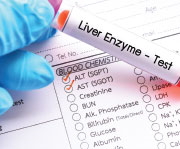 SAMe’s extraordinary capacity to protect and enhance liver function has been well-documented in a wealth of studies. To take one dramatic example, blood alcohol levels among binge drinkers who ingest SAMe at the point of consumption have been shown to be significantly lower than controls.1 In 2010, researchers were able to determine why: SAMe boosts the liver’s alcohol elimination rate by increasing expression of genes within liver cells that are specifically involved in alcohol metabolism.1 Insufficient levels of SAMe have also been linked to a variety of liver diseases, including nonalcoholic fatty liver disease and nonalcoholic steatohepatitis, both increasingly common disorders characterized by fat deposits in liver tissue that may progress to cirrhosis and full-blown liver failure.2,3 Scientists believe SAMe supplementation can prevent the onset and progression of these potentially fatal conditions.
References
- Bardag-Gorce F, Oliva J, Wong W, et al. S-adenosylmethionine decreases the peak blood alcohol levels 3h after an acute bolus of ethanol by inducing alcohol metabolizing enzymes in the liver. Exp Mol Pathol. 2010 Sep 7.
- Wortham M, He L, Gyamfi M, Copple BL, Wan YJ. The transition from fatty liver to NASH associates with SAMe depletion in db/db mice fed a methionine choline-deficient diet. Dig Dis Sci. 2008 Oct;53(10):2761-74.
- Caballero F, Fernandez A, Matias N, et al. Specific contribution of methionine and choline in nutritional nonalcoholic steatohepatitis: impact on mitochondrial S-adenosyl-L-methionine and glutathione. J Biol Chem. 2010 Jun 11;285(24):18528-36.
 In a recent study published in the American Journal of Psychiatry, the results of a clinical trial conducted at Harvard Medical School and Massachusetts General Hospital were announced. The researchers found a significant benefit in male and female patients taking S-adenosylmethionine (SAMe) as an additive therapy to treat major depressive disorders.1
What made the findings of this study so remarkable is that this favorable response was observed in those who had already failed to respond to standard antidepressant drugs.1
This double-blind, randomized controlled trial to evaluate SAMe as an additive therapy against major depression in this drug-resistant population was funded by The National Institute of Mental Health.1
The trial is a follow-up to a smaller study in 2004 that found greater benefit when antidepressant drugs were combined with SAMe than when these drugs were used alone.2 In the current investigation, Harvard Medical School researchers assigned adult depressives taking serotonin reuptake inhibitor drugs (like Prozac®, Effexor®, Celexa®, Zoloft®, Paxil®, and Cymbalta®) to receive 800 mg SAMe or a placebo twice per day for six weeks. Those who received SAMe experienced a 36.1% response rate and a 25.8% remission rate, compared to a 17.6% and a 11.7% response and remission rate in the placebo group.1 This translates into a beneficial response and remission rate that was double for those receiving SAMe compared with placebo.
An accompanying editorial written by University of California-San Francisco professor of psychiatry J. Craig Nelson, MD stated that the Harvard findings are “persuasive” and that “SAMe offers a novel mechanism of treatment action and opens up a new area for future exploration.” 3
References
- Papakostas GI, Mischoulon D, Shyu I, Alpert JE, Fava M. S-adenosyl methionine (SAMe) augmentation of serotonin reuptake inhibitors for antidepressant nonresponders with major depressive disorder: a double-blind, randomized clinical trial. Am J Psychiatry. 2010 Aug;167(8):942-8.
- Alpert JE, Papakostas G, Mischoulon D, et al. S-adenosyl-L-methionine (SAMe) as an adjunct for resistant major depressive disorder: an open trial following partial or nonresponse to selective serotonin reuptake inhibitors or venlafaxine. J Clin Psychopharmacol. 2004 Dec;24(6):661-4.
- Nelson JC. S-adenosyl methionine (SAMe) augmentation in major depressive disorder. Am J Psychiatry. 2010 Aug;167(8):889-91.
Summary
A landmark study funded by the National Institute of Mental Health revealed that the addition of S-adenosylmethionine or SAMe produces compelling results in major depression sufferers taking SSRIs, the majority of whom do not experience relief with prescription drugs alone. SAMe is a naturally occurring molecule found in all living cells, where it supports a host of chemical functions necessary for normal brain activity. It has been found to be safe at very high doses. Despite a wealth of data from the early 1990s, SAMe hadn’t found clinical acceptance until very recently, when new, rigorously controlled trials demonstrated its effectiveness in instances where drugs don’t work. Given SAMe’s impressive safety record, virtually anyone suffering from depressive symptoms should consider it, whether currently taking medication or not.
Material used with permission of Life Extension. All rights reserved.
- Papakostas GI, Mischoulon D, Shyu I, Alpert JE, Fava M. S-adenosyl methionine (SAMe) augmentation of serotonin reuptake inhibitors for antidepressant nonresponders with major depressive disorder: a double-blind, randomized clinical trial. Am J Psychiatry. 2010 Aug;167(8):942-8.
- Alpert JE, Papakostas G, Mischoulon D, et al. S-adenosyl-L-methionine (SAMe) as an adjunct for resistant major depressive disorder: an open trial following partial or nonresponse to selective serotonin reuptake inhibitors or venlafaxine. J Clin Psychopharmacol. 2004 Dec;24(6):661-4.
- Perovic B, Jovanovic M, Miljkovic B, Vezmar S. Getting the balance right: Established and emerging therapies for major depressive disorders. Neuropsychiatr Dis Treat. 2010 Sep 7;6:343-64.
- Panza F, Frisardi V, Capurso C, et al. Polyunsaturated fatty acid and S-adenosylmethionine supplementation in predementia syndromes and Alzheimer’s disease: a review. ScientificWorldJournal. 2009 May 22;9:373-89.
- Gregory PJ, Sperry M, Wilson AF. Dietary supplements for osteoarthritis. Am Fam Physician. 2008 Jan 15;77(2):177-84.
- Fava M. Switching treatments for complicated depression. J Clin Psychiatry. 2010 Feb;71(2):e04.
- Saletu B, Anderer P, Di Padova C, Assandri A, Saletu-Zyhlarz GM. Electrophysiological neuroimaging of the central effects of S-adenosyl-L-methionine by mapping of electroencephalograms and event-related potentials and low-resolution brain electromagnetic tomography. Am J Clin Nutr. 2002 Nov;76(5):1162S-71S.
- Saletu B, Anderer P, Linzmayer L, et al. Pharmacodynamic studies on the central mode of action of S-adenosyl-L-methionine (SAMe) infusions in elderly subjects, utilizing EEG mapping and psychometry. J Neural Transm. 2002 Dec;109(12):1505-26.
- Miller AL. The methylation, neurotransmitter, and antioxidant connections between folate and depression. Altern Med Rev. 2008 Sep;13(3):216-26.
- Carney MW, Toone BK, Reynolds EH. S-adenosylmethionine and affective disorder. Am J Med. 1987 Nov 20;83(5A):104-6.
- Bottiglieri T, Laundy M, Crellin R, Toone BK, Carney MW, Reynolds EH. Homocysteine, folate, methylation, and monoamine metabolism in depression. J Neurol Neurosurg Psychiatry. 2000 Aug;69(2):228-32.
- Herrmann W, Obeid R. Biomarkers of folate and vitamin B(12) status in cerebrospinal fluid. Clin Chem Lab Med. 2007;45(12):1614-20.
- Racagni G, Popoli M. The pharmacological properties of antidepressants. Int Clin Psychopharmacol. 2010 May;25(3):117-31.
- Bottiglieri T. S-Adenosyl-L-methionine (SAMe): from the bench to the bedside–molecular basis of a pleiotrophic molecule. Am J Clin Nutr. 2002 Nov;76(5):1151S-7S.
- Scott JM, Molloy AM, Kennedy DG, Kennedy S, Weir DG. Effects of the disruption of transmethylation in the central nervous system: an animal model. Acta Neurol Scand Suppl. 1994;154:27-31.
- Baldessarini RJ. Neuropharmacology of S-adenosyl-L-methionine. Am J Med. 1987 Nov 20;83(5A):95-103.
- McGowan PO, Kato T. Epigenetics in mood disorders. Environ Health Prev Med. 2008 Jan;13(1):16-24.
- Bottiglieri T, Hyland K, Reynolds EH. The clinical potential of ademetionine (S-adenosylmethionine) in neurological disorders. Drugs. 1994 Aug;48(2):137-52.
- Paul RT, McDonnell AP, Kelly CB. Folic acid: neurochemistry, metabolism and relationship to depression. Hum Psychopharmacol. 2004 Oct;19(7):477-88.
- Yamamoto T, Yatsugi S, Ohno M, Ueki S. Inhibition of mouse-killing behavior by S-adenosyl-L-methionine in midbrain raphe-lesioned and olfactory-bulbectomized rats. Pharmacol Biochem Behav. 1989 Oct;34(2):395-8.
- Benelli A, Filaferro M, Bertolini A, Genedani S. Influence of S-adenosyl-L-methionine on chronic mild stress-induced anhedonia in castrated rats. Br J Pharmacol. 1999 Jun;127(3):645-54.
- Bellido I, Gomez-Luque A, Plaza A, Rius F, Ortiz P, Sanchez de la Cuesta F. S-adenosyl-L-methionine prevents 5-HT(1A) receptors up-regulation induced by acute imipramine in the frontal cortex of the rat. Neurosci Lett. 2002 Mar 15;321(1-2):110-4.
- Genedani S, Saltini S, Benelli A, Filaferro M, Bertolini A. Influence of SAMe on the modifications of brain polyamine levels in an animal model of depression. Neuroreport. 2001 Dec 21;12(18):3939-42.
- Chan A, Shea TB. Effects of dietary supplementation with N-acetyl cysteine, acetyl-L-carnitine and S-adenosyl methionine on cognitive performance and aggression in normal mice and mice expressing human ApoE4. Neuromolecular Med. 2007;9(3):264-9.
- Rosenbaum JF, Fava M, Falk WE, et al. The antidepressant potential of oral S-adenosyl-l-methionine. Acta Psychiatr Scand. 1990 May;81(5):432-6.
- Salmaggi P, Bressa GM, Nicchia G, Coniglio M, La Greca P, Le Grazie C. Double-blind, placebo-controlled study of S-adenosyl-L-methionine in depressed postmenopausal women. Psychother Psychosom. 1993;59(1):34-40.
- Fava M, Giannelli A, Rapisarda V, Patralia A, Guaraldi GP. Rapidity of onset of the antidepressant effect of parenteral S-adenosyl-L-methionine. Psychiatry Res. 1995 Apr 28;56(3):295-7.
- Bell KM, Potkin SG, Carreon D, Plon L. S-adenosylmethionine blood levels in major depression: changes with drug treatment. Acta Neurol Scand Suppl. 1994;154:15-8.
- Delle Chiaie R, Pancheri P, Scapicchio P. Efficacy and tolerability of oral and intramuscular S-adenosyl-L-methionine 1,4-butanedisulfonate (SAMe) in the treatment of major depression: comparison with imipramine in 2 multicenter studies. Am J Clin Nutr. 2002 Nov;76(5):1172S-6S.
- Pancheri P, Scapicchio P, Chiaie RD. A double-blind, randomized parallel-group, efficacy and safety study of intramuscular S-adenosyl-L-methionine 1,4-butanedisulphonate (SAMe) versus imipramine in patients with major depressive disorder. Int J Neuropsychopharmacol. 2002 Dec;5(4):287-94.
- Berlanga C, Ortega-Soto HA, Ontiveros M, Senties H. Efficacy of S-adenosyl-L-methionine in speeding the onset of action of imipramine. Psychiatry Res. 1992 Dec;44(3):257-62.
- Papakostas GI. Evidence for S-adenosyl-L-methionine (SAM-e) for the treatment of major depressive disorder. J Clin Psychiatry. 2009;70 Suppl 5:18-22.
Related products
-

SAM-e (S-Adenosyl-Methionine) 400 mg 30 tablets
Price: 34,72 €Promotes brain and liver health Helps maintain stable mood Helps maintain... -
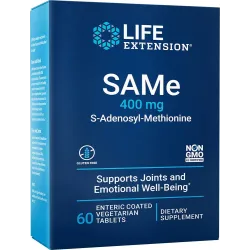
SAM-e (S-Adenosyl-Methionine) 400 mg 60 tablets
Price: 64,15 €Promotes brain and liver health Helps maintain stable mood Helps maintain...
Related posts
-
 Rebuild Aging Joints!
In this article, you will learn about UC-II®, or undenatured type II collagen, a novel intervention for both...
Rebuild Aging Joints!
In this article, you will learn about UC-II®, or undenatured type II collagen, a novel intervention for both... -
Next-Generation Nutrients for Rapid Relief of Joint Pain
In recent years, adults seeking relief from the crippling pain of arthritis have had to choose between expensive,...
-
Feed Your Brain!
Millions of people around the world are adhering to low-fat, low-cholesterol diets in an effort to reduce the impact...
-
Lipoic Acid Reverses Mitochondrial Decay
It is estimated that 85% of the oxygen contained in every breath you take is consumed by the mitochondria within each...
-
Vitamin C and Dihydroquercetin
Every day, our bodies are under continual assault by damaging agents known as free radicals. Generally, both internal...