 English
 Polski
 Deutsch
 Français
 ελληνικά
 Español
 Italiano
50,68 €

Quantity:
Total:
Total products:
Total shipping: To be determined
Total:
Science-based food supplements

Manufacturer: Kenay GmbH
In stock
| Quantity | Price | You Save |
|---|---|---|
| 2 | 44,77 € | Up to 3,73 € |
| 4 | 43,84 € | Up to 11,19 € |
By buying this product you can collect up to 46 loyalty points. Your cart will total 46 points that can be converted during next order into a voucher of 2,30 €.

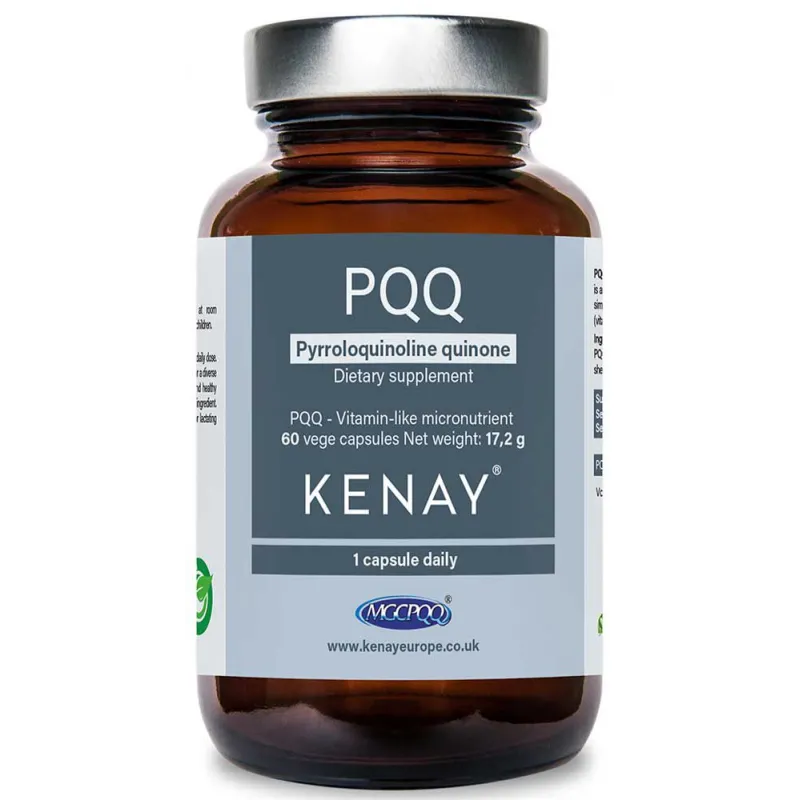
PQQ Pyrroloquinoline quinone
60 capsules
Item Catalog Number: K1724EN
Original product name: PQQ Pyrroloquinoline quinone
PQQ is definitely more than just a strong antioxidant. This nutrient is found in fruits, vegetables and breast milk but only bacteria can produce it.
PQQ - Pyrroloquinoline quinone is a vitamin-like micronutrient wchich belongs to the quinone cofactors family. As an enzymatic cofactor, PQQ transfers electrons, which is a key for the proper functions of mitochondria, which are a kind of "cellular power plants". PQQ helps reverse mitochondrial disorders and stimulates the growth of new mitochondria.
Researchers have found that PQQ regulates the activity of lactate dehydrogenase enzyme which participate in the process of energy production in many organs and tissues throughout the human body.[7]
PQQ affects biological processes such as mitochondriogenesis, reproduction, growth and aging.
As it was shown, in an early stage of development PQQ deficiency reduces mitochondria content and mitochondrial-related gene expression. Current observations suggest that PQQ has strong potential as a potent therapeutic nutraceutical.[1,2]
One of study[3] showed, that daily supplementation with 20 mg PQQ optimizes mitochondrial biogenesis in human subjects.[1-3] Moreover, PQQ supplementation (10–20 mg per day) improved cognitive function and memory in human subjects [1,2,4-6].
Benefits at a Glance:
PQQ shows anti-inflammation and antioxidation effects. PQQ protects the circulatory system, especially the heart, against the destructive effects of free radicals. It also supports proper blood flow in the heart muscle.[8,9]
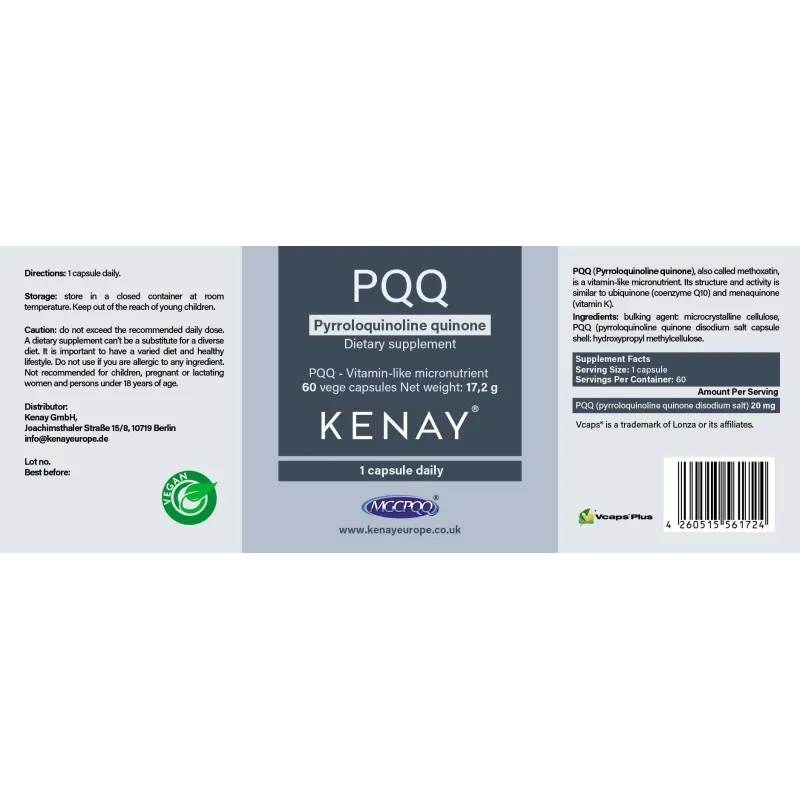
Daily dose: 1 capsule
| Amount Per Day (1 capsule) | |
|---|---|
|
PQQ (pyrroloquinoline quinone disodium salt) |
20 mg |
|
Ingredients: bulking agent: microcrystalline cellulose; pyrroloquinoline quinone disodium salt (PQQ); capsule shell: hydroxypropylmethylcellulose. |
|
Vcaps® is a trademark of Lonza or its affiliates.
Active ingredient supplier: Mitsubishi Gas Chemical Company, Inc. Japan
Dosage and Use
Take one (1) capsule daily or as recommended by a healthcare practitioner.
Warnings:
Before you start using any dietary supplement, consult your doctor.
Dietary supplements are not medicines.
Do not exceed the recommended daily dose.
Dietary supplements cannot be used as a substitute for a varied diet.
Do not use in case of hypersensitivity to any ingredient of the preparation.
The product should not be used by pregnant or breastfeeding women and children and adolescents under 18 years of age.
50,68 €
50,27 €
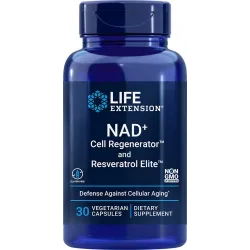
52,71 €
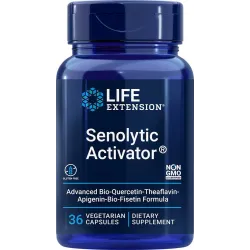
23,76 €


Pyrroloquinoline quinone (PQQ) is a novel vitamin-like compound essential for mitochondrial biogenesis—the creation of new mitochondria—making it uniquely valuable for cellular energy production and healthy aging. While technically not classified as a vitamin, PQQ functions as an essential micronutrient with roles similar to B vitamins in cellular metabolism. The compound was discovered in 1979 and identified as critical for mitochondrial function in 2010, representing one of the most significant recent discoveries in nutritional biochemistry. PQQ's primary mechanism involves activation of PGC-1α (peroxisome proliferator-activated receptor gamma coactivator 1-alpha), the master regulator of mitochondrial biogenesis. This activation stimulates creation of new mitochondria, increasing cellular energy capacity by 20-30% in various tissues. Beyond mitochondrial generation, PQQ serves as an exceptionally potent antioxidant—capable of performing up to 20,000 catalytic conversions compared to vitamin C's single conversion, providing sustained cellular protection from oxidative stress. Research demonstrates PQQ protects neurons from degeneration, supports cognitive function, enhances energy metabolism, and may extend lifespan through mechanisms similar to caloric restriction. The compound occurs naturally in small quantities in foods like kiwi, green peppers, and fermented soybeans, but supplementation provides therapeutic doses unattainable through diet alone.
PQQ demonstrates remarkable neuroprotective properties through multiple complementary mechanisms centered on mitochondrial health and oxidative stress reduction. The brain's high energy demands make it particularly vulnerable to mitochondrial dysfunction—neurons require vast amounts of ATP for neurotransmission, synaptic plasticity, and cellular maintenance. PQQ addresses this by stimulating mitochondrial biogenesis specifically in brain tissue, increasing neuronal energy capacity by 20-30% and enhancing resilience against age-related decline. Clinical trials show PQQ supplementation at 10-20 mg daily significantly improves cognitive performance measures: attention and information processing speed increase by 11-15%, working memory improves by 12-18%, and executive function scores rise by 10-20% after 8-12 weeks. These improvements appear related to enhanced mitochondrial function supporting synaptic activity and neurotransmitter synthesis. Beyond energy support, PQQ protects neurons from multiple insults—it prevents oxidative damage from reactive oxygen species, reduces neuroinflammation by modulating microglial activation, and protects against excitotoxic damage from glutamate excess. Research demonstrates PQQ reduces markers of oxidative stress in brain tissue by 30-40% and preserves neuronal structure in models of neurodegeneration. The compound also stimulates nerve growth factor (NGF) production, promoting neuroplasticity and potentially supporting recovery from brain injury. These combined mechanisms make PQQ valuable for maintaining cognitive function during aging and protecting against neurodegenerative diseases.
PQQ's ability to increase mitochondrial number and function translates to measurable improvements in cellular energy production and metabolic health. By stimulating mitochondrial biogenesis, PQQ increases the total cellular capacity for ATP generation—the fundamental energy currency powering all biological processes. Research shows PQQ supplementation increases mitochondrial content in muscle and liver tissue by 20-55% depending on dosage and duration, with corresponding improvements in energy metabolism markers. Clinical trials demonstrate subjective improvements in fatigue and energy levels, with participants reporting 15-25% reductions in fatigue scores and enhanced perception of vitality after 8 weeks of 20 mg daily PQQ. For metabolic health, PQQ influences glucose and lipid metabolism through effects on mitochondrial efficiency and cellular signaling. Studies show improvements in insulin sensitivity, with 12-15% reductions in fasting glucose and enhanced glucose disposal during oral glucose tolerance testing. PQQ also supports healthy lipid profiles through improved fat oxidation, with research demonstrating modest reductions in triglycerides and increased fat burning during exercise. Athletes and active individuals may benefit from enhanced exercise capacity—PQQ improves oxygen utilization efficiency and reduces lactate accumulation, translating to 8-12% improvements in endurance performance and faster recovery between training sessions. The anti-inflammatory effects reduce exercise-induced oxidative stress and muscle damage, supporting adaptation and reducing soreness. These metabolic benefits make PQQ particularly valuable for individuals experiencing age-related energy decline or metabolic dysfunction.
PQQ provides comprehensive cardiovascular protection through mechanisms extending beyond simple antioxidant activity to fundamental improvements in cellular function. Cardiovascular tissues have exceptionally high mitochondrial density due to constant energy demands—the heart beats approximately 100,000 times daily, requiring massive ATP generation. PQQ supports cardiac function by increasing mitochondrial efficiency and number, enhancing the heart's energy reserves and resilience against stress. Animal research demonstrates PQQ protects heart tissue from ischemia-reperfusion injury (damage during heart attack and recovery), reduces infarct size by 30-40%, and improves cardiac function recovery. For vascular health, PQQ improves endothelial function through enhanced nitric oxide production and reduced oxidative stress, with studies showing 10-15% improvements in flow-mediated dilation. The compound also demonstrates anti-atherosclerotic properties, reducing arterial plaque formation and inflammation in vessel walls. Beyond acute cardiovascular protection, PQQ may influence fundamental aging processes through multiple pathways: activating sirtuins (longevity proteins similar to those activated by resveratrol), reducing cellular senescence (aged dysfunctional cells), and protecting telomeres from oxidative damage. Research in model organisms shows PQQ extends lifespan by 10-30% through mechanisms involving mitochondrial optimization and stress resistance. While human longevity studies are ongoing, the cellular and molecular effects suggest PQQ could slow aspects of biological aging. The compound also supports healthy inflammation resolution, reducing chronic low-grade inflammation (inflammaging) associated with accelerated aging and disease risk.
Clinical research supports PQQ dosing ranges of 10-40 mg daily, with most studies utilizing 20 mg for cognitive and metabolic benefits. For cognitive enhancement and neuroprotection, 10-20 mg daily appears optimal based on trials showing significant improvements in attention, memory, and information processing. Individuals seeking maximum mitochondrial biogenesis or addressing fatigue may benefit from 20-30 mg daily, the dose range demonstrating measurable increases in mitochondrial content. Taking PQQ with meals may enhance absorption, though the compound demonstrates good bioavailability even without food. Some practitioners recommend morning dosing to support daytime energy, though PQQ doesn't typically cause sleep disruption with evening use. Effects develop progressively—subjective energy improvements often emerge within 1-2 weeks, cognitive enhancements manifest over 4-8 weeks, and optimal mitochondrial biogenesis requires 8-12 weeks of consistent supplementation. PQQ demonstrates synergy with CoQ10 (ubiquinol)—combining 20 mg PQQ with 100-300 mg CoQ10 provides complementary mitochondrial support, with PQQ stimulating new mitochondria creation while CoQ10 optimizes existing mitochondrial function. The safety profile is excellent, with studies using up to 60 mg daily showing no adverse effects. PQQ is generally well-tolerated with minimal side effects—occasional mild headache or insomnia reported at very high doses but rare at standard 10-20 mg daily. Long-term use appears safe based on available data, though some practitioners recommend periodic breaks or cycling every few months for general supplementation protocols.
Results: Clinical trials demonstrate PQQ supplementation at 20 mg daily improves attention and information processing by 11-15%, enhances working memory by 12-18%, and increases executive function scores by 10-20% after 8-12 weeks in healthy adults.
Citation: Nakano M, et al. Food Style. 2009;21:13(7):49-53.
Results: Research shows PQQ activates PGC-1α increasing mitochondrial biogenesis with 20-55% increases in mitochondrial content measured in muscle and liver tissues, enhancing cellular energy capacity and metabolic efficiency.
Citation: Chowanadisai W, et al. J Biol Chem. 2010 Jan;285(1):142-52.
Results: Studies reveal PQQ reduces oxidative stress markers by 30-40% in neural tissues, protects against excitotoxic damage, and stimulates nerve growth factor production supporting neuroprotection and cognitive resilience.
Citation: Zhang Q, et al. Exp Ther Med. 2016 Sep;12(3):1873-78.
Results: Metabolic trials show PQQ improves insulin sensitivity with 12-15% reductions in fasting glucose, enhances glucose disposal, and modestly reduces triglycerides through improved mitochondrial fat oxidation.
Citation: Harris CB, et al. J Nutr Biochem. 2013 Jan;24(1):127-34.