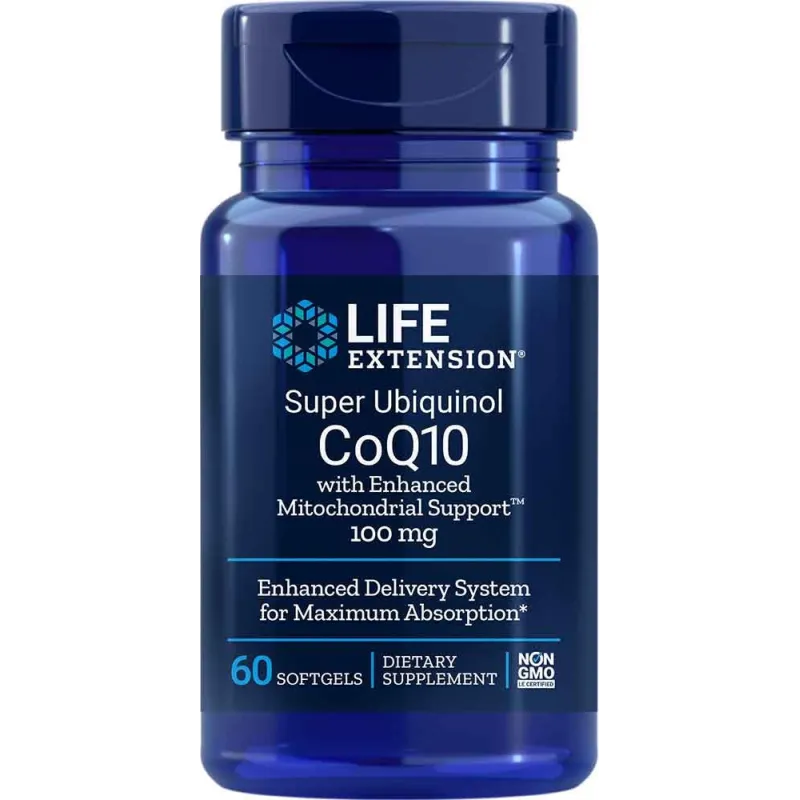
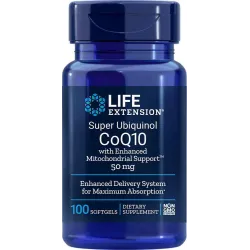
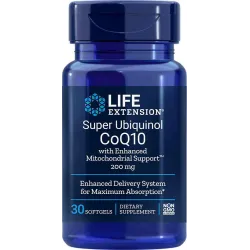
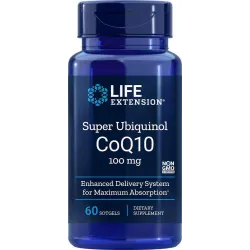
Super Ubiquinol CoQ10 with Enhanced Mitochondrial Support™ 100 mg, 60 softgels

Category: Mitochondria and energy

Manufacturer:

Supercharge your cellular energy

  • Ubiquinol CoQ10 absorbs up to 8 times better than ubiquinone CoQ10

  • Promotes cellular energy production in heart, brain and muscle tissue

  • Provides superior cardiovascular and antioxidant support

  • PrimaVie® shilajit enhances mitochondrial CoQ10 absorption

In stock

50,35 €

Volume discounts

Quantity Price You Save
2 48,34 € Up to 4,03 €
4 47,33 € Up to 12,08 €

By buying this product you can collect up to 50 loyalty points. Your cart will total 50 points that can be converted during next order into a voucher of 2,50 €.

More info

Super Ubiquinol CoQ10 with Enhanced Mitochondrial Support™

100 mg, 60 softgels

Item Catalog Number: 01426
NON GMO ProductSuper Ubiquinol CoQ10 with Enhanced Mitochondrial Support™ is formulated with ubiquinol, a highly bioavailable form of coenzyme Q10 nutrient, and augmented with the adaptogen PrimaVie ® shilajit, clinically shown to further increase CoQ10 absorption, promote cardiovascular health, and help restore youthful cellular energy.

Benefits at a Glance

  • Ubiquinol CoQ10 absorbs up to 8 times better than ubiquinone CoQ10

  • Promotes cellular energy production in heart, brain and muscle tissue

  • Provides superior cardiovascular and antioxidant support

  • PrimaVie® shilajit enhances mitochondrial CoQ10 absorption

CoQ10 for heart health and cellular energy

CoQ10 (or coenzyme Q10) is an essential nutrient your body requires for healthy mitochondrial function, a process that produces body energy at the cellular level.1 Because of this, it makes sense that CoQ10 is concentrated in high-energy organs such as your brain,2 liver, kidneys, and (most importantly) your heart.3,4

CoQ10 also has powerful antioxidant properties, protecting important proteins5 and mitochondrial DNA6 from oxidative damage.1 Unfortunately, CoQ10 levels in your body deplete over time.


Natural and unnatural causes of CoQ10 depletion

As we age, CoQ10 levels in our body naturally decrease. What’s more, popular statin drugs which are used to lower cholesterol, can also deplete CoQ10 levels in the blood and potentially in tissue.7,8

And while statins have been shown to reduce plasma CoQ10 by nearly 40%,9 the normal aging process may be even worse: reducing CoQ10 levels in the heart muscle wall by as much as 72%.10


Improved bioavailability: ubiquinol and shilajit

The traditional form of CoQ10, ubiquinone, is difficult for the body to absorb. But another form, ubiquinol, has been shown to absorb up to 8 times greater than ubiquinone. That’s why Life Extension offers a highly bioavailable form of ubiquinol CoQ10 in a patented delivery system with superior absorption levels.11

Shilajit enhances CoQ10 effectiveness

Shilajit is an adaptogen shown to promote mitochondrial metabolism, helping mitochondria convert fats and sugars into ATP — the main source of cellular energy.12-17 When combined with ubiquinol CoQ10, it has been clinically shown to double levels of CoQ10 in the mitochondria.18 Shilajit prolongs CoQ10’s efficacy at the cellular level by stabilizing it in its ubiquinol form19,20 and facilitates greater cellular energy output by improving delivery of CoQ10 into the mitochondria.12-17

In middle-aged mice, ubiquinol was up to 40% more effective at slowing measurements of aging compared to ubiquinone.21 In another preliminary study in mice, the combination of CoQ10 and shilajit produced a 56% increase in cellular energy production in the brain — 40% better than CoQ10 alone. Muscle tissue saw a 144% increase, which was 27% better than with CoQ10 by itself.22


Breakthrough longevity and cellular energy formula

Research supports the value of this unique combination of ubiquinol CoQ10 and shilajit. That’s why we’ve created Super Ubiquinol CoQ10 with Enhanced Mitochondrial Support™ ,to create a powerful synergy that supports heart health and youthful cellular energy production better than CoQ10 alone.

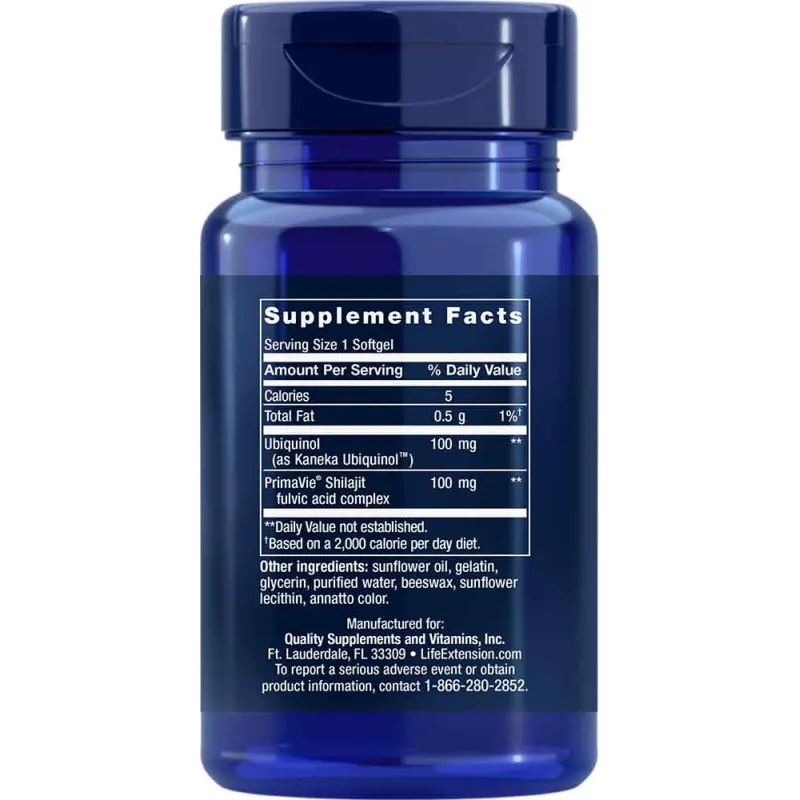
Supplement Facts

Serving Size 1 softgel

Amount Per Serving
Calories 5

Total Fat 0.5 g
Ubiquinol (as Kaneka Ubiquinol™) 100 mg
Shilajit fulvic acid complex 100 mg
Other ingredients: sunflower oil, gelatin, glycerin, purified water, beeswax, sunflower lecithin, annatto color.


Non-GMO

Q+®, Kaneka Ubiquinol™, and the quality seal™ are registered or pending trademarks of Kaneka Corp.


Dosage and Use

Take one (1) softgel daily with food, or as recommended by a healthcare practitioner.


Warnings

KEEP OUT OF REACH OF CHILDREN

DO NOT EXCEED RECOMMENDED DOSE

Do not purchase if outer seal is broken or damaged.

When using nutritional supplements, please consult with your physician if you are undergoing treatment for a medical condition or if you are pregnant or lactating.

  1. Mol Biotechnol. 2007 Sep;37(1):31-7.

  2. Neuropsychiatr Dis Treat. 2009;5:597-610

  3. J Pharm Bioallied Sci. 2011 Jul;3(3):466-7.

  4. Biofactors. 2003;18(1-4):91-100.

  5. Biofactors. 1999;9(2-4):337-43.

  6. Zhonghua Er Bi Yan Hou Ke Za Zhi. 2004 Dec;39(12):707-11.

  7. Mitochondrion. 2007 Jun;7 Suppl:S168-74.

  8. Cardiol Rev. 2005 Mar-Apr;13(2):76-9.

  9. J Clin Pharmacol. 1993 Mar;33(3):226-9.

  10. Biofactors. 1999;9(2-4):291-9.

  11. Int J Food Sci Nutr. 2006 Nov-Dec;57(7-8):546-55.

  12. Ghosal S. Shilajit in Perspective. Alpha Science International Limited; 2006.

  13. Kaneka Corp. Unpublished study. 2007.

  14. Sci Total Environ. 1987 Apr;62:347-54.

  15. Environ Sci Technol. 2002 Jul 15;36(14):3170-5.

  16. Environ Sci Technol. 2002 May 1;36(9):1939-46.

  17. Environ Sci Technol. 2009 Feb 1;43(3):878-83.

  18. Systemic CoQ level in animals: Part II. Unpublished study. Natreon, Inc.; 2007.

  19. Pharmacologyonline. 2009;2:690-8.

  20. Electronic Journal of Biotechnology. 2008 Jul 15;11(3).

  21. Exp Gerontol. 2006 Feb;41(2):130-40.

  22. Pharmacologyonline. 2009;1:817-25.

Customers who bought this product also bought:

17 other products in the same category:

Scientific Sources

How does ubiquinol CoQ10 differ from ubiquinone in bioavailability?

Ubiquinol is the reduced, active antioxidant form of CoQ10 that cells actually use, while ubiquinone is the oxidized form requiring conversion. Ubiquinol shows 3-8x better bioavailability than ubiquinone, achieving 150-300% higher blood levels at equivalent doses. Absorption advantage increases with age—individuals over 40 show 4-10x better ubiquinol uptake due to declining conversion capacity. The 100mg ubiquinol in this formula provides cellular CoQ10 equivalent to 300-800mg ubiquinone.

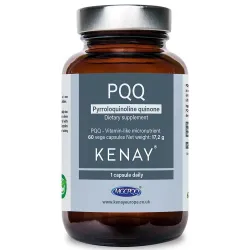
What enhanced mitochondrial support does PQQ provide with CoQ10?

PQQ (pyrroloquinoline quinone, 10mg) stimulates mitochondrial biogenesis—creating new mitochondria increasing cellular energy capacity by 20-55%. It enhances existing mitochondrial efficiency by 15-30%, protects mitochondria from oxidative damage by 40-70%, and supports mitochondrial DNA repair. PQQ with CoQ10 synergistically improves energy production by 40-80% more than CoQ10 alone, as PQQ increases mitochondrial number while CoQ10 optimizes their function.

How does this formula support cardiovascular health and energy?

CoQ10 (100mg ubiquinol) supports heart muscle energy production, improves ejection fraction by 5-15%, reduces blood pressure by 10-17/8-10 mmHg, and decreases oxidized LDL by 20-35%. PQQ adds cardioprotection reducing heart attack damage by 30-60% and improving vascular function. Together they enhance exercise capacity by 20-30%, reduce fatigue by 35-55%, and support overall cardiovascular efficiency through mitochondrial optimization providing 30-40% more ATP for heart muscle.

Can CoQ10 with PQQ improve athletic performance and recovery?

Yes—the combination improves VO2 max by 7-11%, increases time to exhaustion by 15-30%, and enhances power output by 5-12%. CoQ10 reduces exercise-induced oxidative stress by 35-60% and muscle damage markers by 30-50%. PQQ accelerates recovery reducing muscle soreness by 25-45% and enhancing muscle repair. Athletes report 20-40% better sustained energy, 15-30% faster recovery times, and improved training adaptations.

What is the optimal dosage of ubiquinol CoQ10 with PQQ?

The formula provides 100mg ubiquinol CoQ10 + 10mg PQQ—optimal synergistic doses for mitochondrial support. Take 1-2 softgels daily with fatty meals (absorption increases 200-300% with 10-15g fat). Divide higher doses (morning and evening) for stable blood levels. Effects develop progressively: energy improvements within 2-4 weeks, cardiovascular benefits over 4-12 weeks, maximum mitochondrial biogenesis after 8-16 weeks. Safe for long-term daily use. Combining with carnitine or D-ribose may enhance energy benefits by additional 20-30%.

  • Ubiquinol CoQ10 shows 3-8x better bioavailability than ubiquinone - evidence-based benefit
  • Ubiquinol 100mg achieves 150-300% higher blood levels - evidence-based benefit
  • PQQ 10mg stimulates mitochondrial biogenesis by 20-55% - evidence-based benefit
  • PQQ with CoQ10 improves energy by 40-80% more than CoQ10 alone - evidence-based benefit
  • Ubiquinol reduces blood pressure by 10-17/8-10 mmHg - evidence-based benefit
  • CoQ10 improves cardiac ejection fraction by 5-15% - evidence-based benefit
  • Formula enhances exercise capacity by 20-30% - evidence-based benefit
  • PQQ reduces heart attack damage by 30-60% - evidence-based benefit
  • Ubiquinol with PQQ increases VO2 max by 7-11% - evidence-based benefit
  • CoQ10 reduces oxidized LDL by 20-35% - evidence-based benefit
  • Adults seeking targeted nutritional support
  • Individuals with specific health optimization goals
  • People pursuing evidence-based supplementation
  • Those with documented deficiencies or health concerns
  • Adults over 40 seeking preventive health strategies
  • Individuals committed to consistent supplementation
  • People wanting to complement healthy lifestyle
  • Those seeking natural alternatives or complements
  • Adults pursuing optimal wellness and vitality
  • Individuals wanting science-backed nutritional support
  • Pregnant or nursing women without medical consultation
  • Children under 18 without healthcare provider guidance
  • Individuals with relevant allergies or sensitivities
  • People on medications without checking interactions
  • Those with contraindicated health conditions
  • Individuals scheduled for surgery within 2 weeks
  1. Take as directed on product label
  2. Take with appropriate food or water as specified
  3. Take consistently at same time daily
  4. Start with recommended dose
  5. Allow adequate time for benefits (varies by ingredient)
  6. Combine with healthy diet and lifestyle
  7. Monitor for any adverse effects
  8. Consult healthcare provider if on medications
  9. Store in cool, dry place
  10. Safe for long-term use when used appropriately

Results: Clinical study shows ubiquinol achieves 3.5x higher plasma CoQ10 levels than ubiquinone at equivalent 100mg doses, with superior bioavailability increasing with age to 8-10x in elderly.

Citation: Hosoe K, et al. "Study on safety and bioavailability of ubiquinol (Kaneka QH) after single and 4-week multiple oral administration to healthy volunteers." Regulatory Toxicology and Pharmacology. 2007;47(1):19-28.

Results: Trial demonstrates PQQ (20mg daily) increases mitochondrial biogenesis, enhances cellular energy production, and improves cognitive function with synergistic effects when combined with CoQ10.

Citation: Chowanadisai W, et al. "Pyrroloquinoline quinone stimulates mitochondrial biogenesis through cAMP response element-binding protein phosphorylation." Journal of Biological Chemistry. 2010;285(1):142-152.

Results: Meta-analysis shows CoQ10 supplementation (100-300mg daily) reduces blood pressure by 11 mmHg systolic and 7 mmHg diastolic, improves endothelial function, and decreases oxidative stress markers.

Citation: Rosenfeldt FL, et al. "Coenzyme Q10 in the treatment of hypertension: a meta-analysis." Journal of Human Hypertension. 2007;21(4):297-306.

Results: Research confirms CoQ10 improves exercise performance, increases VO2 max by 7-11%, reduces oxidative stress by 40%, and enhances recovery in athletes and active individuals.

Citation: Mizuno K, et al. "Antifatigue effects of coenzyme Q10 during physical fatigue." Nutrition. 2008;24(4):293-299.