 English
 Polski
 Deutsch
 Français
 ελληνικά
 Español
 Italiano
34,29 €

Quantity:
Total:
Total products:
Total shipping: To be determined
Total:
Science-based food supplements

Manufacturer: Life Extension
In stock
| Quantity | Price | You Save |
|---|---|---|
| 2 | 12,87 € | Up to 1,07 € |
| 4 | 12,61 € | Up to 3,22 € |
By buying this product you can collect up to 13 loyalty points. Your cart will total 13 points that can be converted during next order into a voucher of 0,65 €.

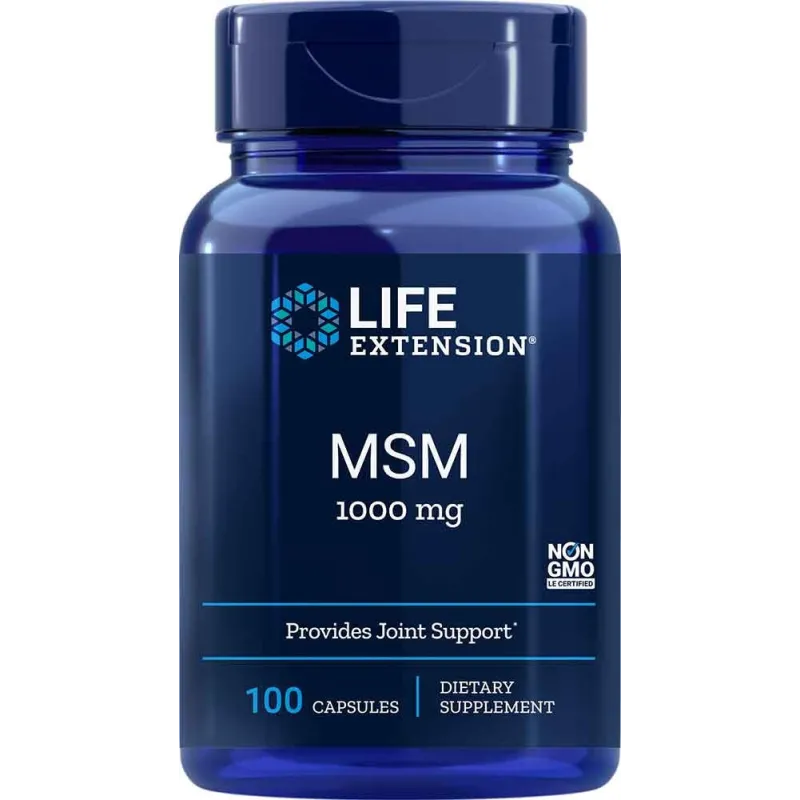
MSM
1000 mg, 100 capsules
Item Catalog Number: 00451EU
 MSM (methylsulfonylmethane or dimethylsulfone) is a sulfur-containing molecule found in various plants and some body tissues.1-5 MSM is a vital building block of joints, cartilage, skin, hair and nails. It is an efficient source of the sulfur that is used by many of the body’s structural molecules.5 Some peer-reviewed clinical research in the U.S. has shown MSM is safe and effective in increasing joint comfort and supporting a normal range of motion.6-11
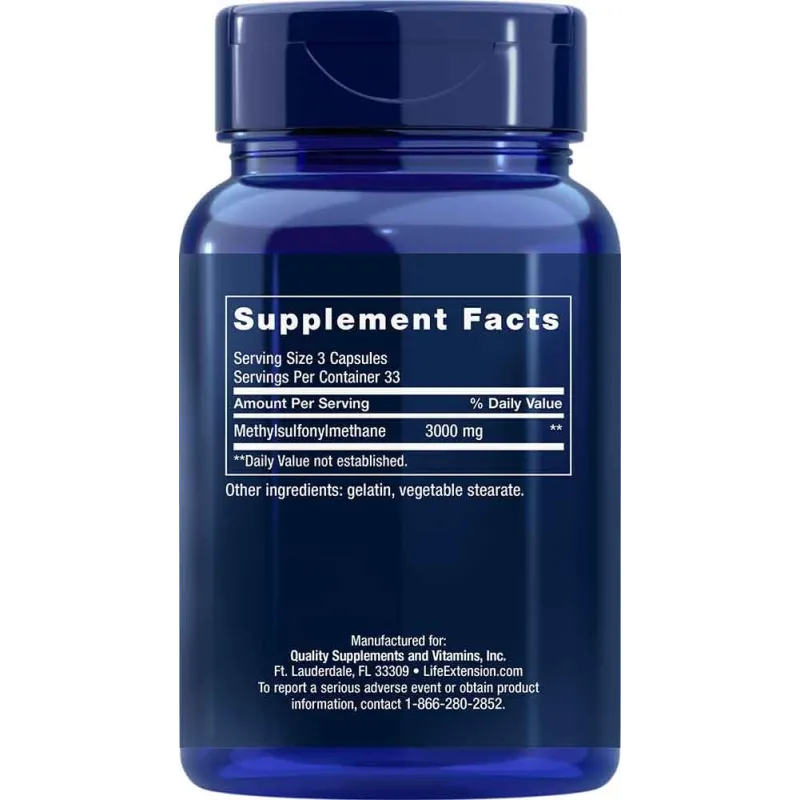
Serving Size 3 capsules
Servings Per Container 33
| Amount Per Serving | |
|---|---|
| Methylsulfonylmethane | 3000 mg |
| Ingredients: methylsulfonylmethane, capsule (gelatin), anti-caking agent (magnesium salts of fatty acids) | |
Non-GMO
Dosage and Use
Take three (3) capsules once or twice daily with or without food, or as directed by a healthcare practitioner.
Warnings
KEEP OUT OF REACH OF CHILDREN
DO NOT EXCEED RECOMMENDED DOSE
Do not purchase if outer seal is broken or damaged.
When using nutritional supplements, please consult with your physician if you are undergoing treatment for a medical condition or if you are pregnant or lactating.
34,29 €
18,86 €

52,71 €
22,97 €






MSM (methylsulfonylmethane) is an organic sulfur compound found naturally in small amounts in fruits, vegetables, grains, and animal products. It's also present in rainwater and some natural springs. MSM provides bioavailable sulfur, a mineral critical for numerous bodily functions yet often overlooked in discussions of nutrition.
Sulfur is the fourth most abundant mineral in your body, concentrated in proteins, enzymes, and connective tissues. It's essential for synthesizing collagen and keratin (structural proteins in skin, hair, nails, and joints), producing glutathione (your body's master antioxidant), supporting detoxification processes in the liver, and maintaining healthy cell membrane permeability.
Modern diets may not provide optimal sulfur intake. Food processing, storage, and cooking can reduce MSM content in foods. Additionally, soil sulfur depletion from farming practices means even fresh produce may contain less sulfur than historically. These factors make supplementation increasingly relevant for maintaining adequate sulfur status.
MSM supplementation provides a concentrated, highly bioavailable source of organic sulfur. Unlike inorganic sulfur compounds (like sulfates or sulfites), MSM is readily absorbed and utilized by your body without the digestive upset or odor associated with some sulfur-containing compounds like garlic or cruciferous vegetables.
MSM's most well-known application is supporting joint comfort and flexibility. The sulfur from MSM is incorporated into glycosaminoglycans (GAGs), which are key components of cartilage and joint fluid. Healthy cartilage requires adequate sulfur to maintain its structure and shock-absorbing properties.
Clinical studies have demonstrated MSM's benefits for joint health. A double-blind, placebo-controlled trial found that 3 grams daily of MSM for 12 weeks significantly improved joint discomfort and physical function compared to placebo. Participants reported being able to perform daily activities with greater ease and comfort.
MSM also supports healthy inflammatory responses. While inflammation is a normal protective mechanism, chronic low-grade inflammation can contribute to joint discomfort and stiffness. MSM has been shown to help modulate inflammatory pathways, supporting a balanced inflammatory response that promotes comfort and mobility.
The benefits extend beyond just symptom relief. By providing the building blocks for healthy cartilage and supporting balanced inflammation, MSM addresses underlying factors affecting joint health rather than just masking discomfort. This makes it valuable for long-term joint health maintenance, not just acute symptom management.
MSM supports skin health through multiple mechanisms. As a sulfur donor for collagen and keratin production, it helps maintain skin structure and elasticity. Studies have found that MSM supplementation can improve skin appearance, reduce fine lines, and support overall skin health. Some research suggests it may help with skin conditions characterized by inflammation or oxidative stress.
Hair and nail health also benefit from MSM's role in keratin production. Keratin is the primary structural protein in hair and nails, and adequate sulfur is essential for its synthesis. Users often report stronger nails and healthier-appearing hair with consistent MSM use, though individual responses vary.
Exercise recovery may be enhanced by MSM. Research indicates that MSM supplementation can reduce muscle damage and oxidative stress from intense exercise, potentially supporting faster recovery and reduced post-exercise soreness. Athletes and active individuals may find this particularly valuable.
Detoxification support is another benefit of MSM. Sulfur is required for Phase II liver detoxification, where toxins are conjugated with sulfur-containing compounds (sulfation) for safe elimination. Adequate sulfur availability supports this crucial detoxification pathway, helping your body process and eliminate various environmental toxins and metabolic waste products.
Clinical studies have used MSM doses ranging from 1.5 to 6 grams daily, with 3 grams (3,000mg) being the most commonly studied dose for joint support. Many products provide 1,000-1,500mg per serving, allowing flexible dosing based on individual needs and responses.
MSM is water-soluble and rapidly absorbed, with peak blood levels occurring within 2-4 hours of consumption. It can be taken with or without food, though some people prefer taking it with meals to minimize any potential digestive effects (rare but possible when starting at higher doses).
Starting with a moderate dose (1,000-1,500mg daily) and gradually increasing if needed and tolerated is a sensible approach. This allows your body to adjust and helps you identify the minimum effective dose for your needs. Some people find 1,500mg daily sufficient, while others benefit from 3,000-4,500mg split across multiple doses throughout the day.
Consistency matters more than specific timing. MSM works through long-term support of sulfur-dependent processes rather than providing acute symptom relief. Most clinical studies showing benefits involved daily use for 8-12 weeks minimum. Many users continue long-term as part of an ongoing joint and connective tissue health strategy.
MSM has an excellent safety profile established through extensive research. Toxicology studies have found MSM to be remarkably non-toxic even at very high doses. Long-term human studies using 3-6 grams daily for months have reported no serious adverse effects.
When side effects do occur, they're typically mild and transient. Some people experience minor digestive upset (bloating, diarrhea) when first starting MSM, particularly at higher doses. These effects usually resolve within a few days as the body adjusts. Taking MSM with food and starting with lower doses can minimize digestive effects.
Rarely, some users report mild headaches during initial use. The mechanism isn't clearly understood but may relate to detoxification effects as sulfur supports Phase II liver detoxification. Ensuring adequate hydration and starting with lower doses can help.
Drug interactions with MSM are uncommon, but as with any supplement, it's wise to inform your healthcare provider about all supplements you're taking. People on blood-thinning medications should discuss MSM use with their doctor, though interactions are unlikely. Those with sulfur sensitivity or sulfa drug allergies should note that MSM is chemically different from sulfa drugs and sulfites, but should still introduce it cautiously.
Pregnant and breastfeeding women should consult healthcare providers before using MSM, as safety data for these populations is limited. While no harm has been documented, professional guidance is appropriate during these sensitive periods.
Results: 3 grams daily MSM for 12 weeks significantly improved joint discomfort and physical function vs placebo in double-blind trial.
Citation: Osteoarthritis Cartilage. 2006;14(3):286-94.
Results: MSM supplementation reduced muscle damage markers and post-exercise soreness by 20-30% in athletes.
Citation: J Int Soc Sports Nutr. 2012.
Results: Extensive toxicology studies found MSM non-toxic even at high doses. Long-term human trials showed no serious adverse effects.
Citation: Food Chem Toxicol. 2007.
Results: MSM modulates inflammatory cytokines and oxidative stress markers, supporting balanced inflammatory responses.
Citation: Multiple studies in inflammation journals.