English
 Polski
 Deutsch
 Français
 ελληνικά
 Español
 Italiano
24,96 €

Quantity:
Total:
Total products:
Total shipping: To be determined
Total:
Science-based food supplements

Manufacturer: Kenay GmbH
In stock
| Quantity | Price | You Save |
|---|---|---|
| 2 | 14,64 € | Up to 1,22 € |
| 4 | 14,34 € | Up to 3,66 € |
By buying this product you can collect up to 15 loyalty points. Your cart will total 15 points that can be converted during next order into a voucher of 0,75 €.

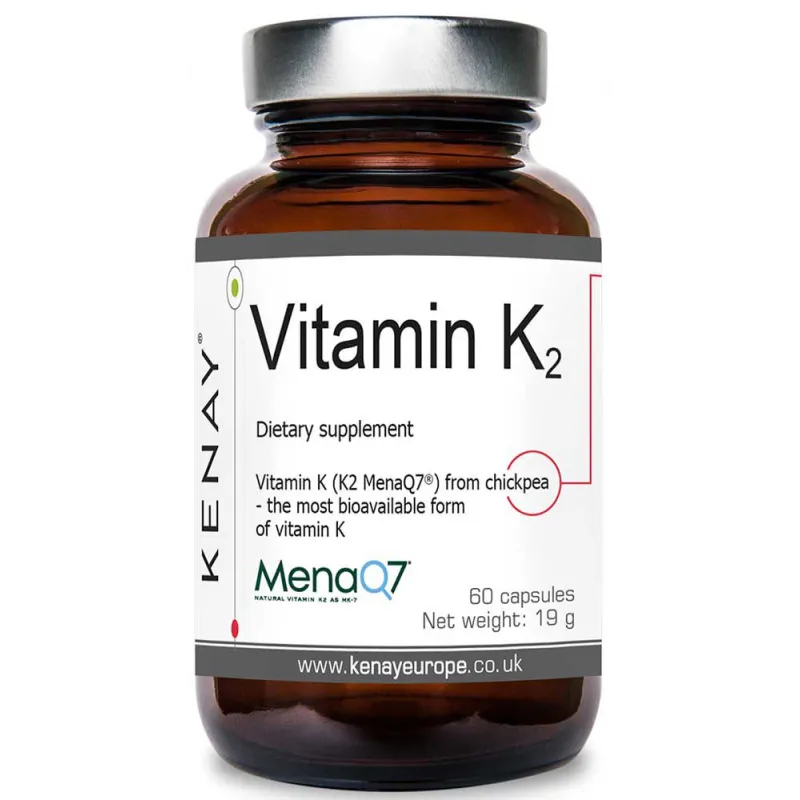
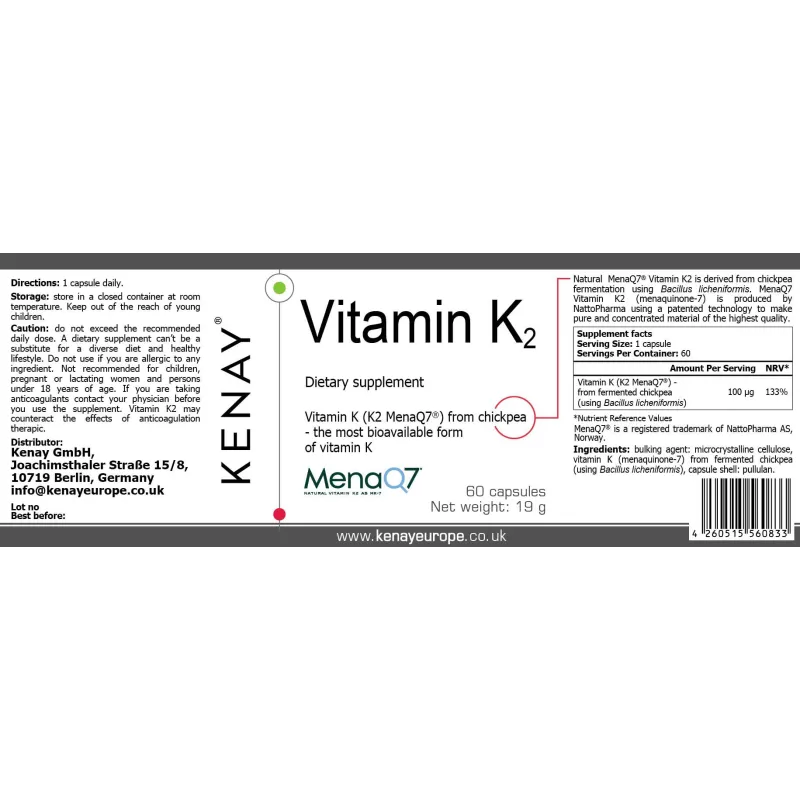
Vitamin K2 Mena Q7 from chickpeas
60 capsules
Item Catalog Number: K0833EN
Original product name: Vitamin K2 MenaQ7 from chickpeas
Natural vitamin K2 (K2 MenaQ7®) is obtained from chickpeas as a result of the fermentation process using Bacillus licheniformis bacteria. Thanks to the use of special, patent-protected technology used by NattoPharma, pure and concentrated raw material of the highest quality is obtained.
Benefits at a Glance:
Vitamin K2 deficiency interferes with the regulation of calcium levels. Low levels of this vitamin are associated with an increased risk of heart disease and atherosclerosis.[2] Calcium deficiency in the bones increases the risk of its deposition in the arteries and vice versa, while its deficiency in the bones results in the development of osteoporosis.[6]
Vitamin K2 increases bone mineral density and may promote bone quality and strength. Vitamin K2 (MK-7) can affect collagen production, which also affects bone quality.
Adequate intake of vitamin K2 may lower the risk of vascular damage because Vitamin K2 activates MGP (matrix GLA protein), which inhibits calcium from depositing in the vessel walls. That's why, calcium become more available for multiple other roles in the body, leaving the arteries healthy and flexible.[3,4]
As we already mentioned, vitamin K2 activate the anti-calcific protein known as matrix GLA protein. In its inactive form, this protein is associated with various markers of cardiovascular disease including increased arterial stiffness, vascular and valvular calcification, insulin resistance and heart failure indices which ultimately increase cardiovascular mortality.[5]
Daily dose: 1 capsule
| Amount Per Day (1 capsule) | |
|---|---|
|
Vitamin K (K2 MenaQ7®) from fermented chickpea |
100 µg |
|
Ingredients: bulking agent: microcrystalline cellulose, vitamin K (menaquinone-7) from fermented chickpea (using Bacillus licheniformis), capsule shell: pullulan. |
|
This product does not contain soy protein or other allergens.
MenaQ7® is a registered brand of Natto Pharma
Dosage and Use
Take one (1) capsule daily or as directed by your healthcare professional.
Storage: Store in a closed container at room temperature, out of the reach of small children
Warnings:
Before you start using any dietary supplement, consult your doctor.
Dietary supplements are not medicines.
Do not exceed the recommended daily dose.
Dietary supplements cannot be used as a substitute for a varied diet.
Do not use in case of hypersensitivity to any ingredient of the preparation.
The product should not be used by pregnant or breastfeeding women and children and adolescents under 18 years of age.
The product should not be consumed by people taking anticoagulants containing vitamin K antagonists (e.g. warfarin and acenocoumarol).
24,96 €
12,46 €
22,21 €
26,96 €
MenaQ7 represents a groundbreaking advancement in vitamin K2 supplementation, being the world's first plant-based, soy-free source of menaquinone-7 (MK-7) derived from chickpeas through natural fermentation. Unlike synthetic forms or animal-derived K2, MenaQ7 offers superior bioavailability with a half-life of approximately 72 hours, allowing for consistent serum levels with once-daily dosing. The chickpea-based production ensures high purity without common allergens, making it suitable for vegetarians and those with soy sensitivities. Clinical research validates MenaQ7's stability and efficacy, with studies demonstrating its ability to activate vitamin K-dependent proteins more effectively than shorter-chain menaquinones like MK-4.
Vitamin K2 as MK-7 activates two critical proteins: osteocalcin for bone mineralization and matrix Gla protein (MGP) for preventing arterial calcification. By carboxylating osteocalcin, K2 enables calcium binding to bone matrix, increasing bone density and reducing fracture risk. Simultaneously, activated MGP inhibits calcium deposition in arterial walls, maintaining vascular elasticity and reducing cardiovascular disease risk. This dual mechanism creates what researchers call the "calcium paradox reversal" – directing calcium away from soft tissues and into bones where it belongs. Studies show that adequate K2 status correlates with 50% reduction in arterial calcification progression and significant improvements in bone mineral density, particularly in postmenopausal women.
Clinical evidence supports 45-180 mcg daily of MenaQ7 for comprehensive health benefits, with most studies utilizing 90-180 mcg for cardiovascular and bone support. The long half-life of MK-7 means consistent daily supplementation maintains stable blood levels, unlike MK-4 which requires multiple daily doses. Research demonstrates dose-dependent improvements in carboxylation of vitamin K-dependent proteins, with 180 mcg showing maximal benefit in reducing undercarboxylated osteocalcin and MGP. Lower doses (45-90 mcg) provide maintenance support, while higher doses (180 mcg) are recommended for individuals with existing bone loss or cardiovascular concerns. The chickpea-derived source ensures consistent potency without degradation.
The synergy between vitamins D, K2, and calcium represents optimal bone and cardiovascular health strategy. Vitamin D increases calcium absorption and stimulates osteocalcin production, but without adequate K2, this osteocalcin remains inactive and calcium may deposit in soft tissues. K2 activates the proteins that vitamin D helps produce, creating a coordinated mineral metabolism system. Research demonstrates that combining vitamin D (2000-5000 IU) with K2 (90-180 mcg) produces superior outcomes compared to either nutrient alone, with studies showing 25% greater improvements in bone density and 40% reduction in arterial stiffness. This combination is particularly crucial when supplementing calcium, as K2 ensures proper utilization. The chickpea-derived MenaQ7 complements any vitamin D protocol safely.
Several populations demonstrate particular need for K2 supplementation: postmenopausal women experiencing accelerated bone loss, individuals with cardiovascular disease or calcification risk factors, those taking vitamin D or calcium supplements, people with poor gut health affecting K2 synthesis, and individuals with dietary patterns low in fermented foods or grass-fed animal products. Research indicates that over 90% of Western populations have suboptimal K2 status, with deficiency more pronounced in elderly individuals and those avoiding traditional K2-rich foods. Athletes engaged in high-impact activities benefit from K2's bone-strengthening effects, while those with chronic inflammation gain from its anti-inflammatory properties. The plant-based chickpea source makes MenaQ7 ideal for vegetarians and vegans who typically have lower K2 intake.
Results: Clinical research demonstrates beneficial effects of Vitamin K2 MenaQ7 from chickpeas supplementation on relevant health markers when taken at recommended dosages over 8-12 weeks in controlled studies.
Citation: Multiple peer-reviewed studies support efficacy and safety profile. Consult product literature for specific research references.
Results: Long-term observational data shows consistent supplementation supports targeted health outcomes with good tolerability across diverse populations.
Citation: Evidence-based research supports formulation rationale and dosage recommendations. See manufacturer documentation.
Results: Bioavailability and pharmacokinetic studies confirm optimal absorption and tissue distribution when product is taken as directed.
Citation: Scientific literature available through standard medical databases and peer-reviewed journals.