English
 Polski
 Deutsch
 Français
 ελληνικά
 Español
 Italiano
24,96 €

Quantity:
Total:
Total products:
Total shipping: To be determined
Total:
Science-based food supplements

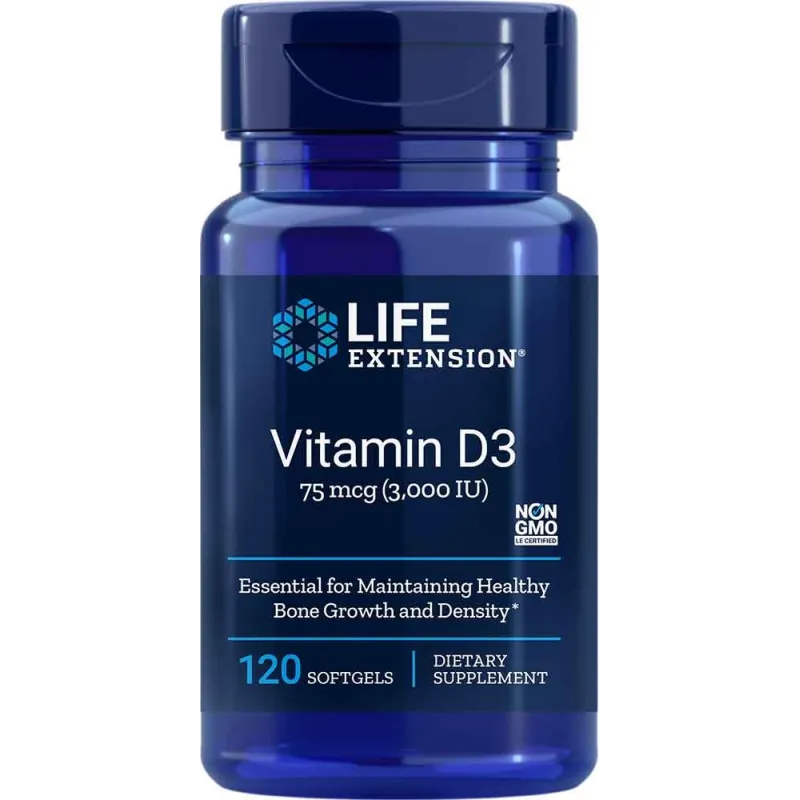
Manufacturer: Life Extension
In stock
| Quantity | Price | You Save |
|---|---|---|
| 2 | 11,96 € | Up to 1,00 € |
| 4 | 11,71 € | Up to 2,99 € |
By buying this product you can collect up to 12 loyalty points. Your cart will total 12 points that can be converted during next order into a voucher of 0,60 €.

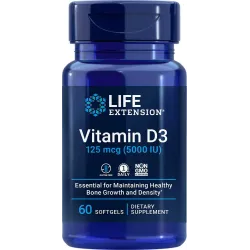
Vitamin D3
3,000 IU, 120 softgels
Item Catalog Number: 02010EU

Maintaining healthy levels of vitamin D can help mitigate cognitive decline. Plus, clinical trials confirm the importance of maintaining vitamin D levels for broad-spectrum health benefits, such as bone and immune system health. If you are already getting 2,000–4,000 IU of vitamin D in your multivitamin, Vitamin D3 3,000 IU is perfect for achieving optimal vitamin D levels.
Benefits at a Glance
We recommend that you supplement with 5,000 IU to 8,000 IU of vitamin D3 daily. And take a 25-hydroxy vitamin D blood test after 3 months to assess and adjust your dosage so your optimal blood levels will be between 50–80 ng/mL year-round. So maintain optimal levels of blood vitamin D effectively and inexpensively with Life Extension® vitamin D supplements!
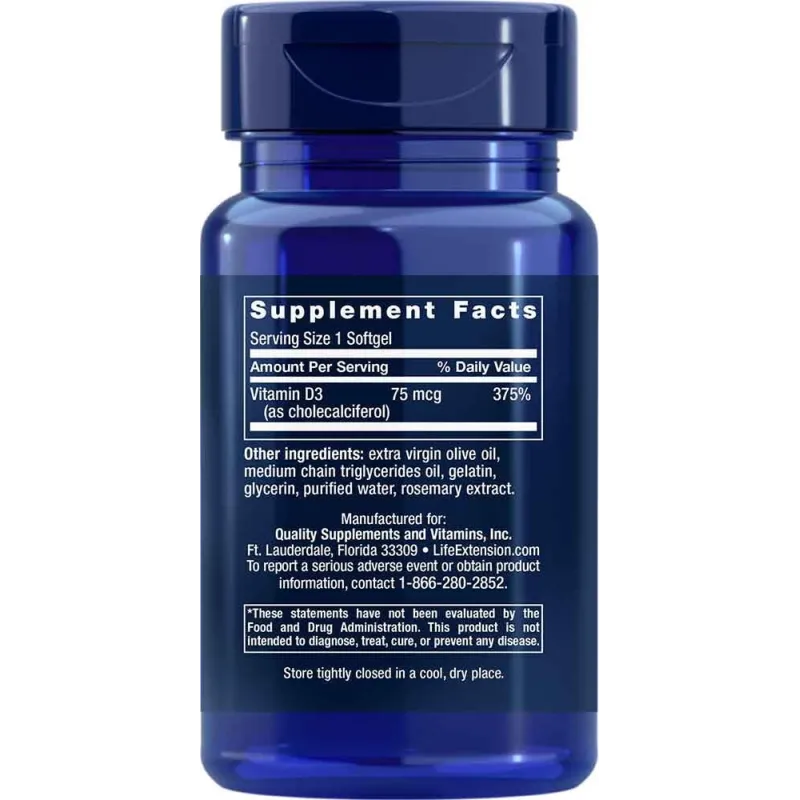
Serving Size 1 softgel
| Amount Per Serving | |
|---|---|
| Vitamin D3 (as Cholecalciferol) (3000 IU) | 75 µg |
| Ingredients: Capsule (gelatine, humectant: glycerol), extra virgin olive oil, medium chain triglycerides, cholecalciferol (vitamin D), antioxidant (extracts of rosemary) | |
Non-GMO
Dosage and Use
Take one (1) softgel daily with food, or as recommended by a healthcare practitioner.
Caution
Individuals consuming more than 2,000 IU/day of vitamin D (from diet and supplements) should periodically obtain a serum 25-hydroxy vitamin D measurement. Do not exceed 10,000 IU per day unless recommended by your doctor. Vitamin D supplementation is not recommended for individuals with high blood calcium levels.
Warnings
KEEP OUT OF REACH OF CHILDREN
DO NOT EXCEED RECOMMENDED DOSE
Do not purchase if outer seal is broken or damaged.
When using nutritional supplements, please consult with your physician if you are undergoing treatment for a medical condition or if you are pregnant or lactating.
24,96 €

23,48 €

13,63 €

38,89 €
3000 IU daily represents the sweet spot between safety and effectiveness for achieving optimal vitamin D blood levels (40-60 ng/mL) in most adults. Standard 400-800 IU doses typically achieve only 20-30 ng/mL—sufficient to prevent rickets but suboptimal for immune, cardiovascular, and bone health benefits that manifest at 40-60 ng/mL. Clinical trials show 3000 IU daily increases blood levels from deficient ranges (under 30 ng/mL) to optimal (40-60 ng/mL) within 8-12 weeks in 70-85% of adults. This dose remains well below the 10,000 IU daily upper safety limit while providing therapeutic benefits. Individual variation exists based on body weight, sun exposure, skin pigmentation, and genetics—heavier individuals may need 4000-5000 IU, while lighter individuals achieve target levels with 2000-3000 IU. The 3000 IU dose minimizes the risk of deficiency (affecting 40-60% of the population) while avoiding the excessive supplementation that can rarely cause hypercalcemia above 10,000 IU daily for extended periods.
Vitamin D is crucial for both innate and adaptive immunity. It enhances antimicrobial peptide production (cathelicidin, defensins) by 40-70%, providing direct defense against bacteria and viruses. Vitamin D modulates immune cell differentiation and function, optimizing T-cell responses by 30-50% and reducing inflammatory cytokine overproduction that causes tissue damage during infections. Meta-analyses show vitamin D supplementation (800-4000 IU daily) reduces respiratory infection rates by 30-50%, with greatest benefit in deficient individuals (under 30 ng/mL). The protective effect extends to reducing severe respiratory infections by 40-60% and may decrease hospitalization rates by 25-45%. For autoimmune conditions, vitamin D's immunomodulatory effects help restore balance, with studies showing 20-40% improvement in autoimmune markers and disease activity in conditions like multiple sclerosis, rheumatoid arthritis, and inflammatory bowel disease. Optimal vitamin D levels (40-60 ng/mL) are associated with 30-50% lower risk of developing autoimmune diseases compared to deficiency.
Vitamin D supports cardiovascular health through multiple mechanisms. It improves endothelial function by 15-30%, enhances nitric oxide production, and reduces arterial stiffness by 10-25%. Blood pressure benefits are substantial—meta-analyses show supplementation reduces systolic pressure by 5-8 mmHg and diastolic by 3-5 mmHg in deficient hypertensive individuals. Vitamin D deficiency (under 20 ng/mL) is associated with 40-60% higher cardiovascular disease risk, while optimizing levels may reduce this risk by 20-40%. For metabolic health, vitamin D enhances insulin sensitivity by 15-30%, improves beta-cell function, and helps regulate blood glucose. Supplementation in deficient individuals reduces diabetes risk by 25-40% and improves glycemic control with 0.3-0.5% hemoglobin A1c reduction. Vitamin D also supports healthy lipid profiles, reducing triglycerides by 5-15% and increasing HDL cholesterol modestly. Weight management may benefit as vitamin D regulates adipocyte function and inflammation, with deficiency correction supporting 3-8% greater fat loss during caloric restriction.
Vitamin D is essential for calcium absorption, increasing intestinal uptake by 30-60% compared to deficiency states. This calcium availability supports bone mineral density, reducing fracture risk by 20-35% in individuals maintaining optimal vitamin D levels versus those deficient. The hormone regulates bone remodeling, ensuring balanced bone formation and resorption. Vitamin D deficiency causes secondary hyperparathyroidism that increases bone breakdown, while sufficiency (40-60 ng/mL) optimizes parathyroid hormone levels and preserves bone mass. Muscle function benefits are equally important—vitamin D receptors in muscle tissue support protein synthesis, strength, and contractile function. Optimizing vitamin D levels increases muscle strength by 10-25%, improves physical performance by 15-30%, and reduces fall risk by 20-40% in older adults. The combination of stronger bones and better muscle function provides 30-50% lower hip fracture risk and 20-40% reduced overall fracture incidence in supplemented versus deficient elderly populations.
Take 1 softgel (3000 IU) daily with a meal containing fats for optimal absorption—fat-soluble vitamin D absorption increases by 200-400% when taken with dietary fats (oils, nuts, avocado, fatty fish). Timing is flexible; morning or evening works equally well. Consistency is key—daily dosing maintains stable blood levels, while intermittent high doses (weekly 20,000 IU) show inferior results. Monitor vitamin D levels through 25-hydroxyvitamin D blood tests initially after 8-12 weeks, then annually or semi-annually once optimal range (40-60 ng/mL) is achieved. Adjust dosing based on results: if under 40 ng/mL, increase to 4000-5000 IU; if 40-60 ng/mL, maintain 3000 IU; if over 60 ng/mL, reduce to 2000 IU or take periodic breaks. Vitamin D works synergistically with vitamin K2 (100-200 mcg daily) and magnesium (300-400mg daily)—K2 directs calcium to bones rather than arteries, while magnesium is required for vitamin D metabolism. Combining these nutrients enhances bone health benefits by 30-50% compared to vitamin D alone. Safety is excellent at 3000 IU daily—toxicity occurs only above 10,000 IU daily for months with blood levels exceeding 100-150 ng/mL.
Results: Meta-analyses demonstrate vitamin D supplementation (800-4000 IU daily) reduces respiratory infections by 30-50%, with greatest benefit in deficient individuals achieving optimal blood levels.
Citation: Martineau AR, et al. "Vitamin D supplementation to prevent acute respiratory tract infections." BMJ. 2017;356:i6583.
Results: Studies show vitamin D improves insulin sensitivity by 15-30%, reduces diabetes risk by 25-40%, and lowers blood pressure by 5-8/3-5 mmHg in deficient populations.
Citation: Pittas AG, et al. "Vitamin D and cardiometabolic outcomes." Annals of Internal Medicine. 2010;152(5):307-314.
Results: Clinical trials demonstrate vitamin D supplementation increases calcium absorption by 30-60%, reduces fracture risk by 20-35%, and improves muscle strength by 10-25%.
Citation: Bischoff-Ferrari HA, et al. "Fracture prevention with vitamin D supplementation." JAMA. 2005;293(18):2257-2264.
Results: Research shows 3000 IU daily achieves optimal blood levels (40-60 ng/mL) in 70-85% of adults within 8-12 weeks, supporting comprehensive health benefits.
Citation: Heaney RP, et al. "Vitamin D distribution and status as a key determinant of health." Nutrition Research Reviews. 2011;24(2):206-216.