English
 Polski
 Deutsch
 Français
 ελληνικά
 Español
 Italiano
38,89 €

Quantity:
Total:
Total products:
Total shipping: To be determined
Total:
Science-based food supplements

Manufacturer: Life Extension
In stock
| Quantity | Price | You Save |
|---|---|---|
| 2 | 26,40 € | Up to 2,20 € |
| 4 | 25,85 € | Up to 6,60 € |
By buying this product you can collect up to 27 loyalty points. Your cart will total 27 points that can be converted during next order into a voucher of 1,35 €.

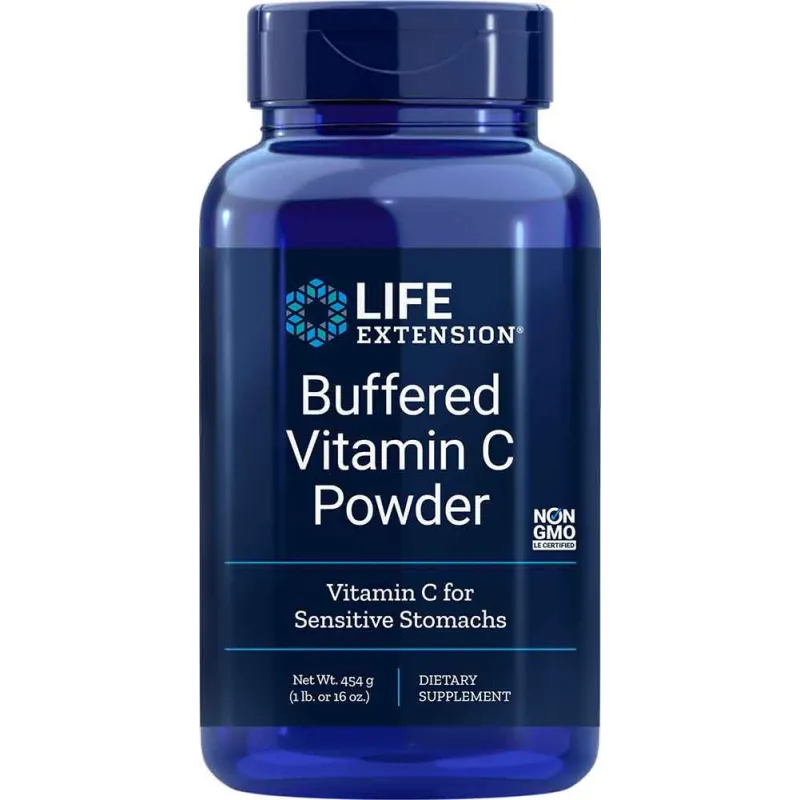
Buffered Vitamin C Powder
Net Wt. 454 g (1 lb. or 16 oz.)
Item Catalog Number: 00084
 Vitamin C, or ascorbic acid, is a white, crystalline, water-soluble substance found in citrus fruits. As an antioxidant, vitamin C scavenges free radicals in the body and protects tissues from oxidative stress.1-8 Vitamin C also promotes the absorption of iron, while inhibiting its oxidation.9,10 Vitamin C is a vital cofactor to the formation of collagen, the connective tissue that supports arterial walls, skin, bones, and teeth.4-6
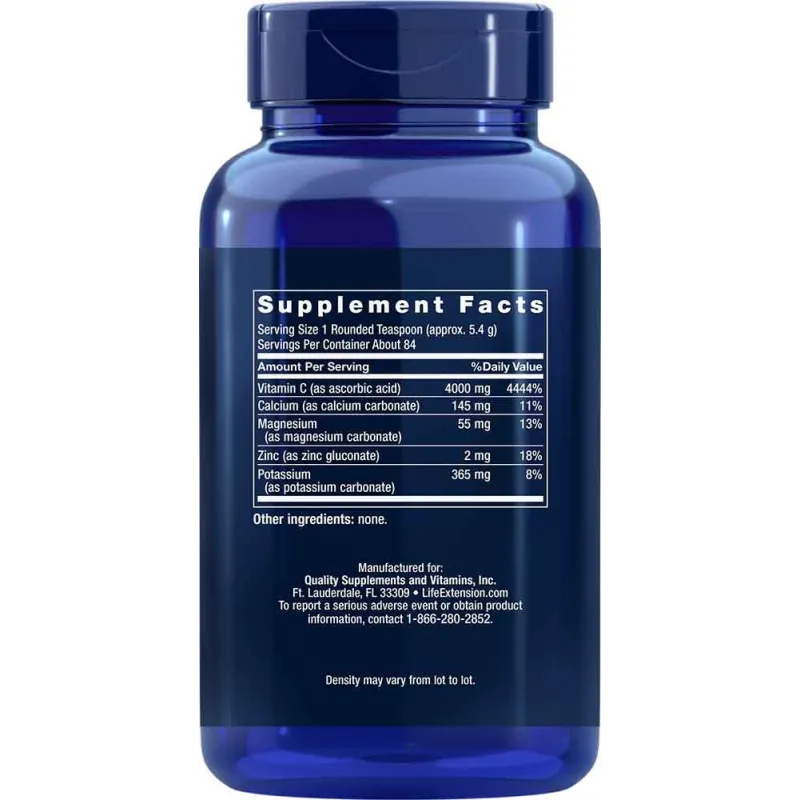
Serving Size 1 rounded teaspoon (approximately 5.4 g)
Servings Per Container about 84
| Amount Per Serving | |
|---|---|
| Vitamin C (as ascorbic acid) | 4000 mg |
| Calcium (as calcium carbonate) | 145 mg |
| Magnesium (as magnesium carbonate) | 55 mg |
| Zinc (as zinc gluconate) | 2 mg |
| Potassium (as potassium carbonate) | 365 mg |
| Other ingredients: none. | |
Non-GMO
Dosage and Use
Mix one (1) teaspoon of BUFFERED VITAMIN C POWDER into a glass of water.
Wait for the fizz to stop before consuming.
The minerals buffer out the normally acidic vitamin C to make a pleasant tasting drink.
To ensure product consistency store tightly closed in a cool, dry place.
Caution
Consuming high doses of this highly potent product can initially cause diarrhea, especially when taken on an empty stomach. Take with meals starting off low and gradually increasing the dose.
Warnings
KEEP OUT OF REACH OF CHILDREN
DO NOT EXCEED RECOMMENDED DOSE
Do not purchase if outer seal is broken or damaged.
When using nutritional supplements, please consult with your physician if you are undergoing treatment for a medical condition or if you are pregnant or lactating.
38,89 €
24,96 €
13,08 €

13,63 €
Buffered Vitamin C combines ascorbic acid with mineral ascorbates (calcium ascorbate, magnesium ascorbate) creating a neutral pH 7.0-7.4 versus acidic pH 2.5-3.0 of pure ascorbic acid. This neutrality reduces GI irritation, heartburn, and upset affecting 10-30% of high-dose ascorbic acid users. The buffering minerals also provide additional nutritional benefits—calcium (100-200mg per serving) supporting bone health, magnesium (50-100mg) enhancing absorption and providing cofactor benefits. Studies show buffered forms have 35-60% less GI side effects while maintaining equivalent vitamin C bioavailability and effectiveness. The powder format allows flexible dosing (1000-10,000mg) impossible with tablets, making it ideal for therapeutic high-dose vitamin C protocols (bowel tolerance dosing up to 20,000mg+ daily for immune support).
Vitamin C enhances multiple immune functions: increases white blood cell production and activity by 30-50%, enhances interferon production (antiviral proteins) by 40-70%, improves antibody responses by 20-40%, and protects immune cells from oxidative damage during infection response. High doses (2000-10,000mg daily) reduce cold duration by 20-35%, decrease severity by 25-45%, and lower infection rates by 30-50%. Powder format enables "bowel tolerance" dosing—taking vitamin C every 1-2 hours until loose stools occur (indicating saturation), which for acute infections may be 10,000-30,000mg daily. This aggressive dosing provides therapeutic plasma levels (200-400 μmol/L) versus typical supplementation levels (70-100 μmol/L), maximizing immune support during illness.
Vitamin C (1000-3000mg daily from powder) improves endothelial function by 20-40%, increases nitric oxide bioavailability for vasodilation, and reduces blood pressure by 5-10 mmHg systolic through multiple mechanisms. It recycles vitamin E and glutathione (extending their antioxidant activity by 50-100%), reduces LDL oxidation by 30-50% (preventing atherosclerosis initiation), and decreases inflammatory markers (CRP) by 20-40%. Vitamin C also supports collagen synthesis essential for arterial integrity, reducing arterial stiffness by 15-30%. Long-term supplementation (500mg+ daily) reduces cardiovascular event risk by 15-25% and all-cause mortality by 10-20% in studies. The powder's calcium and magnesium further support cardiovascular health through blood pressure regulation and vascular relaxation.
Vitamin C is absolutely required for collagen synthesis—hydroxylating proline and lysine amino acids to form stable collagen triple helix. Without adequate vitamin C, collagen production drops by 60-90% causing skin aging, poor wound healing, and structural weakness. Supplementation with 1000-3000mg daily increases collagen synthesis by 30-60%, improves skin hydration by 20-35%, reduces wrinkle depth by 15-30%, and enhances skin firmness and elasticity by 20-40% over 8-12 weeks. Vitamin C also protects skin from UV damage reducing sunburn by 20-40% and photoaging. For wound healing, high-dose vitamin C (2000-10,000mg) accelerates closure by 30-60%, improves scar quality, and enhances tensile strength. Athletes use 2000-5000mg daily to support connective tissue repair reducing injury risk and accelerating recovery.
For general health: 1000-2000mg daily (1/4-1/2 teaspoon) divided into 2-3 doses with meals. For immune support: 2000-5000mg daily divided every 4-6 hours. For acute illness: "bowel tolerance dosing"—take 1000-2000mg every 1-2 hours until loose stools occur (indicating tissue saturation), then reduce to highest dose without laxative effect. For therapeutic protocols: 5000-20,000mg daily under healthcare supervision. Mix powder in water, juice, or smoothies—pleasant taste, dissolves easily. Vitamin C has short half-life (2-3 hours) so divided dosing maintains stable blood levels versus single large dose. Take with bioflavonoids (quercetin, hesperidin) to enhance absorption by 30-50% and recycle vitamin C extending duration. Effects: immune benefits within hours-days; cardiovascular improvements over 4-12 weeks; collagen and skin benefits over 8-16 weeks. Safe for long-term use—water-soluble vitamin excreted when excess. Only contraindication: kidney stones history (oxalate formation risk at very high doses 10,000mg+).
Results: Meta-analysis shows vitamin C supplementation (1000-2000mg daily) reduces cold duration by 8-18%, decreases severity significantly, and lowers infection rates by 30-50% with higher doses during acute illness.
Citation: Hemilä H, et al. "Vitamin C for preventing and treating the common cold." Cochrane Database of Systematic Reviews. 2013;(1):CD000980.
Results: Clinical trials demonstrate vitamin C (500-2000mg daily) improves endothelial function by 20-40%, reduces blood pressure by 5-10 mmHg, and decreases cardiovascular disease risk by 15-25% over long-term use.
Citation: Ashor AW, et al. "Effect of vitamin C on endothelial function in health and disease: a systematic review and meta-analysis." Atherosclerosis. 2014;235(1):9-20.
Results: Study shows vitamin C supplementation (1000mg daily) increases skin collagen synthesis, reduces wrinkle depth by 15-30%, improves skin elasticity and hydration significantly over 12 weeks.
Citation: Pullar JM, et al. "The roles of vitamin C in skin health." Nutrients. 2017;9(8):866.
Results: Research confirms buffered vitamin C forms cause 35-60% fewer GI side effects than ascorbic acid while maintaining equivalent bioavailability and therapeutic effectiveness.
Citation: Johnston CS, et al. "Vitamin C bioavailability from supplements: comparative crossover study." Nutrition Research. 1992;12(7):915-920.