
 English
 Polski
 Deutsch
 Français
 ελληνικά
 Español
 Italiano
Maximize the Effects of Vitamin C
Humans can't producetheir own vitamin C, which is why it's important to get it daily from outside sources.1
But there's a problem: When people take large doses of vitamin C, most of it is poorly absorbed and quickly excreted.1,2
Scientists have found a solution.
To deliver more vitamin C to the body, researchers combined it with plant-based compounds that improve its absorption by nearly seven times compared to unformulated regular vitamin C.3
This formula also keeps vitamin C levels elevated for far longer than standard vitamin C, maximizing the amount our bodies can use.3
A Health Enhancer
 Vitamin C is a water-soluble nutrient and powerful antioxidant with a wide variety of health benefits. Among others, it:
- Supports the immune system and promotes healthy immune responses,1,4,5
- Improves cardiovascular health and function,1,4,6
- Helps protect against viral and other infections,7-10
- Promotes wound healing,1,4,11 and
- Reduces oxidative stress,1,4,12 a driver of age-related chronic disease.12
Studies suggest that higher intake of vitamin C enhances immune function and may help reduce cardiovascular risk.4,6,13
Many people take high daily doses of standard vitamin C to try to get these benefits. However, there are diminishing returns when oral doses get above a certain level, as efficiency of absorption goes down as oral doses go up.
For instance, at doses over 1 gram per day, less than 50% is actually absorbed .1 Even oral doses above 200-400 mg lead to decreased absorption.2
This means that higher oral doses of unformulated vitamin C lead to only small increases in vitamin C levels in the body.
Increased Bioavailability
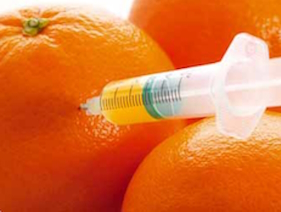 Researchers have developed a unique delivery system that overcomes these problems, boosting the absorption and optimizing blood levels of vitamin C.3
There are two parts to this formulation:3
- First, vitamin C is encapsulated in liposomes, small structures made of plant-derived phospholipids (compounds that make up cell membranes). This encapsulation of vitamin C by liposomes improves theabsorption of vitamin C into the bloodstream by nearly seven timesover traditional vitamin C.
- To protect the liposomes, researchers used a second plant-derived compound, a hydrogel formed of indigestible fiber called galactomannans, derived from fenugreek seeds. This hydrogel surrounds and shields the liposomes, ensuring sustained absorption of the vitamin C released in the gut.
This liposomal hydrogel vitamin C has shown remarkable results in elevating vitamin C levels in the body.
With traditional vitamin C, blood levels peak about one hour after ingestion, then rapidly drop back to baseline levels.
With liposomal hydrogel vitamin C, blood levels continue to rise up to four hours after ingestion and reach a much higher peak, indicating significantly improved absorption and availability to tissues.
A single daily dose of liposomal hydrogel vitamin C leads to much higher around-the-clock vitamin C levels in the blood.
What You Need To Know: Improved Vitamin C Bioavailability
- Vitamin C plays a critical role in supporting immunity, cardiovascular health, strong connective tissues, and more.
- Traditional vitamin C is poorly absorbed and metabolized quickly. When high doses of this form are taken, much of it is excreted unused.
- Encapsulating vitamin C in a liposomal hydrogel delivery system increases absorption by nearly seven times compared to standard vitamin C, keeping levels high all day long.
Strong Immune Support
 High circulating vitamin C in the blood can enhance health in several ways. One of the most notable is its support of immunity.4,14,15
Vitamin C unlocks functions in the immune system that cannot be activated without sufficient levels of this vitamin, such as controlling inflammation, and protecting against cell- damaging oxidants.5,10
Some of the specific ways vitamin C promotes healthy immunity are by:
- Enhancing the ability of neutrophils, a first-responder immune defense, to reach the site of infection. In one study of participants with low levels of vitamin C, daily vitamin C intakeincreased neutrophil response by 20%.16
- Promoting lymphocyte growth, maturation, survival, and antibody defense.17,18 Lymphocytes are part of the innate immune system and include NK (natural killer) cells, B cells, and T cells.
- Supporting collagen synthesis. Protein collagen is an important structural part of the body's physical barriers against infection from bacteria, viruses, and other microbes. Vitamin C is required for collagen to correctly form in the body, even when taking oral collagen.5
These and other actions can help fight against infections.10 For example, vitamin C intake can reduce the incidence, duration, and severity of colds.4,13-15
Why Getting Enough Vitamin C Matters
 Elevating and sustaining vitamin C levels in the bodycanoffer additional health benefits, including:
- Antioxidant Activity: Vitamin C can help prevent or reduce oxidative damage, a major contributor to aging and age-related diseases.12
- Wound Healing: Vitamin C's role in the synthesis of collagen, which provides strength to connective tissues throughout the body, helps keep tissues in peak form and accelerates wound healing after injury.19-21
- Cardiovascular Protection: People with the highest blood levels of vitamin C are less likely to die from cardiovascular causes than those with the lowest levels.22 In patients with heart failure, vitamin C intake improves the flow of blood through arteries.4
Liposomal hydrogel vitamin C can maximize the ability of vitamin C to deliver these and other benefits.
Summary
Vitamin C supports a robust immune response, resilient cardiovascular health, and confers other benefits. Traditional vitamin C is poorly absorbed and much of its common oral dosage is excreted unused.
Encapsulating vitamin C in a protective liposomal hydrogel delivery system increases its absorption by nearly seven times and keeps levels elevated around the clock.
Material used with permission of Life Extension. All rights reserved.
- Available at: https://ods.od.nih.gov/factsheets/VitaminC-HealthProfessional. Accessed September 18, 2022.
- Lykkesfeldt J. On the effect of vitamin C intake on human health: How to (mis)interprete the clinical evidence. Redox Biology. 2020 Jul 1;34:101532.
- Joseph A, Kumar D, Balakrishnan A, et al. Surface-engineered liposomal particles of calcium ascorbate with fenugreek galactomannan enhanced the oral bioavailability of ascorbic acid: a randomized, double-blinded, 3-sequence, crossover study. RSC Adv. 2021 Nov 23;11(60):38161-71.
- Available at: https://lpi.oregonstate.edu/mic/vitamins/vitamin-C. Accessed 2020.
- Carr AC, Maggini S. Vitamin C and Immune Function. Nutrients. 2017 Nov 3;9(11).
- Morelli MB, Gambardella J, Castellanos V, et al. Vitamin C and Cardiovascular Disease: An Update. Antioxidants (Basel). 2020 Dec 3;9(12).
- Hemilä H. Vitamin C and Infectious Diseases. Paper presented at: Vitamin C; 1998, Milano.
- Colunga Biancatelli RML, Berrill M, Marik PE. The antiviral properties of vitamin C. Expert Rev Anti Infect Ther. 2020 Feb;18(2):99-101.
- Available at: https://nutritionsource.hsph.harvard.edu/vitamin-c/. Accessed May 23, 2024.
- Ang A, Pullar JM, Currie MJ, Vissers MCM. Vitamin C and immune cell function in inflammation and cancer. Biochem Soc Trans. 2018 Oct 19;46(5):1147-59.
- Pisalsitsakul N, Pinnoi C, Sutanthavibul N, Kamolratanakul P. Taking 200 mg Vitamin C Three Times per Day Improved Extraction Socket Wound Healing Parameters: A Randomized Clinical Trial. Int J Dent. 2022;2022:6437200.
- Monacelli F, Acquarone E, Giannotti C, et al. Vitamin C, Aging and Alzheimer's Disease. Nutrients. 2017 Jun 27;9(7).
- Schlueter AK, Johnston CS. Vitamin C: Overview and Update. Journal of Evidence-Based Complementary and Alternative Medicine. 2011;16(1):49-57.
- Kim TK, Lim HR, Byun JS. Vitamin C supplementation reduces the odds of developing a common cold in Republic of Korea Army recruits: randomised controlled trial. BMJ Mil Health. 2022 Apr;168(2):117-23.
- Bucher A, White N. Vitamin C in the Prevention and Treatment of the Common Cold. Am J Lifestyle Med. 2016 May-Jun;10(3):181-3.
- Moore A, Khanna D. The Role of Vitamin C in Human Immunity and Its Treatment Potential Against COVID-19: A Review Article. Cureus. 2023 Jan;15(1):e33740.
- Huijskens MJ, Walczak M, Koller N, et al. Technical advance: ascorbic acid induces development of double-positive T cells from human hematopoietic stem cells in the absence of stromal cells. J Leukoc Biol. 2014 Dec;96(6):1165-75.
- Manning J, Mitchell B, Appadurai DA, et al. Vitamin C promotes maturation of T-cells. Antioxid Redox Signal. 2013 Dec 10;19(17):2054-67.
- Bikker A, Wielders J, van Loo R, Loubert M. Ascorbic acid deficiency impairs wound healing in surgical patients: Four case reports. International Journal of Surgery Open. 2016 Mar 1;2:15-8.
- Ravetti S, Clemente C, Brignone S, et al. Ascorbic Acid in Skin Health. Cosmetics. 2019;6(4):58.
- Bechara N, Flood VM, Gunton JE. A Systematic Review on the Role of Vitamin C in Tissue Healing. Antioxidants (Basel). 2022 Aug 19;11(8).
- Collins BJ, Mukherjee MS, Miller MD, Delaney CL. Effect of Dietary or Supplemental Vitamin C Intake on Vitamin C Levels in Patients with and without Cardiovascular Disease: A Systematic Review. Nutrients. 2021 Jul 8;13(7).
Related product
-
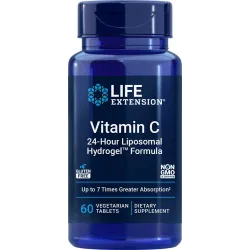
Vitamin C 24-Hour Liposomal Hydrogel™ Formula
Price: 28,96 €Get the most out of your vitamin C! Up to 7x greater absorption than...
Related posts
-
 Is Conventional Pomegranate Extract Enough?
An abundance of clinical data has established pomegranate as a broad-spectrum, multi-modal defense against the...
Is Conventional Pomegranate Extract Enough?
An abundance of clinical data has established pomegranate as a broad-spectrum, multi-modal defense against the... -
Lipoic Acid Reverses Mitochondrial Decay
It is estimated that 85% of the oxygen contained in every breath you take is consumed by the mitochondria within each...
-
Vitamin C and Dihydroquercetin
Every day, our bodies are under continual assault by damaging agents known as free radicals. Generally, both internal...
-
How Resveratrol Combats Leading Causes of Death
In 1997, the first scientific paper on resveratrol was published showing that this polyphenol could prevent cancer in...
-
Cukrzyca opis choroby Część 2
Cukrzycy typu 1 potrzebują dożywotniej insulinoterapii, choć suplementy wymienione w niniejszym rozdziale mogą pomóc...