
 English
 Polski
 Deutsch
 Français
 ελληνικά
 Español
 Italiano
How Dopamine Protects the Aging Brain
 Dopamine is a neurotransmitter that promotes feelings of pleasure and reward, supports memory, attention, and more.1
As we age, increased activity of an enzyme called monoamine oxidase B (MAO-B) degrades dopamine, causing levels to fall.2
Lower dopamine levels can contribute to reduced motivation and decreased enthusiasm for things that would excite most people.
A solution is to ingest compounds that inhibit the MAO-B enzyme.
Scientists have found that components of phellodendron tree bark accomplish this in lab studies3,4 and have neuroprotective effects in animals.5-7
Preclinical research also shows that a specific form of vitamin B12 may protect neurons and help prevent a decline in dopamine levels.8
These compounds may help maintain motivation and feelings of pleasure, while reducing risk for neurodegenerative illnesses.
What is Dopamine?
 Dopamine is often referred to as the “feel-good hormone” due to its role in regulating mood.1
The brain releases dopamine during pleasurable activities. Low dopamine levels are associated with depression and a lack of motivation and pleasure.9
But the brain uses dopamine for more than mood elevation.
This neurotransmitter also influences movement, learning, cognition, and memory.10
Dopamine enables youthful cognitive performance and body coordination.11,12
Dopamine depletion plays a role in certain neuro-degenerative diseases, while increasing dopamine has been shown to prolong lifespan in animals.1,13,14
Dangers of Reduced Dopamine
In a region of the brain that plays a role in cognitive and motor function, levels of dopamine decline by about 13% each decade after age 45.15
This decline coincides with an increase in the brain levels of monoamine oxidase B (MAO-B), an enzyme that degrades neurotransmitters such as dopamine.2
Low dopamine levels are associated with depression, lack of motivation, and pleasure.9 These mood and motivational changes also may be seen with normal aging in some people.
Rising MAO-B levels pose even more of a threat.
MAO-B activity is higher in dementia patients than in non-impaired individuals the same age,16 suggesting a role in neurodegeneration.
One reason may be that increased MAO-B activity results in formation of potentially damaging by-products2,17,18 that can contribute to neurodegenerative diseases such as Parkinson’s and Alzheimer’s disease.
Doctors frequently prescribe MAO-B inhibitors such as deprenyl (also called selegiline) to stop MAO-B degradation of dopamine in patients with Parkinson’s disease.19
Inhibiting MAO-B activity helps decrease the breakdown of dopamine and the potential harm that can be done by too much enzyme activity. This helps protect our aging brains.
The Effects of Phellodendron
 Scientists discovered that some plants have MAO-B-inhibiting properties.
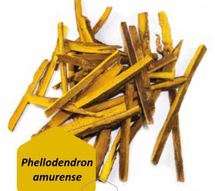
After investigating hundreds of botanicals, they identified phellodendron tree bark as one of the most potent plant-derived MAO-B inhibitors.3,4
Phellodendron (no relation to the houseplant philodendron) is also known as Amur cork tree. It has been safely used in traditional Chinese medicine for centuries to treat various ailments.5
In lab research, extract of phellodendron bark selectively inhibited over 80% of MAO-B activity, which is comparable to the drug deprenyl.4
This may enable dopamine levels to increase while blocking the neurotoxic effects of elevated MAO-B.
Phellodendron’s neuroprotective properties go beyond MAO-B inhibition. 5,6,20
In scientific studies, phellodendron protects against neuroinflammation, beta-amyloid production, and other changes associated with Alzheimer’s disease, suggesting it may help to maintain cognitive function into older age.20
Phellodendron has also demonstrated anti-inflammatory, antibacterial, antiviral, and antitumor properties,5 helping to protect both the brain and body.
Those who take MAO-B-inhibiting drugs such as deprenyl do not need to take phellodendron. Phellodendron is not a substitute for physician-prescribed medications.
A B12 Form Helps Sustain Dopamine Levels
 There are two bioactive forms of vitamin B12. 21 One of them, adenosylcobalamin, has been shown in lab research to prevent a decline in dopamine levels and protect neurons.8
In research partially funded by the Michael J. Fox Foundation, scientists prepared brain slices of mice that carried a mutation linked to Parkinson’s disease and treated some with adenosylcobalamin.8 Every two minutes, they stimulated the dopamine-producing neurons.
After 20 minutes, the untreated control slices were releasing approximately 20% less dopamine. In the mice, dopamine production dropped by up to 45%.
In the adenosylcobalamin-treated slices, dopamine production was equal to that of animals without the mutation linked to Parkinson’s disease.8
Stated differently, instead of dopamine production declining by 45% after 20 minutes like in the untreated brain slices, in the treated slices, it only dropped by 20% in response to the artificial stimulation.
This suggests that adenosylcobalamin may help prevent dopamine loss and related neurotoxicity.
Taken together, phellodendron extract and adenosylcobalamin may prevent an age-related decline in critical dopamine levels.
Summary
 Levels of the neurotransmitter dopamine decline in the aging brain, in part due to increased activity of the enzyme MAO-B.
The result can be decreased motivation, diminished pleasure, and an increased risk for neurodegenerative diseases.
Scientists have found that phellodendron bark extract inhibits MAO-B, helping to maintain dopamine levels and prevent neurotoxicity.
A form of vitamin B12 called adenosylcobalamin may also prevent a decline in dopamine levels and help inhibit neurodegeneration.
These compounds may prevent declines in pleasure and motivation and protect the aging brain.
 Increases in the enzyme monoamine oxidase B (MAO-B) contribute to lower levels of the neurotransmitter dopamine after middle age. This can lead to reduced motivation and pleasure.
- Heightened MAO-B activity is also linked to altered brain function and certain neurodegenerative diseases.
- After screening hundreds of plants, scientists identified phellodendron bark extract as one of the most powerful inhibitors of MAO-B.
- A form of vitamin B12 called adenosylcobalamin has also been shown to help prevent a decline in dopamine levels and to inhibit neurodegeneration in preclinical studies.
- These compounds may help maintain positive mood and motivation while inhibiting neurodegeneration.
Inhibiting MAO-B May Boost Lifespan
 The drug deprenyl is prescribed to inhibit MAO-B activity, most often in Parkinson’s disease patients.19 Inhibiting MAO-B leaves more dopamine in the brain’s neural circuits.
In dogs, deprenyl treatment helped improve cognitive function.22
Additionally, animal studies have also found that MAO-B inhibition extends lifespan.23-29
For example, rats given deprenyl had an average lifespan up to 40% longer than untreated rats.27,28
Material used with permission of Life Extension. All rights reserved.
- Klein MO, Battagello DS, Cardoso AR, et al. Dopamine: Functions, Signaling, and Association with Neurological Diseases. Cell Mol Neurobiol. 2019 Jan;39(1):31-59.
- Kumar MJ, Andersen JK. Perspectives on MAO-B in aging and neurological disease: where do we go from here? Mol Neurobiol. 2004 Aug;30(1):77-89.
- Mazzio E, Deiab S, Park K, et al. High throughput screening to identify natural human monoamine oxidase B inhibitors. Phytother Res. 2013 Jun;27(6):818-28.
- Zarmouh NO, Messeha SS, Elshami FM, et al. Natural Products Screening for the Identification of Selective Monoamine Oxidase-B Inhibitors. European J Med Plants. 2016 May;15(1).
- Sun Y, Lenon GB, Yang AWH. Phellodendri Cortex: A Phytochemical, Pharmacological, and Pharmacokinetic Review. Evid Based Complement Alternat Med. 2019;2019:7621929.
- Xian YF, Lin ZX, Ip SP, et al. Comparison the neuropreotective effect of Cortex Phellodendri chinensis and Cortex Phellodendri amurensis against beta-amyloid-induced neurotoxicity in PC12 cells. Phytomedicine. 2013 Jan 15;20(2):187-93.
- Young-Pyo K, In-Chul, J. , & Sang-Ryong, L. Effects of Phellodendron amurense Extract on the Alzheimer’s Disease Model. Journal of Physiology & Pathology in Korean Medicine. 2005;19(1):130-8.
- Schaffner A, Li X, Gomez-Llorente Y, et al. Vitamin B12 modulates Parkinson’s disease LRRK2 kinase activity through allosteric regulation and confers neuroprotection. Cell Res. 2019 Apr;29(4):313-29.
- Dunlop BW, Nemeroff CB. The role of dopamine in the pathophysiology of depression. Arch Gen Psychiatry. 2007 Mar;64(3):327-37.
- Ayano G. Dopamine: Receptors, Functions, Synthesis, Pathways, Locations and Mental Disorders: Review of Literatures. Journal of Mental Disorders and Treatment. 2016 01/01;2(2).
- Backman L, Lindenberger U, Li SC, et al. Linking cognitive aging to alterations in dopamine neurotransmitter functioning: recent data and future avenues. Neurosci Biobehav Rev. 2010 Apr;34(5):670-7.
- Howe M, Ridouh I, Allegra Mascaro AL, et al. Coordination of rapid cholinergic and dopaminergic signaling in striatum during spontaneous movement. Elife. 2019 Mar 28;8.
- Masato A, Plotegher N, Boassa D, et al. Impaired dopamine metabolism in Parkinson’s disease pathogenesis. Mol Neurodegener. 2019 Aug 20;14(1):35.
- Knoll J. The striatal dopamine dependency of life span in male rats. Longevity study with (-)deprenyl. Mech Ageing Dev. 1988 Dec;46(1-3):237-62.
- Knoll J. Deprenyl (selegiline): the history of its development and pharmacological action. Acta Neurol Scand Suppl. 1983;95:57-80.
- Oreland L, Gottfries CG. Brain and brain monoamine oxidase in aging and in dementia of Alzheimer’s type. Prog Neuropsychopharmacol Biol Psychiatry. 1986;10(3-5):533-40.
- Finberg JP, Rabey JM. Inhibitors of MAO-A and MAO-B in Psychiatry and Neurology. Front Pharmacol. 2016;7:340.
- Naoi M, Maruyama W, Inaba-Hasegawa K. Type A and B monoamine oxidase in age-related neurodegenerative disorders: their distinct roles in neuronal death and survival. Curr Top Med Chem. 2012;12(20):2177-88.
- Szoko E, Tabi T, Riederer P, et al. Pharmacological aspects of the neuroprotective effects of irreversible MAO-B inhibitors, selegiline and rasagiline, in Parkinson’s disease. J Neural Transm (Vienna). 2018 Nov;125(11):1735-49.
- Kim Y, Jung I, Lee S. Effects of Phellodendron amurense extract on the Alzheimer’s disease model. Journal of Physiology & Pathology in Korean Medicine. 2005;19(1):130-8.
- Available at: https://ods.od.nih.gov/factsheets/VitaminB12-HealthProfessional/. Accessed April 28, 2022.
- Milgram NW, Ivy GO, Head E, et al. The effect of L-deprenyl on behavior, cognitive function, and biogenic amines in the dog. Neurochem Res. 1993 Dec;18(12):1211-9.
- Stoll S, Hafner U, Pohl O, et al. Age-related memory decline and longevity under treatment with selegiline. Life Sci. 1994;55(25-26):2155-63.
- Kitani K, Kanai S, Carrillo MC, et al. (-)Deprenyl increases the life span as well as activities of superoxide dismutase and catalase but not of glutathione peroxidase in selective brain regions in Fischer rats. Ann N Y Acad Sci. 1994 Jun 30;717:60-71.
- Kitani K, Kanai S, Ivy GO, et al. Assessing the effects of deprenyl on longevity and antioxidant defenses in different animal models. Ann N Y Acad Sci. 1998 Nov 20;854:291-306.
- Kitani K, Minami C, Isobe K-i, et al. Why (−)deprenyl prolongs survivals of experimental animals: Increase of anti-oxidant enzymes in brain and other body tissues as well as mobilization of various humoral factors may lead to systemic anti-aging effects. Mechanisms of Ageing and Development. 2002;123(8):1087-100.
- Knoll J, Dallo J, Yen TT. Striatal dopamine, sexual activity and lifespan. Longevity of rats treated with (-)deprenyl. Life Sci. 1989;45(6):525-31.
- Knoll J, Yen TT, Miklya I. Sexually low performing male rats die earlier than their high performing peers and (-)deprenyl treatment eliminates this difference. Life Sci. 1994;54(15):1047-57.
- Stoll S, Hafner U, Kränzlin B, et al. Chronic Treatment of Syrian Hamsters With Low-Dose Selegiline Increases Life Span in Females But Not Males. Neurobiology of Aging. 1997;18(2):205-11.
Related product
-
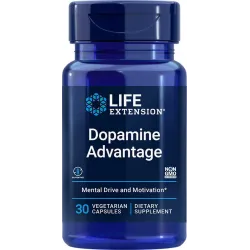
Dopamine Advantage
Price: 15,28 €Youthful dopamine levels to stay sharp & motivated Helps maintain...
Related posts
-
 Feed Your Brain!
Millions of people around the world are adhering to low-fat, low-cholesterol diets in an effort to reduce the impact...
Feed Your Brain!
Millions of people around the world are adhering to low-fat, low-cholesterol diets in an effort to reduce the impact... -
Lipoic Acid Reverses Mitochondrial Decay
It is estimated that 85% of the oxygen contained in every breath you take is consumed by the mitochondria within each...
-
Vitamin C and Dihydroquercetin
Every day, our bodies are under continual assault by damaging agents known as free radicals. Generally, both internal...
-
How Resveratrol Combats Leading Causes of Death
In 1997, the first scientific paper on resveratrol was published showing that this polyphenol could prevent cancer in...
-
Discovering Coffee's Unique Health Benefits
Every morning, many of us sip our coffee with no real thought given to the beans behind the brew. But coffee beans...