
 English
 Polski
 Deutsch
 Français
 ελληνικά
 Español
 Italiano
Boost Nitric Oxide to Reduce Cardiovascular Risk
 Nitric oxide is a substance your body naturally produces.
It signals blood vessels to widen, allowing blood to flow through freely.
But nitric oxide production decreases with age.1
This contributes to endothelial dysfunction that leads to the initiation and progression of arterial disease.2-5
The consequences of endothelial dysfunction are:
- Diminished circulation
- High blood pressure
- Thrombosis
(clots inside blood vessels) - Atherosclerosis
These are major causes of stroke and heart attack.5-8
We can’t get nitric oxide directly from diet or supplements.
The good news is that L-arginine and aronia berries help the body make more of it.
Endothelial Dysfunction and Cardiovascular Disease
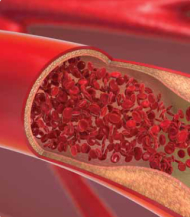 The endothelium is the inner lining of blood vessels, and it plays a critical role in regulating the flow of blood.2-4
It does this by producing nitric oxide, which signals blood vessels to dilate (widen). That allows greater blood flow to tissues, including the heart and brain.
But as we age, our body makes less nitric oxide.1 That can lead to endothelial dysfunction, which means the blood vessels are unable to dilate and constrict as needed, reducing blood flow.2-4
This condition, referred to as arterial stiffness, contributes to high blood pressure, formation of atherosclerotic plaque, and inflammation in the arteries—all of which can lead to cardiovascular disease.9
It also greatly increases the risk of abnormal clotting, which can block blood vessels, leading to heart attack, stroke, and sudden cardiac death.10,11
Endothelial dysfunction is surprisingly common; one study showed it affected about one third of people without any prior history of cardiovascular disease.12 The elderly, diabetics, the obese, smokers, people with cardiovascular disease, and those with high cholesterol or high blood pressure have a higher risk.2-4
But if we can increase the amount of nitric oxide in our blood vessels, it may stop, and even reverse endothelial dysfunction.
-
 The endothelium is a layer of cells lining the inside of blood vessels. It produces nitric oxide, a gas that signals the vessel to dilate, allowing blood to flow through and preventing abnormal clotting.
 -
With age and other risk factors, nitric oxide production declines, contributing to endothelial dysfunction. This increases risk for the development of cardiovascular disease events, including heart attack and stroke.
-
L-arginine is a precursor the body needs to make nitric oxide. A new form, inositol-stabilized arginine silicate, improves its bioavailability and supports higher levels in the bloodstream for a longer time.
-
Aronia berries help activate the enzyme that converts L-arginine into nitric oxide.
-
These two ingredients work to boost nitric oxide production, helping blood vessels dilate more efficiently. This may significantly reduce risk for heart attack, stroke, and other cardiovascular events.
How L-Arginine Helps
 Unfortunately, we can’t simply take nitric oxide as a supplement. It has an extremely short half-life, which means it’s too quickly metabolized and eliminated from the bloodstream to be useful.
To work properly, blood vessels must make nitric oxide for themselves. To do so, they need a precursor compound. This precursor is an amino acid called L-arginine.
Aware of this link between L-arginine and nitric oxide production, researchers evaluated whether increasing intake of L-arginine improves blood vessel dilation, lowering risk for disease.13-17
One of the main ways to test this is to measure how much a blood vessel widens in response to an increase in blood flow, something called flow-mediated dilation.
In a landmark clinical trial published in the International Journal of Cardiology, scientists gave patients with high blood pressure a single dose of either L-arginine or a placebo.15 While the placebo group had no change in their blood vessel function, those receiving L-arginine had an improvement in their flow-mediated dilation from an average of 1.7% to 5.9%.
Considering that each 1% improvement in flow-mediated dilation correlates with a 12% lower risk of cardiovascular events like heart attacks and strokes,18,19 this would suggest a 50% reduction in risk of cardiovascular events if the effect is sustained over time.
Other longer-term clinical studies have shown that taking L-arginine can lower blood pressure and reduce symptoms associated with coronary artery disease.16,20
A New, Better Form of L-Arginine
 Life Extension® has written about L-arginine for the past 38 years. But in the last few years, scientists have developed and tested a new form.
Known as inositol-stabilized arginine silicate, this novel form is more bioavailable, which means more of it is absorbed into the bloodstream after ingestion.
Studies show that L-arginine blood levels increase within one hour after supplementation with inositol-stabilized arginine silicate and stay there for many hours.21,22
It appears to do this by inhibiting the enzyme arginase, which breaks down L-arginine in the digestive tract, allowing more of the L-arginine to enter and circulate in the blood longer.23
Aronia Berry Improves Endothelial Function
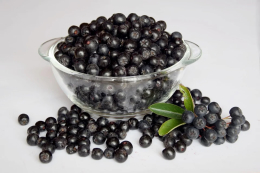 Aronia berries are small, dark purple berries native to North America. They’re high in anthocyanins, beneficial polyphenols.
Scientists discovered that like L-arginine, aronia can improve endothelial function.
While L-arginine provides the precursor needed to form nitric oxide, polyphenols from aronia berries appear to increase the activity of the enzyme that converts the L-arginine into nitric oxide.
It does this by inducing the modification of the enzyme, called endothelial nitric oxide synthase, in a way that turns the enzyme “on.”24
In one randomized, controlled trial, daily supplementation with 500 mg of aronia whole fruit berry for 12 weeks resulted in improved flow-mediated dilation.25 Subjects taking the aronia had a 0.9% improvement in flow-mediated dilation compared to those taking a placebo.
That may sound small, but bear in mind that each 1% improvement in flow-mediated dilation correlates with a 12% lower risk of cardiovascular events,18,19 suggesting that this corresponds to a nearly 11% reduction in risk for cardiovascular events.
The enhanced bioavailability of inositol-stabilized arginine silicate coupled with the increased endothelial nitric oxide synthase activity from aronia berries make this a potent duo in the production of nitric oxide.
Summary
 Our bodies produce nitric oxide, which signals blood vessels to dilate. With age, its production declines, contributing to endothelial dysfunction.
Endothelial dysfunction increases the risk of cardiovascular disease, including heart attacks and strokes.
Two ingredients, L-arginine and aronia berries, boost the body’s production of nitric oxide.
Human studies show that they improve the flow of blood through the vessels, which can reduce the risk for cardiovascular disease.
Material used with permission of Life Extension. All rights reserved.
- Torregrossa AC, Aranke M, Bryan NS. Nitric oxide and geriatrics: Implications in diagnostics and treatment of the elderly. J Geriatr Cardiol. 2011 Dec;8(4):230-42.
- Davignon J, Ganz P. Role of endothelial dysfunction in atherosclerosis. Circulation. 2004 Jun 15;109(23 Suppl 1):III27-32.
- Widlansky ME, Gokce N, Keaney JF, Jr., et al. The clinical implications of endothelial dysfunction. J Am Coll Cardiol. 2003 Oct 1;42(7):1149-60.
- Widmer RJ, Lerman A. Endothelial dysfunction and cardiovascular disease. Glob Cardiol Sci Pract. 2014;2014(3):291-308.
- Seals DR, Jablonski KL, Donato AJ. Aging and vascular endothelial function in humans. Clin Sci (Lond). 2011 May;120(9):357-75.
- Fordjour PA, Wang Y, Shi Y, et al. Possible mechanisms of C-reactive protein mediated acute myocardial infarction. Eur J Pharmacol. 2015 Aug 5;760:72-80.
- Eelen G, de Zeeuw P, Simons M, et al. Endothelial cell metabolism in normal and diseased vasculature. Circ Res. 2015 Mar 27;116(7):1231-44.
- Huveneers S, Daemen MJ, Hordijk PL. Between Rho(k) and a hard place: the relation between vessel wall stiffness, endothelial contractility, and cardiovascular disease. Circ Res. 2015 Feb 27;116(5):895-908.
- Namba T, Masaki N, Takase B, et al. Arterial Stiffness Assessed by Cardio-Ankle Vascular Index. Int J Mol Sci. 2019 Jul 26;20(15).
- Aykan AC, Hatem E, Kalaycioglu E, et al. Assessment of arterial stiffness in patients with venous thromboembolism: Separate or continuous circuits? Phlebology. 2017 Jun;32(5):316-21.
- Cooper JN, Evans RW, Mori Brooks M, et al. Associations between arterial stiffness and platelet activation in normotensive overweight and obese young adults. Clin Exp Hypertens. 2014;36(3):115-22.
- Toggweiler S, Schoenenberger A, Urbanek N, et al. The prevalence of endothelial dysfunction in patients with and without coronary artery disease. Clin Cardiol. 2010 Dec;33(12):746-52.
- Cooke JP, Singer AH, Tsao P, et al. Antiatherogenic effects of L-arginine in the hypercholesterolemic rabbit. J Clin Invest. 1992 Sep;90(3):1168-72.
- Hambrecht R, Hilbrich L, Erbs S, et al. Correction of endothelial dysfunction in chronic heart failure: additional effects of exercise training and oral L-arginine supplementation. J Am Coll Cardiol. 2000 Mar 1;35(3):706-13.
- Lekakis JP, Papathanassiou S, Papaioannou TG, et al. Oral L-arginine improves endothelial dysfunction in patients with essential hypertension. Int J Cardiol. 2002 Dec;86(2-3):317-23.
- Lerman A, Burnett JC, Jr., Higano ST, et al. Long-term L-arginine supplementation improves small-vessel coronary endothelial function in humans. Circulation. 1998 Jun 2;97(21):2123-8.
- Melik Z, Zaletel P, Virtic T, et al. L-arginine as dietary supplement for improving microvascular function. Clin Hemorheol Microcirc. 2017;65(3):205-17.
- Matsuzawa Y, Kwon TG, Lennon RJ, et al. Prognostic Value of Flow-Mediated Vasodilation in Brachial Artery and Fingertip Artery for Cardiovascular Events: A Systematic Review and Meta-Analysis. J Am Heart Assoc. 2015 Nov 13;4(11).
- Shimbo D, Grahame-Clarke C, Miyake Y, et al. The association between endothelial dysfunction and cardiovascular outcomes in a population-based multi-ethnic cohort. Atherosclerosis. 2007 May;192(1):197-203.
- McRae MP. Therapeutic Benefits of l-Arginine: An Umbrella Review of Meta-analyses. J Chiropr Med. 2016 Sep;15(3):184-9.
- Kalman DS, Feldman S, Samson A, et al. A clinical evaluation to determine the safety, pharmacokinetics, and pharmacodynamics of an inositol-stabilized arginine silicate dietary supplement in healthy adult males. Clin Pharmacol. 2015;7:103-9.
- Komorowski J, Perez Ojalvo S. A pharmacokinetic evaluation of the duration of effect of inositol-stabilized arginine silicate and arginine hydrochloride in healthy adult males. FASEB J. 2016;30 (1_suppl).
- Komorowski J, Perez Ojalvo S, Sylla S, et al. Poster Presentation presented at the American Society for Nutrition’s Annual Meeting 2018. Arginase inhibition by inositol-stabilized arginine silicate (ASI; Nitrosigine); a novel mechanism by which ASI enhances arginine bioavailability. Current Developments in Nutrition. 2018.
- Varela CE, Fromentin E, Roller M, et al. Effects of a natural extract of Aronia Melanocarpa berry on endothelial cell nitric oxide production. J Food Biochem. 2016 Aug;40(4):404-10.
- Istas G, Wood E, Le Sayec M, et al. Effects of aronia berry (poly)phenols on vascular function and gut microbiota: a double-blind randomized controlled trial in adult men. Am J Clin Nutr. 2019 Aug 1;110(2):316-29.
Related product
-
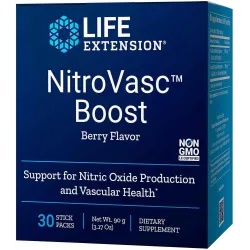
NitroVasc™ Boost (Berry)
Price: 27,30 €Supports circulatory health Encourages healthy levels of endothelial...
Related posts
-
 Is Conventional Pomegranate Extract Enough?
An abundance of clinical data has established pomegranate as a broad-spectrum, multi-modal defense against the...
Is Conventional Pomegranate Extract Enough?
An abundance of clinical data has established pomegranate as a broad-spectrum, multi-modal defense against the... -
Lipoic Acid Reverses Mitochondrial Decay
It is estimated that 85% of the oxygen contained in every breath you take is consumed by the mitochondria within each...
-
Vitamin C and Dihydroquercetin
Every day, our bodies are under continual assault by damaging agents known as free radicals. Generally, both internal...
-
How Resveratrol Combats Leading Causes of Death
In 1997, the first scientific paper on resveratrol was published showing that this polyphenol could prevent cancer in...
-
Cukrzyca opis choroby Część 2
Cukrzycy typu 1 potrzebują dożywotniej insulinoterapii, choć suplementy wymienione w niniejszym rozdziale mogą pomóc...