
 English
 Polski
 Deutsch
 Français
 ελληνικά
 Español
 Italiano
Enhanced Absorption Ubiquinol CoQ10
 Findings just released at the 5th Annual International CoQ10 Symposium (November 9-12, 2007, in Kobe, Japan) show ubiquinol to be remarkably beneficial in those with advanced-stage cardiac disorders. Conventional CoQ10 (ubiquinone), on the other hand, was not adequately absorbed in these cardiac patients. According to the researchers, patients with severe heart failure have difficulty assimilating ubiquinone into their bloodstream, whereas ubiquinol readily absorbs and displays greater clinical benefit. (A full report on this landmark study will be described in the issue of Life Extension magazine that members will receive in January 2008.)
Not satisfied to produce the world’s best CoQ10 (ubiquinol), the largest Japanese maker of CoQ10 has just developed a patented method to enable even more ubiquinol to be absorbed than before.
This new enhanced-delivery ubiquinol formula is only available from the Life Extension Foundation Buyers Club. The incredible news is that this superior ubiquinol can provide more absorbed CoQ10 for less money than even the original ubiquinol.
More humans are supplementing with coenzyme Q10 than ever before. One reason is the increased awareness that the “statin” drugs used to lower LDL and cholesterol deplete the body of CoQ10.4-7
What most doctors don’t know, however, is that normal aging may result in a greater reduction in CoQ10 than is caused by taking statin drugs.8-10
For example, while statin drugs have been shown to reduce plasma CoQ10 by 40%, the aging process reduces CoQ10 levels in the heart muscle wall by 72%. The chart on this page reveals the CoQ10 deficiencies that occur in various tissues as humans age.11
What is particularly frightening is the thought of elderly people taking statin drugs who fail to supplement with CoQ10. The CoQ10 deficit caused by the dual effects of aging and statin drug use would result in severe depletion of cellular vitality.
 In 2006, Life Extension introduced a new form of coenzyme Q10 called “ubiquinol” that provided significantly greater benefits.
Compared to conventional CoQ10, ubiquinol was shown to:
- Absorb into the bloodstream up to eight times better1
- Reduce fatigue 90% more effectively2
- Slow aging in middle-age mice 40% better3
CoQ10 and the aging mitochondria
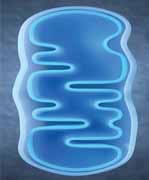 About 95% of cellular energy is produced from structures in the cell called mitochondria. Coenzyme Q10 is incorporated into the mitochondria of our cells where it facilitates the transformation of fats and sugars into energy. A large body of scientific evidence shows that CoQ10’s ability to restore mitochondrial function has a profound effect on one’s overall health.12, 13
When CoQ10 levels diminish, the ability of cells to sustain even basic metabolic functions is impaired. This results in the development of multiple disorders characteristic of normal aging. Fortunately, coenzyme Q10 levels can be fully restored by taking the proper dose of supplemental CoQ10.
Heart cells have a high-energy demand, and many clinical studies have investigated the effect of CoQ10 on cardiac function. Efficacy has been shown in studies when CoQ10 was used for congestive heart failure, coronary artery occlusion, and valvular disorders.14,19 Scientists have also found that CoQ10 provides benefits to other organs whose cells require high-level energy metabolism such as the brain and kidneys.12, 20, 21
Why ubiquinol is superior to ubiquinone
 In 2006 Life Extension announced a technological breakthrough that enabled people to gain access to stabilized “ubiquinol” CoQ10 for the first time. Only modest doses of ubiquinol dramatically increased CoQ10 blood levels compared to conventional (ubiquinone) supplements.
In experimental studies, ubiquinol was shown to achieve 3.75 times higher plasma concentrations eight hours after dosing versus conventional CoQ10. Ubiquinol also reduced exercise-induced fatigue 90% better than conventional CoQ10.3
What most excited Life Extension researchers was a side-by-side comparison study that measured the rate of aging in mice given ubiquinol, ubiquinone, or placebo. As would be expected, both ubiquinone and ubiquinol slowed aging (by 45%) compared to placebo up to a certain point in the study. As the mice continued to age, however, the rate of aging in the ubiquinol group slowed until at one point in the study they were aging 40% less than the ubiquinone group and 51% less than the placebo group.3
Even more dramatic were photographs and video footage comparing the three different groups of mice. Twelve-month-old mice receiving no supplemental CoQ10 were essentially immobile and unresponsive, exhibiting lesions in and around the eye, with spinal and limb deformities as well as a patchy, discolored coat. Many of these pathological events seen in mice not supplemented with CoQ10 are classic signs of degenerative aging suffered by elderly humans. The ubiquinone group faired better, but visible signs of pathological aging were still clearly seen.3
On the other hand, the 12-month-old mice supplemented with ubiquinol, were shown to be alert, responsive, and energetic, with no physical lesions or deformities and a glossy coat resembling that of a young, healthy mouse. 3
A review of all the scientific findings clearly shows that ubiquinol is the preferred form of CoQ10 to ingest. As you will read next, Japanese researchers have discovered a delivery mechanism to provide even higher potencies of ubiquinol to the bloodstream.
| Tissue Affected | % Decrease of CoQ10 |
| Heart Muscle Wall | 72% [14] |
| Pancreas | 69% [15] |
| Epidermis (skin) | 75% [16] |
| Kidney | 35% [17] |
| Liver | 10% [18] |
| Heart | 57% [19] |
| Adrenal Gland | 47% [20] |
Obtaining even higher blood levels of CoQ10
 Over the past five years, scientists have discovered that higher doses of CoQ10 are needed to achieve optimal results. This originally caused a dilemma with consumers, as they were faced with having to swallow many expensive CoQ10 capsules to derive the desired benefits.
With the advent of stabilized ubiquinol, consumers could affordably achieve the high blood levels of CoQ10 that scientific studies showed provided optimal benefits.
Life Extension is pleased to announce the discovery of an enhanced ubiquinol delivery system that has been shown to double peak CoQ10 blood levels in mice compared to the original ubiquinol formula. Equally impressive is the ability of this enhanced ubiquinol formula to achieve 66% greater total amount of CoQ10 in blood over 24 hours than the original formula.
Human and animal research documents improved benefits when higher amounts of CoQ10 are delivered over a more sustained period of time. This new enhanced-absorbing ubiquinol may therefore provide greater biological effects than any previous CoQ10 supplement.
Exclusive absorption technology now available at lower prices
Life Extension has been issued an exclusive license to distribute this patented enhanced absorbing ubiquinol. Unlike greedy pharmaceutical companies that charge outlandish prices for trivial improvements to their drugs, the cost of this new enhanced delivery ubiquinol formula has not increased. It is in fact significantly lower priced than what the original ubiquinol capsules first sold for just one year ago!
Material used with permission of Life Extension. All rights reserved.
1. Hosoe K, Kitano M, Kishida H, et al. Study on safety and bioavailability of ubiquinol (Kaneka QH) after single and 4-week multiple oral administration to healthy volunteers. Regul Toxicol Pharmacol. 2007 Feb;47(1):19-28.
2. KANEKA CORP. Anti-fatigue effect in rats. Unpublished data, Kaneka Corp.
3. Yan J, Fujii K, Yao J, et al. Reduced coenzyme Q10 supplementation decelerates senescence in SAMP1 mice. Exp Gerontol. 2006 Feb;41(2):130-40.
4. Bargossi AM, Grossi G, et al. Exogenous CoQ10 supplementation prevents plasma ubiquinone reduction induced by the HMG CoA reductase inhibitors. Mol Aspect Med. 1994;15(S):187-193.
5. Langsjoen PH, Langsjoen AM. The clinical use of HMG CoA-reductase inhibitors and the associated depletion of coenzyme Q10. A review of animal and human publications. Biofactors. 2003;18(1-4):101-11.
6. Mabuchi H, Higashikata T, Kawashiri M, Katsuda S, Mizuno M, Nohara A, Inazu A, Koizumi J, Kobayashi J. Reduction of serum ubiquinol-10 and ubiquinone-10 levels by atorvastatin in hypercholesterolemic patients. Journal of Atheroscler Thromb. 2005;12(2):111-9.
7. Mortensen SA, Leth A. et al. Dose-related decrease of serum CoQ10 during treatment with HMG-CoA reductase inhibitors. Mol Aspect Med. 1997; 1andamp;(S):137-144.
8. Hoppe U, Bergemann J, et al. Coenzyme Q10, a cutaneous antioxidant and energizer. Biofactors. 1999;9(2-4):371-8.
9. Kalen A, Appelkvist EL, Dallner G. Age-related changes in the lipid compositions of rat and human tissues. Lipids. 1989 Jul;24(7):579-84.
10. Rosenfeldt FL, Pepe S, et al. Coenzyme Q10 improves the tolerance of the senescent myocardium to aerobic and ischemic stress: studies in rats and in human trial tissue. Biofactors. 1999;9(2-4):291-9.
11. Ghirlanda G, Oradei A, Manto A, et al. Evidence of plasma CoQ10-lowering effect by HMG-CoA reductase inhibitors: a double-blind, placebo-controlled study. J Clin Pharmacol. 1993 Mar;33(3):226-9.
12. Matthews RT, Yang L, Browne S, Baik M, Beal MF. Coenzyme Q10 administration increases brain mitochondrial concentrations and exerts neuroprotective effects. Proc Natl Acad Sci USA. 1998 Jul 21;95(15):8892-7.
13. Menke T, Gille G, Reber F, et al. Coenzyme Q10 reduces the toxicity of rotenone in neuronal cultures by preserving the mitochondrial membrane potential. Biofactors. 2003;18(1-4):65-72.
14. Greenberg S, Frishman WH. Coenzyme Q10: a new drug for cardiovascular disease. J Clin Pharmacol. 1990 Jul;30(7):596-608.
15. Hofman-Bang C, Rehnqvist N, Swedberg K, et al. Coenzyme Q10 as an adjunctive in the treatment of chronic congestive heart failure. The Q10 Study Group. J Card Fail. 1995 Mar;1(2):101-7.
16. Munkholm H, Hansen HH, Rasmussen K. Coenzyme Q10 treatment in serious heart failure. Biofactors. 1999;9(2-) :285-9.
17. Thomas SR, Leichtweis SB, Pettersson K, et al. Dietary cosupplementation with vitamin E and coenzyme Q(10) inhibits atherosclerosis in apolipoprotein E gene knockout mice. Arterioscler Thromb Vasc Biol. 2001 Apr;21(4): 585-93.
18. Tran MT, Mitchell TM, Kennedy DT, et al. Role of coenzyme Q10 in chronic heart failure, angina, and hypertension. Pharmacotherapy. 2001 Jul;21(7):797-806.
19. Witting PK, Pettersson K, Letters J, et al. Anti-atherogenic effect of coenzyme Q10 in apolipoprotein E gene knockout mice. Free Radic Biol Med. 2000 Aug;29(3-4):295-305.
20. Gazdikova K, Gvozdjakova A, et al. Effect of coenzyme Q10 in patients with kidney diseases. Cas Lek Cesk. 2001 May 24;140(10):307-10.
21. Naini A, Lewis VJ, Hirano M, et al. Primary coenzyme Q10 deficiency and the brain. Biofactors. 2003;18(1-4):145-52.
Related products
-
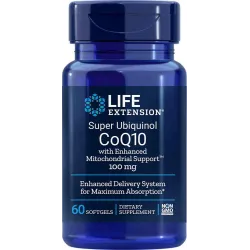
Super Ubiquinol CoQ10 with Enhanced...
Price: 50,35 €Supercharge your cellular energy Ubiquinol CoQ10 absorbs up to 8 times... -
Super Ubiquinol CoQ10 with PQQ
Price: 42,87 €Triple-action support for cellular energy production Contains the... -
Super Ubiquinol CoQ10 with Enhanced...
Price: 50,27 €Supercharge your cellular energy Ubiquinol CoQ10 absorbs up to 8 times... -
Super Ubiquinol CoQ10 with Enhanced...
Price: 48,15 €Supercharge your cellular energy Ubiquinol CoQ10 absorbs up to 8 times... -
Super Ubiquinol CoQ10
Price: 42,58 €Our most absorbable CoQ10 Supports cardiovascular health Promotes healthy...
Related posts
-
 Is Conventional Pomegranate Extract Enough?
An abundance of clinical data has established pomegranate as a broad-spectrum, multi-modal defense against the...
Is Conventional Pomegranate Extract Enough?
An abundance of clinical data has established pomegranate as a broad-spectrum, multi-modal defense against the... -
Lipoic Acid Reverses Mitochondrial Decay
It is estimated that 85% of the oxygen contained in every breath you take is consumed by the mitochondria within each...
-
Vitamin C and Dihydroquercetin
Every day, our bodies are under continual assault by damaging agents known as free radicals. Generally, both internal...
-
How Resveratrol Combats Leading Causes of Death
In 1997, the first scientific paper on resveratrol was published showing that this polyphenol could prevent cancer in...
-
Autoimmune Diseases part 1
Autoimmune diseases are characterized by the body's immune responses being directed against its own tissues, causing...