
 English
 Polski
 Deutsch
 Français
 ελληνικά
 Español
 Italiano
Slow and Reverse Hair Loss
 It might begin with a slight receding hairline or thinning of the hair. But one day, you look in the mirror, and it hits you: You’re going bald!
You’re not alone. Progressive hair loss or baldness affects about 80% of older men.1,2 The question is: What can you do about it?
Hair replacement options are available but are expensive and do not always fulfill expectations of men experiencing significant hair loss.
As an alternative, scientists have identified plant-derived ingredients that target hair loss at, well, its root.
By targeting an enzyme that contributes to increased levels of DHT, these ingredients help restore hair growth and fullness and reduce hair loss.1,3
In one study, 95% of men taking a blend of two of these ingredients had improved hair growth.1
In another trial, participants with mild-to-moderate hair loss who took a third plant extract saw a 29% decrease in hair loss and a 5% increase in hair density.3
Scientists have combined these ingredients into an oral formula for hair support, reversal of hair loss, and a boost of hair growth.
DHT and Baldness
 The progressive hair loss known as androgenetic alopecia, is known as male pattern baldness.4
People with this condition usually have:4
- Heightened levels of the hormone dihydrotestosterone (DHT), an androgen (male sex hormone),
- Elevated activity of 5-alpha reductase, an enzyme that converts testosterone into DHT, and
- More abundant androgen receptors in areas of the scalp affected by hair loss.
An increase in DHT is associated with the miniaturization of hair follicles, which leads to hair loss and decreased hair density and, eventually, baldness.4
Current Medications
Scientists have long investigated ways to slow or reverse hair loss. Two commonly used FDA-approved treatments are available for pattern baldness: topical minoxidil and oral finasteride.5,6
One topical baldness drug, minoxidil (Rogaine®), targets blood flow to hair follicles to promote growth.
The other drug, finasteride (Propecia®), is taken orally and is designed to inhibit 5-alpha reductase, the enzyme that converts testosterone into DHT.3
These treatments require about six months of consistent application before noticeable improvements become apparent.5
Drug-Free Approaches
 Scientists looking for a safer and drug-free way to support hair growth and density focused on two plant-derived formulas.
One formula combines standardized extracts of black rice and prickly pear flower.
Prickly pear was shown in lab studies to inhibit 5-alpha reductase. Other cell studies demonstrated that, when combined, these extracts increased the viability of cells at the bottom of hair follicles that play a key role in hair formation and growth.1
The other formula is a saw palmetto oil standardized to 2%-3% beta-sitosterol and 85% total fatty acids. Lab studies showed that this novel formula inhibited 5-alpha reductase and provided anti-inflammatory and angiogenic (forming new blood capillaries) effects.3
Scientists tested each formula in clinical trials.
Black Rice-Prickly Pear Boosts Hair Growth
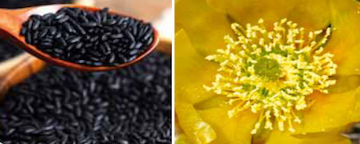 Men with mild-to-moderate male pattern baldness took either a placebo or 250 mg of the black rice-prickly pear blend daily.1
The progress of treatment was evaluated by high-resolution imaging called phototrichogram— a non-invasive evaluating tool for hair growth—and a self-assessment questionnaire. High-resolution images of the scalp were used by dermatologists to count the number of hairs per square centimeter and their thickness and length.
After six months, treated men had:1
- 9.5% increase in hair density,
- 28.2% increase in anagen hair density (hairs in the growing phase),
- Increased hair growth scores in 95.1% of subjects (vs. 34.1% in the placebo group), and
- 75.6% of individuals who reported overall satisfaction with improvements in hair growth and a decrease in hair loss.
The first positive results were observed within just two months by 63.5% of treated subjects.1
Saw Palmetto
 In another clinical trial, participants with mild-to-moderate androgenetic alopecia took either a placebo or 100 mg of saw palmetto oil daily.3
After 16 weeks, the treatment group had a:3
- 5.17% increase in hair density (vs. 3.23% decrease in the placebo group),
- 29% decrease in hair shedding, using a “comb test,” and
- 20.5% decrease in hair shedding, using a “hair pull test.”
Improved thickness and appearance of hair shafts were reported by 50% of treated subjects, but only 10.5% of the placebo group.
An improvement in the amount of hair covering the scalp, and a smaller area of thinning hair, was reported by 33.3% of treated subjects compared to only 10.5% of the placebo group.
Blood tests confirmed that the treated group had an average 22.2% reduced level of serum DHT in this study.3
Saw palmetto is well-tolerated and does not interfere with medications.7
These nutrient ingredients have been combined into a single oral blend to maximize the potential increase in hair growth and decline in hair loss.
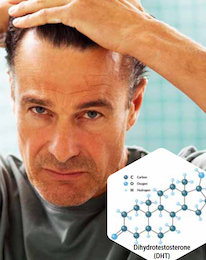 The hair loss and baldness that affects about 80% of American men is associated with elevated levels of the hormone dihydrotestosterone (DHT).
- In a clinical study of men with male pattern baldness, a blend of black rice and prickly pear flower extracts increased hair growth for a stunning 95% of subjects.
- In another clinical study, oral saw palmetto oil decreased hair shedding by up to 29% and increased hair density and new hair growth.
- These three ingredients have been combined into a single oral formula to optimize hair growth and reversal of hair loss.
Summary
 About 80 million Americans experience androgenetic alopecia, the most prevalent form of baldness, and its severity is on the rise.8 It is often linked to an increase in the hormone dihydrotestosterone (DHT).
Scientists have identified plant-derived ingredients that lower DHT levels, reducing this key driver of hair loss.
In a clinical trial on a blend of black rice and prickly pear flower extracts, 95% of treated men had increased hair growth within six months.
In another study, 50% of participants taking saw palmetto oil reported improvement in hair thickness and appearance and 33.3% had new hair growth in 16 weeks.
A combination of all three ingredients may help prevent hair loss and optimize support for hair growth and fullness.
Material used with permission of Life Extension. All rights reserved.
- Nobile V. Efficacy of Oryza Sativa L. (Black Rice) and Opuntia Ficus Indica L. Blend in Men with Androgenetic Alopecia: A Randomized, Double−Blind, Placebo−Controlled Clinical Trial. Journal of Cosmetology & Trichology. 2023;9(3).
- Aukerman EL, Jafferany M. The psychological consequences of androgenetic alopecia: A systematic review. J Cosmet Dermatol. ;22(1):89-95.
- Sudeep HV, Rashmi S, Jestin TV, et al. Oral and Topical Administration of a Standardized Saw Palmetto Oil Reduces Hair Fall and Improves the Hair Growth in Androgenetic Alopecia Subjects - A 16-Week Randomized, Placebo-Controlled Study. Clin Cosmet Investig Dermatol. 2023;16:3251-66.
- Owecka B, Tomaszewska A, Dobrzeniecki K, et al. The Hormonal Background of Hair Loss in Non-Scarring Alopecias. Biomedicines. ;12(3).
- Asfour L CW, Sinclair R. Male Androgenetic Alopecia. National Library of Medicine; 2023.
- Devjani S, Ezemma O, Kelley KJ, et al. Androgenetic Alopecia: Therapy Update. Drugs. ;83(8):701-15.
- Available at: https://www.nccih.nih.gov/health/saw-palmetto. Accessed February 4, 2025.
- Aggarwal I, Puyana C, Chandan N, et al. 42173 Racial and ethnic disparities in androgenetic alopecia clinical trials in the USA. Journal of the American Academy of Dermatology. 2023;89(3):AB214.
Related product
-
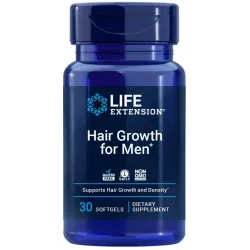
Hair Growth for Men
Price: 24,89 €Supports hair growth, fullness and density Promotes hair health &...
Related posts
-
 MSM - The Multi-Purpose Compound
MSM (methyl-sulfonyl-methane), also known as dimethyl sulfone, is a naturally occurring sulfur compound, found in...
MSM - The Multi-Purpose Compound
MSM (methyl-sulfonyl-methane), also known as dimethyl sulfone, is a naturally occurring sulfur compound, found in... -
Magnesium: Widespread Deficiency with Deadly Consequences
Magnesium is the fourth most abundant mineral in the body and is essential to good health. Approximately 50% of total...
-
Getting Back To Basics … How Low-Cost Zinc Helps Combat Deadly Immunosenescence
Zinc is required by the body for more than 2,000 transcription factors involved in gene expressions of various...
-
Rebuild Youthful Skin, Hair, and Nails from Within
Although aging impacts the whole body, the most visible effects occur in our skin, hair, and nails. As we mature,...
-
Oral Collagen Improves Skin and Joint Health
Collagen makes up about one-third of all protein in the body. In the skin and joints, collagen provides structural...