
 English
 Polski
 Deutsch
 Français
 ελληνικά
 Español
 Italiano
Vitamin K2 and Dental Health: A Promising Nutrient for Stronger Teeth and Healthy Gums
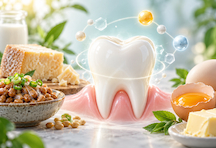 Vitamin K2 is attracting growing interest in scientific research, not only because of its role in maintaining healthy bones, but also because of its potential benefits for teeth, gums, and the tissues that support them.
Although studies directly examining the effects of vitamin K2 supplementation on dental health are still limited, the findings so far provide interesting reasons to explore the role of this essential nutrient further.
How Vitamin K2 Supports Calcium Metabolism
Vitamin K2, also known as menaquinone, plays an important role in the body's calcium metabolism. It helps activate proteins involved in regulating calcium metabolism, including osteocalcin and Matrix Gla Protein (MGP).
Osteocalcin is involved in bone formation and remodeling, while MGP helps regulate calcium deposition in various tissues.
These properties make vitamin K2 a subject of growing scientific interest in research on the health of bones, teeth, and their surrounding tissues [1].
MK-4 and MK-7 are among the best-studied forms of vitamin K2.
The role of vitamin K2 in mineral metabolism is well established. Its potential effects on tooth enamel and long-term dental health are becoming an increasingly interesting area of research.
Vitamin K2 and Tooth Decay: Encouraging Research

In July 2025, an interesting study published in Frontiers in Oral Health explored the relationship between vitamin and mineral intake and the occurrence of dental caries [2].
Using data from the US National Health and Nutrition Examination Survey (NHANES), researchers observed that higher vitamin K intake was associated, in some analyses, with fewer decayed, missing, or filled teeth. This association was observed among adolescents. Findings involving phosphorus and other vitamins also attracted the researchers' attention.
Further interesting findings came from a study published in June 2026 in Medicine. Researchers analyzed data from 4,221 participants in the US NHANES program, investigating associations between vitamin intake and dental caries [3].
Lower reported vitamin K2 intake was associated with a higher likelihood of dental caries, providing another interesting insight into the possible role of this vitamin in oral health.
Both studies offer encouraging findings, although they examined vitamin K2 more broadly rather than the direct effects of K2 supplements. These results provide a promising foundation for further exploration of the potential benefits of vitamin K2 for dental health.
Vitamin K2 and Periodontal Health
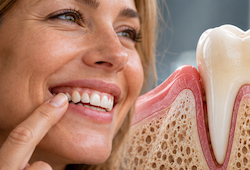 Dental health depends not only on the condition of tooth enamel but also on the health of the gums, periodontal ligaments, and the bone surrounding tooth roots. Together, these tissues provide stability and support for the teeth.
In 2023, a study published in Healthcare involved 100 participants: 50 with periodontitis and 50 without the condition [4].
Participants with periodontitis showed lower values of markers associated with vitamin K2-related activity. These values generally decreased as the severity of the disease increased. The researchers also observed associations with bleeding on probing, loss of periodontal attachment, and loss of the bone surrounding the teeth.
This is an interesting finding, particularly in the context of vitamin K2's role in processes related to bone tissue. It is worth remembering, however, that the researchers assessed osteocalcin-based markers rather than directly measuring blood concentrations of individual forms of vitamin K2.
Laboratory research has also produced promising findings. In 2021, researchers demonstrated that vitamin K2 promoted the differentiation of periodontal ligament stem cells toward cells with bone-forming characteristics through the Wnt/β-catenin signaling pathway [5].
This process is important for the formation and maintenance of healthy bone tissue.
In another study published in 2026, scientists investigated the use of vitamins K2 and B12 in experimental dentin conditioning for regenerative dental procedures [6].
They observed favorable results related to the attachment and migration of periodontal ligament stem cells, as well as processes associated with mineralization.
Although these were laboratory experiments rather than studies of oral supplementation, they highlight the interesting potential of vitamin K2 in research on the tissues surrounding the teeth.
Natural Food Sources of Vitamin K2
 Vitamin K2 can be obtained naturally through the diet. It is found primarily in fermented foods and certain animal-derived products.
One of its richest sources is natto, a traditional Japanese food made from soybeans fermented with Bacillus subtilis bacteria.
Natto is particularly rich in the MK-7 form. A 100 g portion may contain approximately 850-1,000 µg of vitamin K2 [9].
Fermented and aged cheeses, including Gouda, Edam, and Emmental, can also be good sources. Depending on their production methods, they contain different forms of K2, particularly MK-8 and MK-9.
Vitamin K2 can also be found in egg yolks, poultry, pork, liver, butter, and certain full-fat dairy products. Animal-derived foods contain, among other forms, MK-4.
It is also worth distinguishing vitamin K2 from vitamin K1. Spinach, kale, and broccoli are rich in vitamin K1, but they are not significant direct sources of K2.
A varied diet that includes natural sources of K2 is a simple way to obtain this interesting vitamin.
Why Vitamins K2 and D3 Make an Interesting Combination
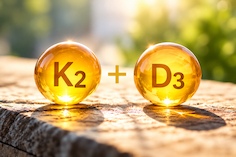 Vitamins K2 and D3 play different but complementary roles in the body's mineral metabolism.
Vitamin D3 supports the absorption of calcium and phosphorus, which are essential for maintaining healthy bones and teeth.
Vitamin K2 helps activate proteins involved in regulating calcium metabolism, such as osteocalcin and MGP.
It is therefore no surprise that scientists are interested in the combined effects of these two vitamins.
A meta-analysis published in 2020 evaluated eight clinical trials involving a total of 971 participants. The researchers examined the combined effects of vitamins D and K2 on bone health [7].
They reported improvements in certain measures of bone mineral density and a reduction in undercarboxylated osteocalcin, a marker associated with vitamin K2 activity.
The complementary roles of vitamins D3 and K2 in calcium metabolism have generated considerable scientific interest in their combination.
Important: People taking warfarin or other vitamin K antagonist medications should consult their doctor before taking K2 supplements, as vitamin K2 may interfere with their treatment [1].
Summary

Vitamin K2 plays an important role in the body's calcium metabolism. Population studies have revealed promising associations between vitamin K intake and dental health. Meanwhile, periodontal research and laboratory studies provide interesting insights into the potential role of K2 in maintaining the health of tissues that support the teeth.
Another interesting area of research is the combination of vitamins K2 and D3, whose complementary actions are important for calcium metabolism and bone health.
Good oral hygiene, regular dental checkups, and limiting frequent sugar consumption remain essential for maintaining dental health. A varied diet that includes natural sources of vitamin K2 and provides an adequate intake of vitamin D is also important.
Scientific findings to date open up promising possibilities for further exploring the role of vitamin K2 in maintaining healthy teeth and periodontal tissues.
- National Institutes of Health, Office of Dietary Supplements. Vitamin K: Fact Sheet for Health Professionals. https://ods.od.nih.gov/factsheets/VitaminK-HealthProfessional/
- Khan, D., et al. (2025). Higher fat-soluble vitamin and phosphorus intake are associated with less dental caries among children and adolescents in the United States, NHANES 2011-2018. Frontiers in Oral Health, 6. https://doi.org/10.3389/froh.2025.1617695
- Huang, J., Zhang, Y., & Zeng, B. (2026). Assessing the role of vitamins in dental caries occurrence: A retrospective study using NHANES data 2011 to 2018. Medicine, 105(26), e49191. https://doi.org/10.1097/MD.0000000000049191
- Olszewska-Czyz, I., & Firkova, E. (2023). A Case Control Study Evaluating the Relationship between Vitamin K2 Serum Level and Periodontitis. Healthcare, 11(22), 2937. https://doi.org/10.3390/healthcare11222937
- Cui, Q., et al. (2021). Vitamin K2 promotes the osteogenic differentiation of periodontal ligament stem cells via the Wnt/β-catenin signaling pathway. Archives of Oral Biology, 124, 105057. https://doi.org/10.1016/j.archoralbio.2021.105057
- Kandil, H. M., et al. (2026). Exploring vitamin K2 and B12 as bioactive micronutrients for dentin conditioning in regenerative endodontics procedures. Naunyn-Schmiedeberg's Archives of Pharmacology, 399, 12645-12658. https://doi.org/10.1007/s00210-026-05129-8
- Kuang, X., et al. (2020). The combination effect of vitamin K and vitamin D on human bone quality: a meta-analysis of randomized controlled trials. Food & Function, 11, 3280-3297. https://doi.org/10.1039/C9FO03063H
- Walther, B., Karl, J. P., Booth, S. L., & Boyaval, P. (2013). Menaquinones, Bacteria, and the Food Supply: The Relevance of Dairy and Fermented Food Products to Vitamin K Requirements. Advances in Nutrition, 4(4), 463-473. https://doi.org/10.3945/an.113.003855
- EFSA Panel on Dietetic Products, Nutrition and Allergies (2017). Dietary reference values for vitamin K. EFSA Journal, 15(5), 4780. https://doi.org/10.2903/j.efsa.2017.4780
Related products
-

-

Low-Dose Vitamin K2 (MK-7) EU
Price: 19,65 €Helps maintain bone density Plays a critical role in maintaining healthy... -
Vitamins D and K with Sea-Iodine™
Price: 18,86 €Helps maintain bone density & promotes vascular health Supplementation... -

Vitamin K2 MenaQ7 from chickpeas
Price: 15,25 €Supports Bone and Cardiovascular Health Supports bone health...
Related posts
-
 Osteoporosis. The Importance of Bone Health
The health of our bones is instrumental to our health and longevity in general. This understanding is especially...
-
Nadciśnienie i „zarządzanie” ciśnieniem krwi. Część 2
Konwencjonalne leczenie nadciśnienia rozpoczyna się od modyfikacji stylu życia, z jednoczesnym dodaniem jednej lub...
-
Ciśnienie krwi i nadciśnienie - „zarządzanie”. Część 3
Wysokie ciśnienie krwi jest bardzo niebezpieczne. Pacjenci często dowiadują się o nim dopiero kiedy wystąpi atak...
-
Osteoporosis - The Little-Known Link Between Bone Health and Total Health
Scientists at the leading edge of osteology (bone research) are discovering that in addition to immune strength,...
-
Benign Prostatic Hyperplasia (BPH) part 2
To slow the natural progression of BPH and its symptoms, the Life Extension Foundation suggests that you have annual...