
 English
 Polski
 Deutsch
 Français
 ελληνικά
 Español
 Italiano
Depression. S-adenosylmethionine (SAMe) part 1
%20part%201.jpg) In 2004, the FDA mandated that all antidepressants carry a “black box” warning on their labels following the discovery of a heightened risk of suicidal thoughts among children taking the pills.1 In December 2006, following a huge federal analysis of hundreds of clinical trials, FDA regulators for the first time acknowledged that the drugs can trigger suicidal thoughts among patients older than 18.1 Prescription antidepressants have brought relief to millions of people who suffer the debilitating symptoms of depressive disease. However, reports linking these drugs to a heightened risk of potentially dangerous side effects have led scientists to continue to search for natural agents that safely and effectively elevate mood. One the most advanced mood-elevating therapies available today is S-adenosylmethionine, a natural compound that the Life Extension Foundation introduced to American consumers back in 1996. Long prescribed in Europe to alleviate depression, SAMe has been demonstrated to be as effective as certain pharmaceutical drugs in improving mood and a host of other conditions—without the side effects often associated with such drugs. In addition to relieving depressive symptoms, SAMe has shown efficacy in fighting liver disease, relieving arthritis pain, and even supporting healthy endothelial function. In this article, we bring readers up to date on research findings attesting to the many diverse health benefits of SAMe. S-adenosylmethionine (SAMe) is a natural compound found in nearly
In 2004, the FDA mandated that all antidepressants carry a “black box” warning on their labels following the discovery of a heightened risk of suicidal thoughts among children taking the pills.1 In December 2006, following a huge federal analysis of hundreds of clinical trials, FDA regulators for the first time acknowledged that the drugs can trigger suicidal thoughts among patients older than 18.1 Prescription antidepressants have brought relief to millions of people who suffer the debilitating symptoms of depressive disease. However, reports linking these drugs to a heightened risk of potentially dangerous side effects have led scientists to continue to search for natural agents that safely and effectively elevate mood. One the most advanced mood-elevating therapies available today is S-adenosylmethionine, a natural compound that the Life Extension Foundation introduced to American consumers back in 1996. Long prescribed in Europe to alleviate depression, SAMe has been demonstrated to be as effective as certain pharmaceutical drugs in improving mood and a host of other conditions—without the side effects often associated with such drugs. In addition to relieving depressive symptoms, SAMe has shown efficacy in fighting liver disease, relieving arthritis pain, and even supporting healthy endothelial function. In this article, we bring readers up to date on research findings attesting to the many diverse health benefits of SAMe. S-adenosylmethionine (SAMe) is a natural compound found in nearly  every body tissue and fluid, where it participates in myriad life-sustaining biochemical reactions.2 In fact, scientists have discovered that SAMe has many of the same beneficial effects in the body as drugs prescribed for numerous health disorders.3-5 Not only does SAMe have a 30-year history of effectiveness in treating depression,6 but growing evidence attests to its efficacy in preventing and treating several types of liver disease.7 Moreover, SAMe has been shown to be at least as effective as most nonsteroidal anti-inflammatory drugs (NSAIDs) in treating arthritis.5 Couple these benefits with its outstanding safety profile, and it is easy to see why a growing number of health professionals regard SAMe as a first-line therapy in managing a host of health conditions.
SAMe Boosts Mood, Complements Prescription Antidepressants
Depression is a major public health problem that afflicts adolescents and children as well as adults. Successive generations of antidepressant drugs, such as tricyclic antidepressants and serotonin reuptake inhibitors (SSRIs), have been hailed as breakthroughs in the treatment of depressive illness Tricyclic antidepressants (such as imipramine, amitryptiline, and others) fell out of favor in the early 1990s, after growing evidence that they induced numerous serious side effects and were often poorly tolerated.8 These side effects appeared to be absent in the newer SSRIs that became hugely popular in the 1990s and remain so today. However, recent findings indicating that SSRIs appear to increase the risk of suicidal ideation in some patients have been the source of both concern and controversy.9 In 2004, the FDA placed a “black box” warning on SSRIs, indicating that the drugs may increase the risk of suicidal thoughts in children,10 and the agency has continued to warn about possible side effects in patients of all ages. These developments pose a vexing dilemma for patients as well as their doctors, who wish to successfully manage depression yet avoid the potentially fatal side effects associated with prescription antidepressants. To safely and effectively manage depression, more people are turning to SAMe. Although SAMe has been used to treat depression for more than a quarter of a century,11,12 it has received relatively little attention in the mainstream medical literature until recently. Today, however, growing evidence suggests that SAMe works as well as certain antidepressants, while demonstrating a superior safety profile. SAMe influences the metabolism of the brain neurotransmitters dopamine and serotonin, both of which help control mood.13 It also crosses the nearly impenetrable barrier between the blood and the brain, an obstacle that prevents many drugs from acting on the central nervous system.14 Naturally occurring levels of SAMe are lower in the spinal fluid of people suffering depression,15 and increasing blood levels of SAMe have been found to produce improvements in depressive symptoms.16 Scientists have also discovered a clear link between SAMe and folic acid, demonstrating that the two nutrients work together to beneficially affect monoamine neurotransmitters, thereby providing support for healthy mood and optimal cognitive and nervous system function.13 In a small open trial in 1984, researchers treated nine depressed inpatients with SAMe, and seven showed improvement in or resolution of their symptoms.17 In another open trial in 20 outpatients, treatment with SAMe completely resolved depressive symptoms in 7 of 11 patients who had no history of poor response to antidepressants, and in 2 of 9 patients who had failed previous treatments with antidepressants.18 Several studies in the late 1980s found SAMe to be as effective as tricyclic antidepressants 8 in fighting depression. In one double-blind, controlled trial of patients with major depression,16 nine were given intravenous SAMe and nine took imipramine for 14 days. Improvement was seen in the SAMe group by the end of the first week, and by the end of the trial, 66% of the SAMe group had exhibited significant improvement, compared to only 22% in the imipramine group. More recently, Italian researchers published the results of two multicenter trials comparing SAMe with oral imipramine.3,19 In the first trial, 143 patients took 1600 mg of SAMe orally each day, while 138 took 150 mg a day of imipramine. In the second trial, 147 patients received 400 mg a day of SAMe by intramuscular injection, and 148 took oral imipramine. Researchers then compared the patients’ scores on two standard scales of depression. While the results of treatment were the same for patients receiving SAMe and imipramine, the SAMe patients experienced significantly fewer side effects. As many as 46% of patients
  with major depressive illness show either a partial response or no response to antidepressant therapy, highlighting the need for strategies to improve the efficacy of treatment for depression.12 In 2004, researchers studied the complementary effects of SAMe and modern antidepressant drugs.20
Thirty patients who had incomplete responses to SSRIs or venlafaxine (Effexor®) were administered 800-1600 mg per day of SAMe for six weeks. Fifty percent of these treatment-resistant patients improved with the addition of SAMe to their therapy, and 43% experienced remission of symptoms. The authors concluded that augmenting antidepressant therapy with SAMe might well be effective in alleviating treatment-resistant depression. A quick onset of action is particularly important in therapies to treat depression. While most prescription drugs take up to three weeks to produce significant effects, injections of SAMe (at 400 mg per day) in 195 patients
21 reduced depressive symptoms after just seven days, with further improvement by 15 days—nearly a week before improvement might be expected with prescription medications. In depressed patients with HIV/AIDS,22 SAMe treatment also reduced depression symptom scores after just one week of treatment, with steady improvement continuing for all eight weeks of the trial. SAMe has also been demonstrated to speed the onset of action of standard antidepressants. For example, in a double-blind study of 40 patients beginning treatment with 150 mg a day of oral imipramine,23 injections of SAMe (at 200 mg a day) decreased depressive symptoms faster than imipramine alone. Fibromyalgia, a crippling condition marked by severe musculoskeletal pain and frequent sleep disturbances, often results in marked mood changes, including depressive symptoms. SAMe at doses of up to 800 mg a day has shown promise in alleviating fibromyalgia symptoms such as depression, fatigue, and morning stiffness—presumably as a result of its anti-inflammatory and mood-elevating properties.24,25- Long used in Europe as a prescription drug to fight depression, S-adenosylmethionine (SAMe) was introduced to the US in 1996 by the Life Extension Foundation.

- SAMe participates in many essential biochemical reactions in the body, contributing to antioxidant protection, cell signaling, and production of neurotransmitters and hormones.
- SAMe quickly and effectively elevates depressed mood, with an efficacy comparable to that of prescription drugs and minimal or no side effects. It may even help manage cases of resistant depression.
- SAMe offers numerous benefits for those with liver and gall bladder diseases by enhancing bile flow and protecting the liver against toxin-induced damage. It also alleviates the pain and inflammation of arthritis, with effects comparable to those of nonsteroidal anti-inflammatory drugs (NSAIDs) such as ibuprofen.
- SAMe supports healthy endothelial function and may one day be used to protect blood vessel linings against the dangerous effects of ischemia (oxygen deprivation) that occurs with heart attack, stroke, and transplant surgery.
1. Vedantum S. Antidepressants a suicide risk for young adults. The Washington Post. December 14, 2006:A16
2. Friedel HA, Goa KL, Benfield P. S-adenosyl-L-methionine. A review of its pharmacological properties and therapeutic potential in liver dysfunction and affective disorders in relation to its physiological role in cell metabolism. Drugs. 1989 Sep;38(3):389-416.
3. Pancheri P, Scapicchio P, Chiaie RD. A double-blind, randomized parallel-group, efficacy and safety study of intramuscular S-adenosyl-L-methionine 1,4-butanedisulphonate (SAMe) versus imipramine in patients with major depressive disorder. Int J Neuropsychopharmacol. 2002 Dec;5(4):287-94.
4. Roncaglia N, Locatelli A, Arreghini A, et al. A randomised controlled trial of ursodeoxycholic acid and S-adenosyl-l-methionine in the treatment of gestational cholestasis. BJOG. 2004 Jan;111(1):17-21.
5. Soeken KL, Lee WL, Bausell RB, Agelli M, Berman BM. Safety and efficacy of S-adenosylmethionine (SAMe) for osteoarthritis. J Fam Pract. 2002 May;51(5):425-30.
6. Mischoulon D, Fava M. Role of S-adenosyl-L-methionine in the treatment of depression: a review of the evidence. Am J Clin Nutr. 2002 Nov;76(5):1158S-61S.
7. Frezza M, Surrenti C, Manzillo G, et al. Oral S-adenosylmethionine in the symptomatic treatment of intrahepatic cholestasis. A double-blind, placebo-controlled study. Gastroenterology. 1990 Jul;99(1):211-5.
8. Kagan BL, Sultzer DL, Rosenlicht N, Gerner RH. Oral S-adenosylmethionine in depression: a randomized, double-blind, placebo-controlled trial. Am J Psychiatry. 1990 May;147(5):591-5.
9. Gibbons RD, Hur K, Bhaumik DK, Mann JJ. The relationship between antidepressant prescription rates and rate of early adolescent suicide. Am J Psychiatry. 2006 Nov;163(11):1898-904.
10. Rihmer Z, Akiskal H. Do antidepressants t(h)reat(en) depressives? Toward a clinically judicious formulation of the antidepressant-suicidality FDA advisory in light of declining national suicide statistics from many countries. J Affect Disord. 2006 Aug;94(1-3):3-13.
11. Monaco P, Quattrocchi F. Study of the antidepressive effects of a biological transmethylating agent (S-adenosyl-methione or SAM). Riv Neurol. 1979 Nov;49(6):417-39.
12. Papakostas GI, Alpert JE, Fava M. S-adenosyl-methionine in depression: a comprehensive review of the literature. Curr Psychiatry Rep. 2003 Dec;5(6):460-6.
13. Carney MW, Edeh J, Bottiglieri T, Reynolds EM, Toone BK. Affective illness and S-adenosyl methionine: a preliminary report. Clin Neuropharmacol. 1986;9(4):379-85.
14. Carney MW, Toone BK, Reynolds EH. S-adenosylmethionine and affective disorder. Am J Med. 1987 Nov 20;83(5A):104-6.
15. Bottiglieri T, Godfrey P, Flynn T, et al. Cerebrospinal fluid S-adenosylmethionine in depression and dementia: effects of treatment with parenteral and oral S-adenosylmethionine. J Neurol Neurosurg Psychiatry. 1990 Dec;53(12):1096-8.
16. Bell KM, Potkin SG, Carreon D, Plon L. S-adenosylmethionine blood levels in major depression: changes with drug treatment. Acta Neurol Scand Suppl. 1994;154:15-8.
17. Lipinski JF, Cohen BM, Frankenburg F, et al. Open trial of S-adenosylmethionine for treatment of depression. Am J Psychiatry. 1984 Mar;141(3):448-50.
18. Rosenbaum JF, Fava M, Falk WE, et al. The antidepressant potential of oral S-adenosyl-l-methionine. Acta Psychiatr Scand. 1990 May;81(5):432-6.
19. Delle CR, Pancheri P, Scapicchio P. Efficacy and tolerability of oral and intramuscular S-adenosyl-L-methionine 1,4-butanedisulfonate (SAMe) in the treatment of major depression: comparison with imipramine in 2 multicenter studies. Am J Clin Nutr. 2002 Nov;76(5):1172S-6S.
20. Alpert JE, Papakostas G, Mischoulon D, et al. S-adenosyl-L-methionine (SAMe) as an adjunct for resistant major depressive disorder: an open trial following partial or nonresponse to selective serotonin reuptake inhibitors or venlafaxine. J Clin Psychopharmacol. 2004 Dec;24(6):661-4.
21. Fava M, Giannelli A, Rapisarda V, Patralia A, Guaraldi GP. Rapidity of onset of the antidepressant effect of parenteral S-adenosyl-L-methionine. Psychiatry Res. 1995 Apr 28;56(3):295-7.
22. Shippy RA, Mendez D, Jones K, Cergnul I, Karpiak SE. S-adenosylmethionine (SAM-e) for the treatment of depression in people living with HIV/AIDS. BMC Psychiatry. 2004 Nov 11;438.
23. Berlanga C, Ortega-Soto HA, Ontiveros M, Senties H. Efficacy of S-adenosyl-L-methionine in speeding the onset of action of imipramine. Psychiatry Res. 1992 Dec;44(3):257-262.
24. Jacobsen S, nneskiold-Samsoe B, Andersen RB. Oral S-adenosylmethionine in primary fibromyalgia. Double-blind clinical evaluation. Scand J Rheumatol. 1991;20(4):294-302.
25. Tavoni A, Vitali C, Bombardieri S, Pasero G. Evaluation of S-adenosylmethionine in primary fibromyalgia. A double-blind crossover study. Am J Med. 1987 Nov 20;83(5A):107-10.
26. Miller AL. The methionine-homocysteine cycle and its effects on cognitive diseases. Altern Med Rev. 2003 Feb;8(1):7-19.
27. Bottiglieri T. Folate, vitamin B12, and neuropsychiatric disorders. Nutr Rev. 1996 Dec;54(12):382-90.
28. Bottiglieri T, Laundy M, Crellin R, et al. Homocysteine, folate, methylation, and monoamine metabolism in depression. J Neurol Neurosurg Psychiatry. 2000 Aug;69(2):228-32.
29. Colell A, Garcia-Ruiz C, Miranda M, et al. Selective glutathione depletion of mitochondria by ethanol sensitizes hepatocytes to tumor necrosis factor. Gastroenterology. 1998 Dec;115(6):1541-51.
30. Fernandez-Checa JC, Kaplowitz N, Garcia-Ruiz C, et al. GSH transport in mitochondria: defense against TNF-induced oxidative stress and alcohol-induced defect. Am J Physiol. 1997 Jul;273(1 Pt 1):G7-17.
31. Patrick L. Toxic metals and antioxidants: Part II. The role of antioxidants in arsenic and cadmium toxicity. Altern Med Rev. 2003 May;8(2):106-28.
32. Chawla RK, Bonkovsky HL, Galambos JT. Biochemistry and pharmacology of S-adenosyl-L-methionine and rationale for its use in liver disease. Drugs. 1990;40 Suppl 3:98-110.
33. Sofia HJ, Chen G, Hetzler BG, Reyes-Spindola JF, Miller NE. Radical SAM, a novel protein superfamily linking unresolved steps in familiar biosynthetic pathways with radical mechanisms: functional characterization using new analysis and information visualization methods. Nucleic Acids Res. 2001 Mar 1;29(5):1097-106.
34. Fernandez-Checa JC, Colell A, Garcia-Ruiz C. S-Adenosyl-L-methionine and mitochondrial reduced glutathione depletion in alcoholic liver disease. Alcohol. 2002 Jul;27(3):179-83.
35. Arias-Diaz J, Vara E, Garcia C et al. S-adenosylmethionine protects hepatocytes against the effects of cytokines. J Surg Res. 1996 Apr;62(1):79-84.
36. Dhiman RK, Chawla YK. Is there a link between oestrogen therapy and gallbladder disease? Expert Opin Drug Saf. 2006 Jan;5(1):117-29.
37. Richardson WS, Carter KM, Helm B, et al. Risk factors for gallstone disease in the laparoscopic era. Surg Endosc. 2002 Mar;16(3):450-2.
38. Di PC, Tritapepe R, Di PF, Frezza M, Stramentinoli G. S-adenosyl-L-methionine antagonizes oral contraceptive-induced bile cholesterol supersaturation in healthy women: preliminary report of a controlled randomized trial. Am J Gastroenterol. 1984 Dec;79(12):941-4.
39. Look MP, Riezler R, Reichel C, et al. Is the increase in serum cystathionine levels in patients with liver cirrhosis a consequence of impaired homocysteine transsulfuration at the level of gamma-cystathionase? Scand J Gastroenterol. 2000 Aug;35(8):866-72.
40. Yu J, Sauter S, Parlesak A. Suppression of TNF-alpha production by S-adenosylmethionine in human mononuclear leukocytes is not mediated by polyamines. Biol Chem. 2006 Dec;387(12):1619-27.
41. Loguercio C, Nardi G, Argenzio F, et al. Effect of S-adenosyl-L-methionine administration on red blood cell cysteine and glutathione levels in alcoholic patients with and without liver disease. Alcohol Alcohol. 1994 Sep;29(5):597-604.
42. Diaz BA, Dominguez HR, Uribe AF. Parenteral S-adenosylmethionine compared to placebos in the treatment of alcoholic liver diseases. An Med Interna. 1996 Jan;13(1):9-15.
43. Mato JM, Camara J, Fernandez de PJ, et al. S-adenosylmethionine in alcoholic liver cirrhosis: a randomized, placebo-controlled, double-blind, multicenter clinical trial. J Hepatol. 1999 Jun;30(6):1081-9.
44. Purohit V, Russo D. Role of S-adenosyl-L-methionine in the treatment of alcoholic liver disease: introduction and summary of the symposium. Alcohol. 2002 Jul;27(3):151-4.
45. Podymova SD, Nadinskaia MIu. Clinical trial of heptral in patients with chronic diffuse liver disease with intrahepatic cholestasis syndrome. Klin Med (Mosk). 1998;76(10):45-8.
46. Polli E, Cortellaro M, Parrini L, Tessari L, Cherie LG. Pharmacological and clinical aspects of S-adenosylmethionine (SAMe) in primary degenerative arthropathy (osteoarthrosis). Minerva Med. 1975 Dec 5;66(83):4443-59.
47. Stramentinoli G, Pezzoli C, Catto E. Anti-inflammatory and analgesic action of S-adenosyl-L-methionine (SAMe) in experimental tests on laboratory animals. Minerva Med. 1975 Dec 5;66(83):4434-42.
48. Barcelo HA, Wiemeyer JC, Sagasta CL, Macias M, Barreira JC. Effect of S-adenosylmethionine on experimental osteoarthritis in rabbits. Am J Med. 1987 Nov 20;83(5A):55-9.
49. Barcelo HA, Wiemeyer JC, Sagasta CL, Macias M, Barreira JC. Experimental osteoarthritis and its course when treated with S-adenosyl-L-methionine. Rev Clin Esp. 1990 Jun;187(2):74-8.
50. Gutierrez S, Palacios I, Sanchez-Pernaute O, et al. SAMe restores the changes in the proliferation and in the synthesis of fibronectin and proteoglycans induced by tumour necrosis factor alpha on cultured rabbit synovial cells. Br J Rheumatol. 1997 Jan;36(1):27-31.
51. Glorioso S, Todesco S, Mazzi A, et al. Double-blind multicentre study of the activity of S-adenosylmethionine in hip and knee osteoarthritis. Int J Clin Pharmacol Res. 1985;5(1):39-49.
52. Caruso I, Pietrogrande V. Italian double-blind multicenter study comparing S-adenosylmethionine, naproxen, and placebo in the treatment of degenerative joint disease. Am J Med. 1987 Nov 20;83(5A):66-71.
53. Maccagno A, Di Giorgio EE, Caston OL, Sagasta CL. Double-blind controlled clinical trial of oral S-adenosylmethionine versus piroxicam in knee osteoarthritis. Am J Med. 1987 Nov 20;83(5A):72-7.
54. Vetter G. Double-blind comparative clinical trial with S-adenosylmethionine and indomethacin in the treatment of osteoarthritis. Am J Med. 1987 Nov 20;83(5A):78-80.
55. Najm WI, Reinsch S, Hoehler F, Tobis JS, Harvey PW. S-adenosyl methionine (SAMe) versus celecoxib for the treatment of osteoarthritis symptoms: a double-blind cross-over trial. BMC Musculoskelet Disord. 2004 Feb 26;5:6.
56. Available at: http://www.pdrhealth.com/drug_info/nmdrugprofiles/nutsupdrugs/sad_0231.shtml. Accessed February 5, 2007.
57. Goren JL, Stoll AL, Damico KE, Sarmiento IA, Cohen BM. Bioavailability and lack of toxicity of S-adenosyl-L-methionine (SAMe) in humans. Pharmacotherapy. 2004 Nov;24(11):1501-7.
58. Carney MW, Chary TK, Bottiglieri T, Reynolds EH. The switch mechanism and the bipolar/unipolar dichotomy. Br J Psychiatry. 1989 Jan;154:48-51.
59. Han SH, Quon MJ, Koh KK. Reciprocal relationships between abnormal metabolic parameters and endothelial dysfunction. Curr Opin Lipidol. 2007 Feb;18(1):58-65.
60. Martens FM, Visseren FL. The operative risk factors in the metabolic syndrome: is it lipids and high BP or are there direct vascular effects of insulin resistance and obesity. Curr Diab Rep. 2007 Feb;7(1):74-81.
61. Wassink AM, Olijhoek JK, Visseren FL. The metabolic syndrome: metabolic changes with vascular consequences. Eur J Clin Invest. 2007 Jan;37(1):8-17.
62. Purushothaman KR, Meerarani P, Moreno PR. Inflammation and neovascularization in diabetic atherosclerosis. Indian J Exp Biol. 2007 Jan;45(1):93-102.
63. Soucy KG, Lim HK, Benjo A, et al. Single exposure gamma-irradiation amplifies xanthine oxidase activity and induces endothelial dysfunction in rat aorta. Radiat Environ Biophys. 2007 Jan 26.
64. Spijkerman AM, Smulders YM, Kostense PJ, et al. S-adenosylmethionine and 5-methyltetrahydrofolate are associated with endothelial function after controlling for confounding by homocysteine: the Hoorn Study. Arterioscler Thromb Vasc Biol. 2005 Apr;25(4):778-84.
65. Net M, Valero R, Almenara R, et al. Hepatic preconditioning after prolonged warm ischemia by means of S-adenosyl-L-methionine administration in pig liver transplantation from non-heart-beating donors. Transplantation. 2003 Jun 27;75(12):1970-7.
Related products
-

SAM-e (S-Adenosyl-Methionine) 400 mg 30 tablets
Price: 34,72 €Promotes brain and liver health Helps maintain stable mood Helps maintain... -
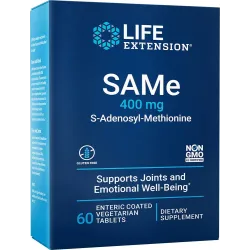
SAM-e (S-Adenosyl-Methionine) 400 mg 60 tablets
Price: 64,15 €Promotes brain and liver health Helps maintain stable mood Helps maintain...
Related posts
-
 Rebuild Aging Joints!
In this article, you will learn about UC-II®, or undenatured type II collagen, a novel intervention for both...
Rebuild Aging Joints!
In this article, you will learn about UC-II®, or undenatured type II collagen, a novel intervention for both... -
Next-Generation Nutrients for Rapid Relief of Joint Pain
In recent years, adults seeking relief from the crippling pain of arthritis have had to choose between expensive,...
-
Feed Your Brain!
Millions of people around the world are adhering to low-fat, low-cholesterol diets in an effort to reduce the impact...
-
Vitamin C and Dihydroquercetin
Every day, our bodies are under continual assault by damaging agents known as free radicals. Generally, both internal...
-
Autoimmune Diseases part 1
Autoimmune diseases are characterized by the body's immune responses being directed against its own tissues, causing...