
 English
 Polski
 Deutsch
 Français
 ελληνικά
 Español
 Italiano
Revitalize Skin with Vegan Procollagen
Collagen forms 70% of the skin's underlying scaffolding known as the dermis.1 It is required to maintain youthful-looking skin.2,3
With age, our internal collagen production markedly declines.3,4
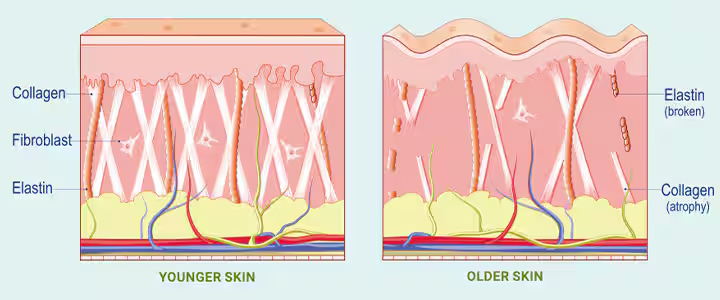 Collagen loss weakens skin structures, leading to dryness, sagging, and wrinkles.2
Scientists have developed a vegan approach to collagen replenishment known as procollagen with inducer compounds that promote the body's production of collagen.
In 2024, the Journal of Functional Foods published the results of a clinical trial showing that in just 8 weeks, this plant-derived procollagen:
- Decreased wrinkles by 14%.
- Enhanced smoothness by 13%.
- Increased (skin) collagen density by 8%.
It provided the benefits of collagen, using vegan ingredients.
The Secret to Youthful Skin
Collagen, the most abundant protein in the human body,3 is essential for youthful-looking skin.
Type 1 is the main collagen found in skin, making up 80%-90% of the subsurface layer of the skin by weight.6 Collagen gives skin a smooth appearance, firmness, and resilience.7
 It also provides flexibility. It is integrated with fibers of elastin, a protein that allows the skin to stretch and return to its original shape.
Around age 25, the cells that produce collagen fibers slow down. The remaining fibers can stiffen, break, and lose shape.3,7
With advancing age, the ability to replenish collagen naturally declines by about 1%- 1.5% each year.7
Collagen decline accelerates even faster in women after menopause.8 Smoking, lack of sleep, excess alcohol, and sun exposure also decrease collagen levels.3,9-11
The result of collagen loss is visible skin aging, including thinning, sagging, and wrinkles.12
A Vegan Collagen Biomimetic
To boost collagen levels, people frequently take oral collagen, which is chiefly derived from cows (bovine collagen), chicken, or fish (marine collagen).
When these collagens are ingested, they are broken down into amino acids, which are then absorbed and used by the body.3,13
Although the amino acid profile in animal collagen is similar to that of humans there may be a challenge due to people's sensitivities and dietary preferences.5
Scientists have developed a vegan alternative that has exactly the same amino acid profile as the most abundant collagen found in human skin, known as human type I collagen.
This precise combination of amino acids is known as a human type I collagen biomimetic.
This formulation does not contain collagen. It is a procollagen (a collagen precursor) that mimics the effects of supplementation with animal collagen while using only sustainable, allergen-free, vegan ingredients.
Stimulating Collagen Production
 Although this procollagen delivers the right amino acids in the right proportions, scientists needed to ensure that the human body would optimally assemble these building blocks into collagen.
To make this happen, three inducing compounds were added that have been shown in preclinical studies to stimulate collagen synthesis.5,14,15
These three inducing agents are:
- Vitamin C,
- Ginseng root extract, and
- Gotu kola (Centella asiatica) leaf extract.
In a cell study, human skin fibroblasts (the cells mainly responsible for collagen synthesis) were treated with this combination of amino acids and inducing compounds.
After 48 hours , the collagen in the fibroblasts had increased by 135%,16 showing that this formulation induced new collagen synthesis.
What You Need to Know: A Vegan Alternative to Collagen
 Collagen keeps skin smooth, hydrated, and youthful looking.
- Starting around age 25, collagen production decreases about 1-1.5% per year, leading to wrinkles, roughness, and dry, sagging skin.
- Most oral collagen is derived from cows, chicken, or fish. A new, oral procollagen is entirely vegan, and is used by the human body to make its own collagen.
- This procollagen formula contains an amino acid profile identical to that of human skin type I collagen, plus three inducing compounds that promote the body's own collagen synthesis.
- Human studies showed that taking 5 grams of this vegan alternative decreased wrinkles by 14%, increased skin smoothness up to 16%, and improved hydration, elasticity, and redness.
Rejuvenating Skin
Based on these results, scientists proceeded with human trials.
In a pilot study, adults who took 3.9 grams of this vegan procollagen daily had a 5% increase in collagen density and a 13% decrease in skin wrinkles after four weeks.17
In another pilot study, adults who took 5 grams of the procollagen daily for four weeks had:18
- 14% greater collagen density,
- 16% less roughness,
- 16% less skin redness,
- 14% decrease in wrinkles, and a
- 7% increase in skin hydration.
No adverse effects were observed.
Turning Back the Clock
 Encouraged by these findings, scientists conducted a larger clinical trial of this vegan procollagen and published the results in 2024.
They divided 90 adults into three groups. Daily, before breakfast:5
- Group 1 took a placebo,
- Group 2 took 5 grams of fish collagen, and
- Group 3 took 5 grams of vegan procollagen.
Wrinkles were measured using forehead skin.
After eight weeks, compared to baseline, those who had taken the procollagen had:5
- 8% increase in skin collagen density,
- 14% decrease in skin wrinkles,
- 6% increase in skin elasticity,
- 13% improvement in skin smoothness, and
- 6% increase in skin hydration.
Of those showing wrinkle reduction in the procollagen group, most (63%) had a remarkable average 33% reduction in the size of the wrinkles.5
Overall, the improvements were superior to placebo results and similar to the results for marine collagen, making it an effective vegan alternative to collagen.
Summary
Collagen loss results in wrinkles, sagging, and other signs of skin aging.
Scientists developed an oral vegan procollagen containing the identical amino acid profile found in human skin type I collagen.
They added inducing compounds to stimulate the body's own collagen synthesis.
Human trials showed that this formula safely produces a 13%-14% decrease in skin wrinkles in just eight weeks. Smoothness, hydration, elasticity, and redness also improved.
This procollagen represents an effective vegan alternative to animal-based collagen products.
Material used with permission of Life Extension. All rights reserved.
- Park S. Biochemical, structural and physical changes in aging human skin, and their relationship. Biogerontology. 2022 Jun;23(3):275-88.
- Rittie L, Fisher GJ. Natural and sun-induced aging of human skin. Cold Spring Harb Perspect Med. 2015 Jan 5;5(1):a015370.
- Available at: https://www.hsph.harvard.edu/nutritionsource/collagen/. Accessed May 13, 2024.
- Quan T, Fisher GJ. Role of Age-Associated Alterations of the Dermal Extracellular Matrix Microenvironment in Human Skin Aging: A Mini-Review. Gerontology. 2015;61(5):427-34.
- Lin Y-K, Liang C-H, Lin Y-H, et al. Oral supplementation of vegan collagen biomimetic has beneficial effects on human skin physiology: A double-blind, placebo-controlled study. Journal of Functional Foods. 2024 2024/01/01/;112:105955.
- Asserin J, Lati E, Shioya T, Prawitt J. The effect of oral collagen peptide supplementation on skin moisture and the dermal collagen network: evidence from an ex vivo model and randomized, placebo-controlled clinical trials. Journal of Cosmetic Dermatology. 2015;14(4):291-301.
- Reilly DM, Lozano J. Skin collagen through the lifestages: importance for skin health and beauty. Plastic and Aesthetic Research. 2021;8:2.
- Available at: https://www.aad.org/public/everyday-care/skin-care-secrets/anti-aging/skin-care-during-menopause. Accessed May 13, 2024.
- Gautieri A, Passini FS, Silvan U, et al. Advanced glycation end-products: Mechanics of aged collagen from molecule to tissue. Matrix Biol. 2017 May;59:95-108.
- Danby FW. Nutrition and aging skin: sugar and glycation. Clin Dermatol. 2010 Jul-Aug;28(4):409-11.
- Bosch R, Philips N, Suarez-Perez JA, et al. Mechanisms of Photoaging and Cutaneous Photocarcinogenesis, and Photoprotective Strategies with Phytochemicals. Antioxidants (Basel). 2015 Mar 26;4(2):248-68.
- Ganceviciene R, Liakou AI, Theodoridis A, et al. Skin anti-aging strategies. Dermatoendocrinol. 2012 Jul 1;4(3):308-19.
- Naomi R, Ridzuan PM, Bahari H. Current Insights into Collagen Type I. Polymers (Basel). 2021 Aug 9;13(16).
- Lee J, Jung E, Kim Y, et al. Asiaticoside induces human collagen I synthesis through TGFbeta receptor I kinase (TbetaRI kinase)-independent Smad signaling. Planta Med. 2006 Mar;72(4):324-8.
- Lee J, Jung E, Lee J, et al. Panax ginseng induces human Type I collagen synthesis through activation of Smad signaling. J Ethnopharmacol. 2007 Jan 3;109(1):29-34.
- File. SISDo. Vegan formulation increases collagen synthesis in human fibroblasts 48409.docx. 48409.docx. 2022.
- File. SISDo. Efficacy Evaluation of VeCollal on Skin Conditions 20220325 .pdf. [Data on File]. 2021.
- 2022 SISDoF. Clinical Study 2 Human study report-VeCollal (5g) 20220805.pdf. [Data on File]. 2022.
Related product
-
Vegan Pro Collagen
Price: 40,44 €Helps reduce the appearance of wrinkles, for plant-based diets Helps to...
Related posts
-
 MSM - The Multi-Purpose Compound
MSM (methyl-sulfonyl-methane), also known as dimethyl sulfone, is a naturally occurring sulfur compound, found in...
MSM - The Multi-Purpose Compound
MSM (methyl-sulfonyl-methane), also known as dimethyl sulfone, is a naturally occurring sulfur compound, found in... -
Magnesium: Widespread Deficiency with Deadly Consequences
Magnesium is the fourth most abundant mineral in the body and is essential to good health. Approximately 50% of total...
-
Getting Back To Basics … How Low-Cost Zinc Helps Combat Deadly Immunosenescence
Zinc is required by the body for more than 2,000 transcription factors involved in gene expressions of various...
-
Rebuild Youthful Skin, Hair, and Nails from Within
Although aging impacts the whole body, the most visible effects occur in our skin, hair, and nails. As we mature,...
-
Oral Collagen Improves Skin and Joint Health
Collagen makes up about one-third of all protein in the body. In the skin and joints, collagen provides structural...