
 English
 Polski
 Deutsch
 Français
 ελληνικά
 Español
 Italiano
Prebiotics for Better Health
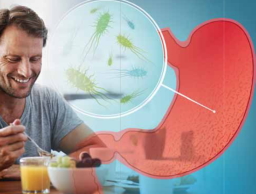 Growing research shows that prebiotics are important “companions” to probiotics for optimal digestive health.
The gut microbiota, which are the trillions of microorganisms that reside in our gut, have been linked to mood, cardiovascular and gastrointestinal health, and the ability to ward off disease.1-4
Among the most important and beneficial gut bacteria are those belonging to the group bifidobacteria.5
Research shows that bifidobacteria have wide-ranging health benefits. They are associated with protection against allergies, high cholesterol levels, and respiratory diseases.6
With age, intestinal levels of beneficial bifidobacteria decline.6
To promote restoration of healthy bifidobacteria levels, scientists have identified a prebiotic called xylooligosaccharide (XOS).
Even in low doses, it increases gut bifidobacteria in as few as 14 days, without unpleasant digestive effects.7,8
XOS also reduces blood levels of cholesterol, triglycerides, and glucose.8
Taking oral XOS is a convenient and quick way to boost beneficial bifidobacteria.
How Prebiotics Work
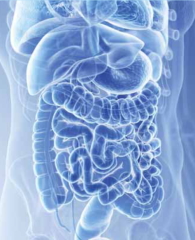 The trillions of microorganisms that reside in the human digestive tract—known as the gut microbiota—do much more than promote healthy digestion. They impact immunity, metabolism, the endocrine system, mood, and cardiovascular health.4,9-12
Foods that nourish and promote healthy gut flora are called prebiotics.
For a food ingredient to be classified as a prebiotic, it must:13
- Resist digestion,
- Be fermented by intestinal microorganisms, and
- Stimulate growth and/or activity of beneficial bacteria.
Most commercial prebiotics require large doses to provide optimal digestive health support. Unfortunately, this can cause excessive flatulence, bloating and general digestive discomfort.14
But years of research identified a prebiotic that works at extremely low doses. It’s known as XOS (xylooligosaccharide).
Even better, it specifically targets and boosts levels of bifidobacteria.
Bifidobacteria Decline with Age
 Levels of beneficial bifidobacteria decline dramatically with age.
In early adulthood, bifidobacteria make up 30%-40% of our gut microbiota. Those levels fall to about:6
- 10% by late middle-age, and
- Less than 5% by old age.
Replenishing intestinal bifidobacteria restores their healthful effects on the body, while leaving less room for dangerous bacteria to take up residence.15
That’s where XOS comes in. Made from non-GMO corn cobs, this prebiotic targets bifidobacteria, preferentially promoting their growth.
XOS Boosts Bifidobacteria
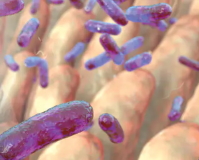 Studies have demonstrated that XOS safely and significantly boosts levels of bifidobacteria.7,8
In one double-blind, randomized, placebo-controlled study, microbiologists and clinical researchers with the UCLA School of Medicine enlisted 32 healthy subjects and divided them into three groups.
Every day for eight weeks, one group took a placebo, the second took 1.4 grams of XOS, and the third took 2.8 grams of XOS.7
The preparation contained 70% XOS, so that the total amount of XOS ingested in the two study groups was 1 gram or 2 grams, respectively.
Both treatment groups had increases in bifido-bacteria, but those taking 2 grams daily of XOS had significantly larger increases than the lower-dose group.7
To achieve similar increases using another common prebiotic, FOS (fructooligosaccharides), you’d have to take 10 to 20 grams, enough to cause cramps and other digestive problems.7
The XOS study found no significant side effects in any of the groups.
Results in Just Two Weeks
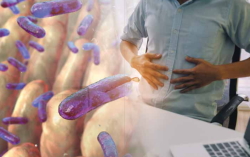 Another team of scientists using the same doses of the same XOS preparation found that this prebiotic could significantly boost bifidobacteria levels in a much shorter time.8
The group taking 1 gram of XOS daily saw significant increases in bifidobacteria in 28 days.8
Those taking 2 grams of XOS daily achieved significant increases in bifidobacteria in just 14 days.8
Why bifidobacteria respond so quickly and effectively to XOS, and at such low doses, is still being studied.
Research shows that bifidobacteria feed on precisely the types of carbohydrates that humans cannot digest, especially the group known as oligosaccharides.
XOS (xylooligosaccharide) is an important example of this group.16
Benefits of XOS
 Taking XOS and raising bifidobacteria levels results in wide-ranging health benefits.8
One study found that taking XOS led to gastrointestinal and metabolic improvements, including:8
- Increased fecal acidity, which inhibits less-desirable bacteria and promotes healthy bacteria,17
- Decreased triglycerides and cholesterol in the blood and increased levels in feces, and
- Decreased blood sugar, protecting against type II diabetes and metabolic syndrome.
A recent 2020 rat study found that XOS supplementation modulates gut flora and reduces colon inflammation caused by high-fat-diet-induced obesity.18
WHAT YOU NEED TO KNOW: The Benefits of a Powerful Prebiotic
- The trillions of bacteria living in the human gut have an enormous impact on our health and vulnerability to disease.
- Higher levels of bifidobacteria are associated with resistance to a wide range of age-related diseases.
- A prebiotic called XOS (xylooligosaccharide) has been validated in human studies to specifically target and boost bifidobacteria. It works in very low doses, without side effects, in as little as two weeks.
In addition, in treated rats XOS counteracted the weight gain induced by a high-fat diet and decreased inflammatory factors in the colon.
Summary
 The trillions of organisms that reside in the human digestive tract, or the gut microbiota, are a critical factor in sustaining our resistance to disease and promoting good health.
Among the most beneficial gut bacteria are those belonging to the group bifidobacteria.
With age, intestinal levels of these beneficial bacteria decline.
Scientists have identified a novel prebiotic called XOS (xylooligosaccharide) that has been shown in human clinical trials to boost bifidobacteria populations in the gut in as little as two weeks.
Unlike other prebiotics, XOS is effective in low doses, without side effects.
XOS has also been shown to lower cholesterol, triglycerides, and blood sugar, risk factors for cardiovascular disease and diabetes, respectively.
Material used with permission of Life Extension. All rights reserved.
- Griffin JL, Wang X, Stanley E. Does our gut microbiome predict cardiovascular risk? A review of the evidence from metabolomics. Circ Cardiovasc Genet. 2015 Feb;8(1):187-91.
- Tang WH, Kitai T, Hazen SL. Gut Microbiota in Cardiovascular Health and Disease. Circ Res. 2017 Mar 31;120(7):1183-96.
- Marques FZ, Mackay CR, Kaye DM. Beyond gut feelings: how the gut microbiota regulates blood pressure. Nat Rev Cardiol. 2018 Jan;15(1):20-32.
- Galland L. The gut microbiome and the brain. J Med Food. 2014 Dec;17(12):1261-72.
- Turroni F, Marchesi JR, Foroni E, et al. Microbiomic analysis of the bifidobacterial population in the human distal gut. ISME J. 2009 Jun;3(6):745-51.
- Arboleya S, Watkins C, Stanton C, et al. Gut Bifidobacteria Populations in Human Health and Aging. Front Microbiol. 2016;7:1204.
- Finegold SM, Li Z, Summanen PH, et al. Xylooligosaccharide increases bifidobacteria but not lactobacilli in human gut microbiota. Food Funct. 2014 Mar;5(3):436-45.
- Na MH, Kim WK. Effects of Xylooligosaccharide Intake on Fecal Bifidobacteria, Lactic acid and Lipid Metabolism in Korean Young Women. Korean J Nutr. 2007;40(2):154-61.
- Khanna S, Tosh PK. A clinician’s primer on the role of the microbiome in human health and disease. Mayo Clin Proc. 2014 Jan;89(1):107-14.
- Sudo N. Microbiome, HPA axis and production of endocrine hormones in the gut. Adv Exp Med Biol. 2014;817:177-94.
- Johnson EL, Heaver SL, Walters WA, et al. Microbiome and metabolic disease: revisiting the bacterial phylum Bacteroidetes. J Mol Med (Berl). 2017 Jan;95(1):1-8.
- Available at: https://www.nih.gov/news-events/news-releases/nih-human-microbiome-project-defines-normal-bacterial-makeup-body. Accessed August 24, 2020.
- Slavin J. Fiber and prebiotics: mechanisms and health benefits. Nutrients. 2013 Apr 22;5(4):1417-35.
- Cummings JH, Macfarlane GT. Gastrointestinal effects of prebiotics. Br J Nutr. 2002 May;87 Suppl 2:S145-51.
- O’Callaghan A, van Sinderen D. Bifidobacteria and Their Role as Members of the Human Gut Microbiota. Front Microbiol. 2016;7:925.
- Pokusaeva K, Fitzgerald GF, van Sinderen D. Carbohydrate metabolism in Bifidobacteria. Genes Nutr. 2011 Aug;6(3):285-306.
- Zhang YJ, Li S, Gan RY, et al. Impacts of gut bacteria on human health and diseases. Int J Mol Sci. 2015 Apr 2;16(4):7493-519.
- Fei Y, Wang Y, Pang Y, et al. Xylooligosaccharide Modulates Gut Microbiota and Alleviates Colonic Inflammation Caused by High Fat Diet Induced Obesity. Front Physiol. 2019 2020-January-22;10(1601):1601.
Related product
-
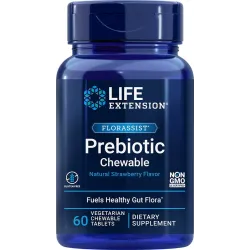
FLORASSIST® Prebiotic Chewable (Strawberry)
Price: 19,53 €Prebiotic supplement provides fuel for gut flora Supports intestinal,...
Related posts
-
 Probiotics Provide Vital Protection Against Chronic Disease
Probiotics, the beneficial bacteria commonly found in yogurt cultures, are popularly thought of as an aid to good...
Probiotics Provide Vital Protection Against Chronic Disease
Probiotics, the beneficial bacteria commonly found in yogurt cultures, are popularly thought of as an aid to good... -
Probiotics supports mood and relaxation
Anxiety and mood disorders are now being recognized as major medical and societal issues. With millions of people...
-
Oral Probiotics Combat Gum Disease
In the era of the COVID-19 pandemic, caring for oral hygiene seems to be particularly important. The human mouth is...
-
What is Glutamine?
The versatile and semi-essential amino acid glutamine can improve intestinal health and exercise response.
-
How the Microbiome Controls Your Health
The discovery of the human microbiome is changing the ways we think about health and disease. Microbiome is the term...